
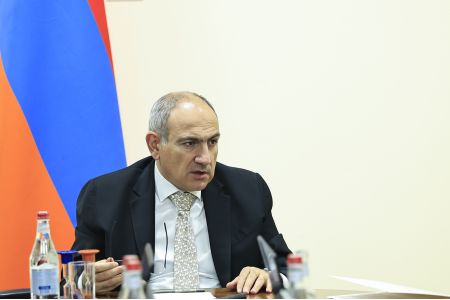
Arminfo. Nothing prevents us from taking the path toward snap parliamentary elections. Prime Minister of Armenia Nikol Pashinyan said this during a briefing on November 26, commenting, at journalists’ request, on the opposition’s categorical refusal to vote for the new draft Constitution.
In this regard, he noted that dialogue with the opposition is certainly important, but dialogue with the public and civil society is more significant for him.
Pashinyan stressed that this is the first draft of the Constitution, and the ruling majority is ready to hear facts and arguments. <But this does not mean that we can and must repeat the previous experience, when all possible proposals are accepted and the text of the Constitution loses its dynamism and aerodynamics>, the head of government noted.
Let us recall that earlier the Prime Minister of Armenia stated that, in the context of adopting a new Constitution, the matter would not come to elections, since a proposal would be formulated that the opposition would be unable to reject.
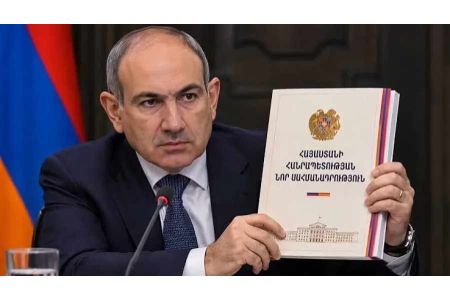
With the publication of the text of the new Constitution, it became known that the document provides for quotas for the opposition in all independent collegial bodies of the country, including the Supreme Judicial Council, the Central Bank, the Central Electoral Commission, and others. However, the opposition has so far stated that it is not ready to reach a deal with the authorities, despite the prime minister’s promises to resign if the people of Armenia do not vote for the adoption of the new Constitution in a referendum, or not to nominate himself for the post of Prime Minister of the Republic of Armenia in the next elections if the Constitution is adopted.
It should be noted that, following the results of the regular parliamentary elections in Armenia held on June 7, 2026, the “Civil Contract” party has a 3/5 majority, which allows it to adopt constitutional laws and make appointments, but the party does not have the 2/3 majority required to introduce direct amendments to the Constitution of Armenia.
Let us add that the demand to change the Constitution began to be voiced frequently after the occupation of Artsakh. Baku claims that it allegedly contains territorial claims against Azerbaijan. The Azerbaijani side presents the fulfillment of these and other demands as a precondition for concluding a “peace treaty.”
Let us recall that the text of the new Constitution contains no references to the Declaration of Independence, which mentioned Nagorno-Karabakh and the international recognition of the Armenian Genocide in the Ottoman Empire. In addition, the text contains changes concerning the Armenian Apostolic Church and states that its activities will be regulated by law, instead of the previous “may be regulated by law.” Significant changes have been made concerning the activities of judges, a procedure has been established for depriving an Armenian citizen of citizenship, and there are restrictions related to the freedom to receive information, among other things.




















 Expert: In Armenia, 43% of families with three or more young children are poor—almost twice the national average
 A security sphere expert commented on a video about Papikyan`s achievements during his five years as Defense Minister
 The future of the South Caucasus was discussed in the capital of a country whose problem remains unresolved — Davtyan
 An Armenian orientalist presented possible US actions against Iran
 Ultra-Orthodox Jews continue to desecrate Armenian holy sites in Jerusalem’s Armenian Quarter
 The Yerevan Museum of Russian Art Turns 42
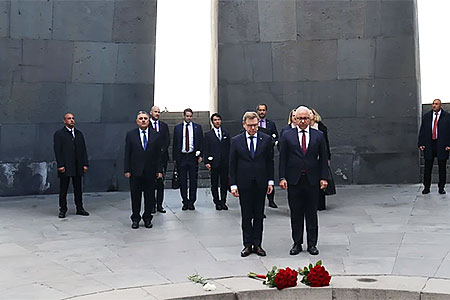
 Armenia and Germany held consultations on defense issues
 Armenia wants to host COP-34 in 2029
 Speaker: Armenia has never approached the CSTO regarding the Karabakh issue
 Lavrov: Armenia will not be expelled from the CSTO
 Drmeyan: The ECHR rejected Azerbaijan`s appeal in the case of Artsakh Defense Army Major Hayk Toroyan
 "Strong Armenia": The brawl in parliament was staged to distract public attention from Pashinyan`s failed foreign policy
 Zakharova commented on the scandalous epithets of the governor of Armenia`s Shirak region about "Ivanov"
 Nikolai Bordyuzha proposed excluding Armenia from the CSTO.
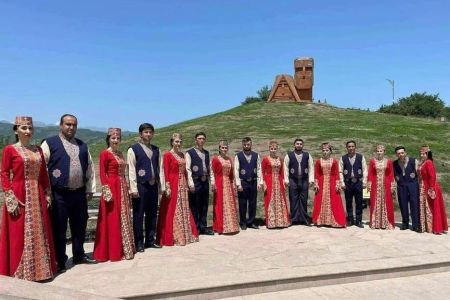 The participation of Artsakh ensembles in an international festival in Vienna was cancelled following the intervention of several foreign embassies