

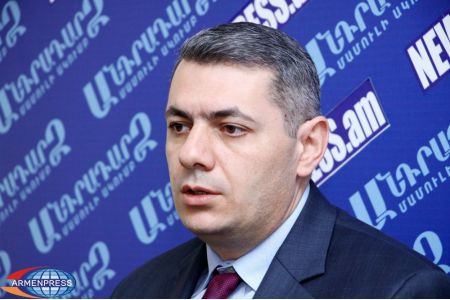
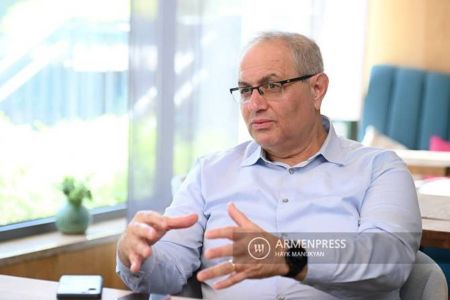
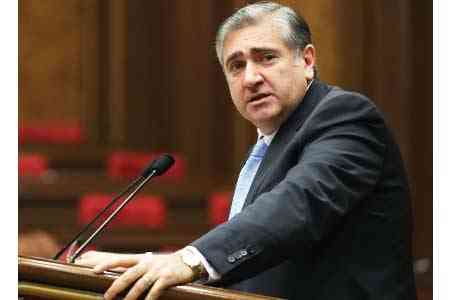
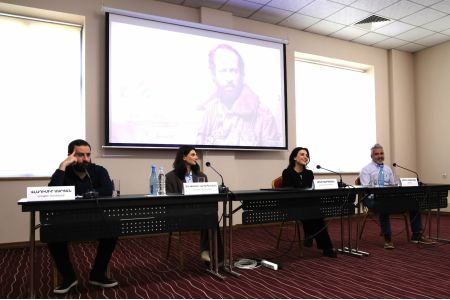
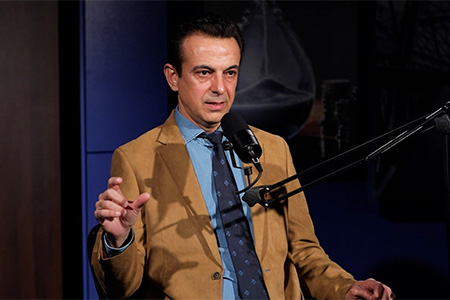
Arminfo. Armenia must soberly assess all the risks that remain surrounding the “Trump Route for International Peace and Prosperity” (TRIPP) project. Doctor of Political Sciences and Deputy Director of the Institute of the Caucasus in Yerevan Sergey Minasyan stated this at a press conference in Yerevan on November 24.
The expert is certain that, in Armenia’s case, it is important to take into account the close interconnection between domestic political processes and the regional context. “Any development in the domestic political situation—whether parliamentary elections or constitutional processes in Armenia—receives an appropriate response in the regional context. And vice versa: any changes in the regional and international situation, not only in the South Caucasus but also far beyond it. For example, the results of the elections in the United States may affect the further development of the situation, including around TRIPP,” Minasyan explained.
At the same time, the expert emphasized that there is a fundamental difference between these two areas. Thus, according to him, domestic political processes in Armenia are a sphere directly influenced by the authorities, citizens and political forces of the country, whereas in the case of TRIPP, Armenia’s capabilities are limited by frameworks determined by external circumstances and the positions of other participants in the process. “There are risks here associated both with Iran and with the possible development of the domestic political situation in the United States. I have the impression that although there was a certain consensus on TRIPP before the U.S. midterm elections, a serious problem has now emerged that is not yet fully perceived in Armenia. In this regard, attention should be paid to the statement by U.S. President Donald Trump, who emphasized that it is specifically TRIPP that is at issue. In other words, this is a political, geopolitical and communication process directly associated with the name of the American president. Therefore, the question arises as to how this process will function under the new domestic political reality in the United States,” the political scientist stated.
He drew attention to the lack of a clear understanding of the further processes surrounding the project against the backdrop of the results of elections to the U.S. legislative body and developments in the region. Minasyan stated that the changed balance of forces in the U.S. Congress and Senate gives the Democrats an opportunity to use levers of influence on Washington’s policy in this region. “It is necessary to understand that the constitutional and domestic political features of the American political system may create certain constraints that Armenia is unable to influence. In addition, Armenia needs to intensify its work with partners. Despite the fact that Armenia is engaged in dialogue with Iran, trying to present and explain its approaches to implementing the project, it is important to take into account that Tehran’s position on this issue goes far beyond the framework of bilateral Armenian-Iranian relations. In other words, Armenia needs to soberly assess the risks that remain,” Minasyan believes.
Speaking about possible risks to the project, Minasyan clarified that at this stage, from the standpoint of its operational implementation, there are no serious obstacles yet. However, according to him, the situation is significantly more complex in regional and global terms, given the rapidly changing circumstances. “In this sense, our task should be to work with all partners—both regional and extra-regional. For example, with China, India and the European Union (EU). It is necessary to interest these actors in the expediency of continuing to implement the project and ensure their involvement in such a way that even if the global or regional context changes, they continue their participation in it,” Minasyan concluded.
It should be noted that Armenia and the United States officially launched the TRIPP project on November 23.
It should be recalled that on August 8, 2025, Armenian Prime Minister Nikol Pashinyan and Azerbaijani President Ilham Aliyev signed a joint seven-point “Declaration on Peace” in Washington. It provides for a joint appeal to the Organization for Security and Co-operation in Europe (OSCE) to terminate the OSCE Minsk Process and related structures, as well as the creation of a transport corridor through Armenian territory that will connect Azerbaijan with its Nakhichevan exclave, surrounded by Armenia, Turkey and Iran. And already on January 14, 2026, the Armenian Foreign Ministry published a framework document signed with the U.S. side in Washington on the implementation of the “Trump Route for International Peace and Prosperity” (TRIPP). The 12-page document presents the project’s main objectives and mechanisms for its operation.
Among other things, the document emphasizes that Armenia intends to authorize and support the creation of TRIPP Development Company. At the same time, the company is expected to be responsible for developing the TRIPP project, receiving an initial development right for a period of 49 years. Armenia intends to offer the United States 74% of the shares in TRIPP Development Company, retaining 26% for itself. It is envisaged that this partnership will be extended for another 50 years, with an additional ownership stake granted to the government of Armenia, as a result of which its share will amount to 49%.



















 A security sphere expert commented on a video about Papikyan`s achievements during his five years as Defense Minister
 The future of the South Caucasus was discussed in the capital of a country whose problem remains unresolved — Davtyan
 An Armenian orientalist presented possible US actions against Iran
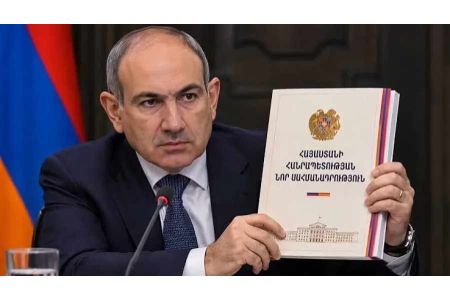 Prime Minister: The Constitution is our collective agreement on the fundamental principles of our internal and external relations
 Ultra-Orthodox Jews continue to desecrate Armenian holy sites in Jerusalem’s Armenian Quarter
 The Yerevan Museum of Russian Art Turns 42
 Armenia wants to host COP-34 in 2029
 Speaker: Armenia has never approached the CSTO regarding the Karabakh issue
 Lavrov: Armenia will not be expelled from the CSTO
 Drmeyan: The ECHR rejected Azerbaijan`s appeal in the case of Artsakh Defense Army Major Hayk Toroyan
 "Strong Armenia": The brawl in parliament was staged to distract public attention from Pashinyan`s failed foreign policy
 Zakharova commented on the scandalous epithets of the governor of Armenia`s Shirak region about "Ivanov"
 Nikolai Bordyuzha proposed excluding Armenia from the CSTO.
 The participation of Artsakh ensembles in an international festival in Vienna was cancelled following the intervention of several foreign embassies
 Expert: It`s time for Armenia to move away from uncertainty and choose between West and East
 The Armenian Foreign Minister commented on the country`s return to work within the CSTO.