

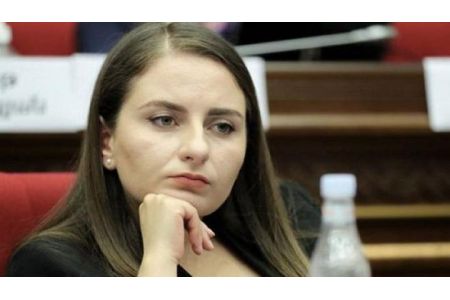
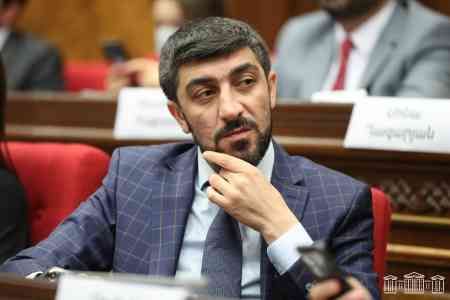
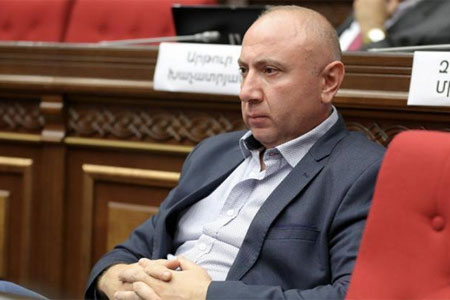
ArmInfo. The main problem facing Armenia’s current authorities in their attempt to push through a new Constitution is that the opposition’s narratives on this issue are more understandable to society than the authorities’ position. Opposition “Armenia” faction MP Kristine Vardanyan stated this on November 19 in a conversation with journalists in parliament.
She expressed the conviction that Armenia’s authorities are irritated by the information campaigns conducted by the opposition regarding the draft of the new Constitution because public opinion on this issue is not on their side. "As for the authorities’ threats to organize similar campaigns, they can do so and personally see the people’s reaction. The opposition managed to outpace the authorities in shaping the public discourse and give what is happening a specific definition — the "Aliyev Constitution." This is precisely what is provoking such a reaction. The opposition acknowledges the presence of this issue on the political agenda and discusses it with citizens, seeking to secure public support for its position," Vardanyan wondered.
She also reaffirmed that the opposition intends, with its votes "against," to prevent this draft from being put to a referendum. In this regard, Vardanyan explained that the information campaigns also pursue another goal — to show that this is not the position of 41 deputies, but the opinion of Armenian society. According to the MP, if the authorities are truly convinced that the opposition does not enjoy public support, then they have all the less reason to worry. "We all understand the situation we are in. People want peace, but they do not want humiliation. And in the case of Azerbaijan’s President Ilham Aliyev, it is precisely about humiliation. Fine, we lost. But who said that we can be spoken to in such a language? Why should the demands be endless?" Vardanyan wondered.
She also drew attention to the fact that Aliyev already has a document signed with Armenian Prime Minister Nikol Pashinyan, which stipulates the supremacy of this agreement over the constitutions of the countries (the Agreement on the Establishment of Peace and Inter-State Relations, initialed in Washington — ed.). "Then what is the problem? Why does he not sign the agreement if he even sees a problem in our Constitution? Because Aliyev is no longer satisfied with the agreements already reached with Pashinyan and the ruling force. He has no personal problems either with Pashinyan or with the ruling Civil Contract faction. He wants the Armenian people to speak and act just like Pashinyan, so that they are humiliated. But I see that this is precisely what the Armenian people do not want," the opposition MP emphasized.
She disagreed with the Armenian prime minister’s claims that the current Constitution contains an "ideology of conflict." For illustration, Vardanyan cited Argentina’s constitution, where a provision on the Falkland Islands is enshrined. However, as the MP noted, this does not become a reason for the United Kingdom to start a war. "Armenian society should not be convinced that what is permissible for other countries is impermissible for Armenia. This humiliation must be stopped. At the same time, the opposition is not against revising the Constitution. It is against changing those provisions that have the status of being inviolable," the MP explained.
Let us recall that on March 12, 2026, Armenian Prime Minister Nikol Pashinyan stated that the preamble of Armenia’s new Constitution should not contain a reference to the Declaration of Independence. He explained his position primarily by saying that "the current Declaration of Independence is built on the logic of conflict." It is noteworthy that the exclusion of the Declaration of Independence is one of Baku’s conditions for Yerevan to sign a peace treaty. Independent experts tend to believe that the Armenian authorities, by initiating constitutional changes, are fulfilling yet another demand from Baku.
We should add that, following the regular parliamentary elections held in Armenia on June 7, 2026, the Civil Contract party has a 3/5 majority, which allows it to adopt constitutional laws and make appointments, but the party does not have the 2/3 majority of votes required to introduce direct amendments to the Constitution of Armenia. We should add that after the occupation of Artsakh, demands are frequently voiced from Baku for Armenia to change its Constitution on the grounds that it allegedly contains territorial claims against Azerbaijan. The Azerbaijani side presents the fulfillment of these and other demands as a precondition for the conclusion of a "peace treaty."





















 A security sphere expert commented on a video about Papikyan`s achievements during his five years as Defense Minister
 The future of the South Caucasus was discussed in the capital of a country whose problem remains unresolved — Davtyan
 An Armenian orientalist presented possible US actions against Iran
 Expert: Official Yerevan should not base its calculations in relations with Ankara on the "crack" in the Turkish-Azerbaijani alliance
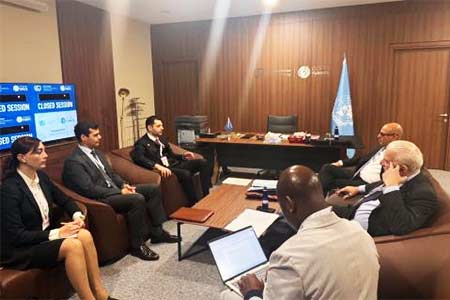 Armenia wants to host COP-34 in 2029
 Speaker: Armenia has never approached the CSTO regarding the Karabakh issue
 Lavrov: Armenia will not be expelled from the CSTO
 Drmeyan: The ECHR rejected Azerbaijan`s appeal in the case of Artsakh Defense Army Major Hayk Toroyan
 "Strong Armenia": The brawl in parliament was staged to distract public attention from Pashinyan`s failed foreign policy
 Zakharova commented on the scandalous epithets of the governor of Armenia`s Shirak region about "Ivanov"
 Nikolai Bordyuzha proposed excluding Armenia from the CSTO.
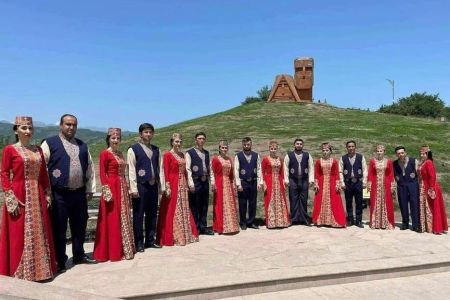 The participation of Artsakh ensembles in an international festival in Vienna was cancelled following the intervention of several foreign embassies
 Expert: It`s time for Armenia to move away from uncertainty and choose between West and East
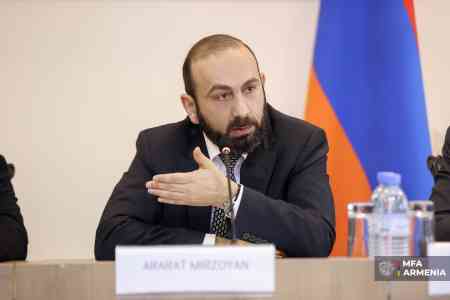 The Armenian Foreign Minister commented on the country`s return to work within the CSTO.
 The Artsakh Public Council expressed outrage at the UN Secretary-General`s behavior
 Lukashenko called for Armenia to assume the CIS presidency in 2029
 Dmitry Medvedev predicted a Ukrainian-like fate for Armenia amid the country`s shift in foreign policy
 Russian Security Council: In Armenia, they want to force Russian asset owners to dispose of their assets