

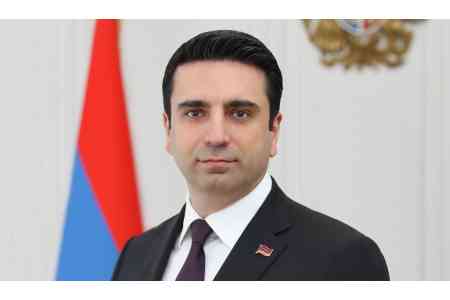
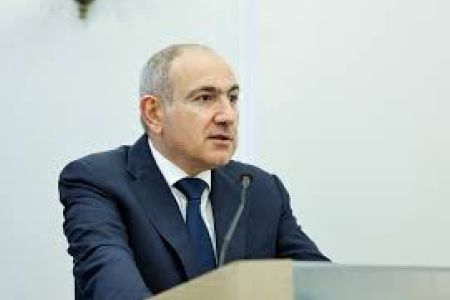
ArmInfo. Neither Armenia nor Azerbaijan are satisfied with the results of the work already carried out to clarify the fate of missing persons. Armenia’s Security Council Secretary Armen Grigoryan stated this in a conversation with journalists on the sidelines of the “Fate of Missing Persons” conference.
Speaking about the steps being taken by the countries to create a unified system for searching for missing persons, Grigoryan said that both Armenia and Azerbaijan are putting forward relevant initiatives. "The Azerbaijani side has already presented its initiative, which could rather be described as a draft action plan. In response, we have also prepared our proposals, which we intend to present in the near future. After that, the sides will compare all the information and continue working to resolve the problem," the Armenian Security Council secretary noted.
Grigoryan said that the issue was also discussed in Bishkek with Azerbaijani presidential aide Hikmet Hajiyev. "During the meeting, both sides outlined the existing issues and agreed to exchange road maps. At the same time, both the Armenian and Azerbaijani sides are dissatisfied with the results of the work already carried out. One of the main difficulties is finding a large amount of information relating to the period of the First War of the 1990s (the First Artsakh War - ed.). We are studying archival materials and trying to establish which servicemen gave interviews during that period," the Armenian Security Council secretary noted.
Grigoryan also spoke about the Cypriot experience, which the sides discussed as part of this issue. He explained that this involves a methodology that makes it possible, by comparing photographs and studying available archives, to reconstruct routes and then identify specific locations for search operations. In response to a question about the criteria used to determine whether a person is considered missing rather than being held captive, Grigoryan explained that a missing person is someone about whose whereabouts and fate there is no information. "In the case of prisoners of war, we rely on information from specific structures, in particular the International Committee of the Red Cross (ICRC), as well as information provided by the other side. At the same time, the possibility cannot be ruled out that people who are currently listed as missing may be alive," Grigoryan explained.
Responding to statements by relatives of missing persons who are convinced that their loved ones are actually being held captive, the Armenian Security Council secretary once again stressed that the very status of being missing does not rule out the possibility that a person may subsequently be found. "That is precisely why the term missing is used, rather than "dead," Grigoryan concluded.
It should be noted that on November 18, the International Committee of the Red Cross (ICRC) reported that more than 1,000 people from Armenia and Nagorno-Karabakh are considered missing in the Nagorno-Karabakh conflict zone for the period from 1990 to 2026.























 A security sphere expert commented on a video about Papikyan`s achievements during his five years as Defense Minister
 The future of the South Caucasus was discussed in the capital of a country whose problem remains unresolved — Davtyan
 An Armenian orientalist presented possible US actions against Iran
 Expert: Official Yerevan should not base its calculations in relations with Ankara on the "crack" in the Turkish-Azerbaijani alliance
 Armenia wants to host COP-34 in 2029
 Speaker: Armenia has never approached the CSTO regarding the Karabakh issue
 Lavrov: Armenia will not be expelled from the CSTO
 Drmeyan: The ECHR rejected Azerbaijan`s appeal in the case of Artsakh Defense Army Major Hayk Toroyan
 "Strong Armenia": The brawl in parliament was staged to distract public attention from Pashinyan`s failed foreign policy
 Zakharova commented on the scandalous epithets of the governor of Armenia`s Shirak region about "Ivanov"
 Nikolai Bordyuzha proposed excluding Armenia from the CSTO.
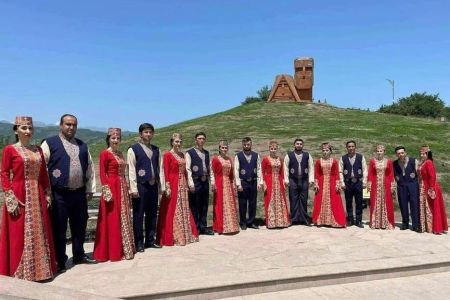 The participation of Artsakh ensembles in an international festival in Vienna was cancelled following the intervention of several foreign embassies
 Expert: It`s time for Armenia to move away from uncertainty and choose between West and East
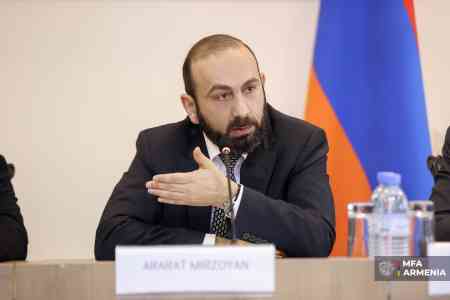 The Armenian Foreign Minister commented on the country`s return to work within the CSTO.
 The Artsakh Public Council expressed outrage at the UN Secretary-General`s behavior
 Lukashenko called for Armenia to assume the CIS presidency in 2029
 Dmitry Medvedev predicted a Ukrainian-like fate for Armenia amid the country`s shift in foreign policy
 Russian Security Council: In Armenia, they want to force Russian asset owners to dispose of their assets