

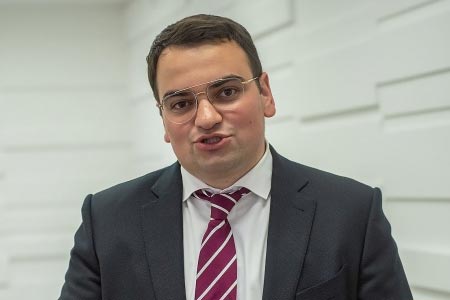
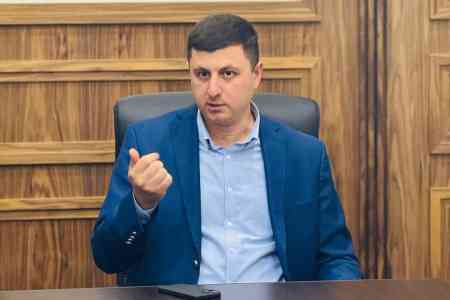
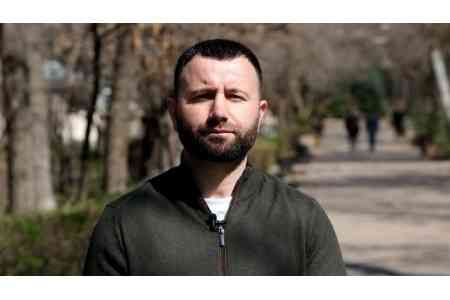
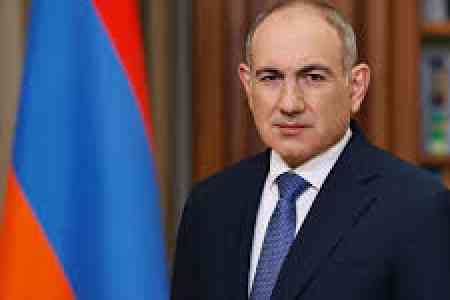
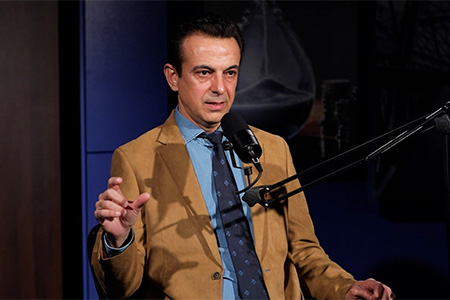
ArmInfo. Azerbaijan will delay the peace process as long as it sees an opportunity to extract additional concessions from Armenia. Narek Karapetyan, head of the Strong Armenia faction, stated this in a podcast summarizing the opposition's awareness-raising campaigns against the "Aliyev Constitution."
Speaking about the reasons why the opposition opposes the removal of the reference to the Declaration of Independence from the Armenian Constitution, Karapetyan recalled that it enshrines the fundamental provisions of the state: the official name of the country - the Republic of Armenia, the foundations of its creation, the vision of it as the embodiment of the centuries-old dream of the Armenian people, the ownership of all national wealth by the people, as well as the democratic principles of statehood. According to him, today the country has reached a situation where the authorities are offering to give up territories, identity, and more, without receiving anything in exchange. "We were told that this is only one path: give it up and we will get peace. But we saw that the road was given up, but peace was not achieved. Then the territories in Tavush and strategic highlands were surrendered. Now we have reached the Declaration of Independence, which essentially outlines the development program for our state," the politician noted.
Karapetyan then recalled that the Constitution, like the state itself, was created on the basis of the Declaration of Independence and adopted by the will of the people. According to him, a situation is emerging today in which the source of legitimacy for state decisions is effectively no longer the will of the people, but the demands of a country opposing Armenia. "The Constitution also contains provisions that were initially defined as unchangeable." "Of course, changes are possible, but such discussions should take place within the country and not lead to further division in society," the faction leader emphasized.
Speaking about the opposition's position if Prime Minister Nikol Pashinyan declares the current concessions to be the last, Karapetyan noted that this requires appropriate guarantees and confirmation from the Armenian prime minister. "The main problem is that even after the signing of the Washington Declaration, Azerbaijan continues to make new demands on Armenia. Baku will delay the peace process as long as it sees an opportunity to extract additional concessions from Yerevan. It's important to remember that the Azerbaijani president is an international affairs specialist by profession and once taught at MGIMO, meaning he understands well how to use the negotiation process to achieve additional benefits. "Final peace can only be achieved when Azerbaijan understands that Armenia no longer intends to comply with its demands," the politician is confident.
Regarding why the opposition is conducting awareness-raising campaigns if it declares it will not support putting the new Constitution to a referendum, Karapetyan emphasized that the political struggle should not be limited to the actions of the political forces themselves. "If the public is not involved in the ongoing processes and their essence is not explained, society may simply not understand what is happening and why it is important. Considering the mistakes of the past, the opposition has come to understand the need for open dialogue with citizens, since their opinion is decisive," Karapetyan noted.
He also emphasized that at this stage, the opposition hopes to resolve the issue through parliament and prevent the new Constitution from being put to a referendum, and that is why it is not resorting to street fighting on this issue. "However, if the authorities attempt to advance it through illegal means, including the use of security forces, then other methods will be used," the faction leader clarified.
In turn, Anna Grigoryan, head of the Armenia parliamentary faction, emphasized that the Constitution is not a document that can be treated superficially or adopted without proper public debate. According to her, the country's Basic Law must enjoy an unprecedentedly broad public consensus. In this regard, she noted that it is no coincidence that the prescribed procedure for adopting the Constitution requires its prior approval by a two-thirds majority of parliament. "That is, the document must undergo a unique political filter in order to ultimately become a unifying foundation for society. However, the authorities decided to amend the Constitution at the request of Azerbaijan at a time when Armenian society is already deeply divided. "Let them not exclude the reference to the Declaration of Independence, let them not change the preamble, and then I can say that I, too, have many ideas about what the Constitution should be and what changes need to be made. We can discuss this within the country and independently determine what exactly needs to be changed," Grigoryan explained.
According to her, the government must realize that this is not only the position of 41 members of parliament, but also the position of Armenian society, which was already demonstrated during the elections to the National Assembly. "And today, dialogue must be conducted not only with citizens who share the position of the opposition, but also with those who support the current government but disagree with its approach to amending the Constitution," Grigoryan concluded.
As a reminder, following the results of the regular parliamentary elections in Armenia, held on June 7, 2026, the Civil Contract party There is a 3/5 majority, which allows for the adoption of constitutional laws and appointments to positions, but the party does not have the 2/3 majority necessary to introduce direct amendments to the Armenian Constitution. It should be added that, since the occupation of Artsakh, Baku has frequently demanded changes to the Armenian Constitution because it allegedly contains territorial claims against Azerbaijan. The Azerbaijani side presents the fulfillment of these and other demands as a precondition for concluding a "peace treaty."























 The future of the South Caucasus was discussed in the capital of a country whose problem remains unresolved — Davtyan
 An Armenian orientalist presented possible US actions against Iran
 Expert: Official Yerevan should not base its calculations in relations with Ankara on the "crack" in the Turkish-Azerbaijani alliance
 Speaker: Armenia has never approached the CSTO regarding the Karabakh issue
 Lavrov: Armenia will not be expelled from the CSTO
 Drmeyan: The ECHR rejected Azerbaijan`s appeal in the case of Artsakh Defense Army Major Hayk Toroyan
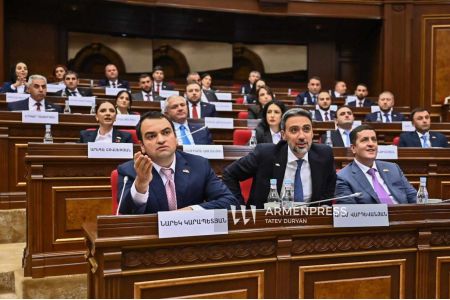 "Strong Armenia": The brawl in parliament was staged to distract public attention from Pashinyan`s failed foreign policy
 Zakharova commented on the scandalous epithets of the governor of Armenia`s Shirak region about "Ivanov"
 Nikolai Bordyuzha proposed excluding Armenia from the CSTO.
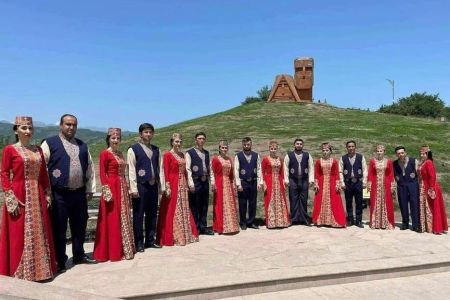 The participation of Artsakh ensembles in an international festival in Vienna was cancelled following the intervention of several foreign embassies
 Expert: It`s time for Armenia to move away from uncertainty and choose between West and East
 The Armenian Foreign Minister commented on the country`s return to work within the CSTO.
 The Artsakh Public Council expressed outrage at the UN Secretary-General`s behavior
 Lukashenko called for Armenia to assume the CIS presidency in 2029
 Dmitry Medvedev predicted a Ukrainian-like fate for Armenia amid the country`s shift in foreign policy
 Russian Security Council: In Armenia, they want to force Russian asset owners to dispose of their assets
 Zakharova: Russia ready to discuss with Armenia the prospects for expanding military cooperation as part of a review of bilateral ties
 Tevanyan: Armenia, like Ukraine and Moldova, is being drawn into the EU’s global war