

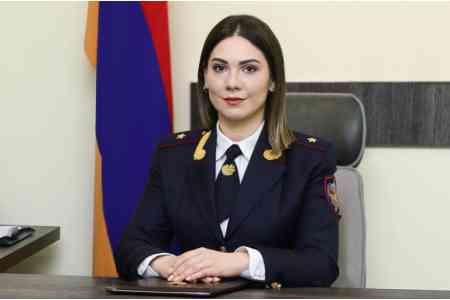
ArmInfo. Arrest as a preventive measure is used significantly less frequently than house arrest or administrative supervision, the number of which exceeds 3,000. Armenian Justice Minister Srbuhi Galyan stated this in a conversation with journalists on November 10, commenting on the death of Arsen Gevorgyan, a candidate for the post of head of the Stepanavan community from the Strong Armenia party, who was in custody.
Galyan noted with regret that similar cases occur both worldwide and in penal institutions (PI). "In this case, I can only say that cardiac arrest was recorded. The issue of his health deteriorating was not raised during his stay in the institution. Early this morning, he complained of feeling unwell. At 7:55 a.m., a paramedic visited him and examined him. An ambulance was later called, after which cardiac arrest was confirmed. I cannot add anything further on this matter," the minister said.
Reacting to the Strong Armenia party's statement that responsibility for Gevorgyan's death lies with the Armenian authorities, Galyan emphasized that the incident is a regrettable incident, which is also regretted by government officials. "Last year, more than 20 deaths were registered, and this year, there have already been four. People with health problems often end up in custody. It appears that Strong Armenia is accusing the authorities of imprisoning people. We have repeatedly emphasized that this is not political persecution. I do not want to list the alleged crimes in question, as we all know about them. "I believe that the state must respond appropriately to committed or suspected offenses. Solving crimes is the state's responsibility," stated the head of the Armenian Ministry of Justice.
When asked whether the incident could lead to a review of the practice of using arrest as a preventive measure, the minister responded that this issue does not directly fall within the purview of the Ministry of Justice, as the agency does not initiate arrest petitions or make decisions on this preventive measure. Galyan, however, assured that arrest is an exceptional measure and is used only in cases of extreme necessity. "The Ministry of Justice, together with the Ministry of Health, is working to revise the list of illnesses that may warrant release from custody." "A new decision is expected soon that will expand the possibilities for releasing individuals with health conditions incompatible with imprisonment," Galyan added.
At the same time, she believes that, compared to previous years, there has been clear progress in this area—in terms of ensuring adequate medical care and medications, as well as in the speed of response, the availability of qualified specialists, and more. Furthermore, the minister assured that it is in their best interests not to resort to frequent arrests, given that penitentiary facilities have limitations.
Earlier, the party's head of communications and public relations, Nelly Avetisyan, confirmed to ArmInfo that Arsen Gevorkyan died in a pretrial detention facility. According to Armenian media reports, he suffered a heart attack.
As a reminder, on October 21, the Anti-Corruption Committee of Armenia opened a criminal case against Arsen Gevorgyan, who headed the Strong Armenia party's proportional list in the Stepanavan Municipal Council elections, and 13 other individuals. It was later reported that the court ordered Gevorgyan arrested for two months. Five others were placed under two-month pretrial detention or house arrest.
It is noteworthy that the day before these events, Armenian Prime Minister Nikol Pashinyan offered to write to him personally to those citizens and candidates for community heads in the local government elections who were under pressure from the ruling Civil Contract party. However, by the evening of that same day, he himself began threatening representatives of the opposition. It should be noted that all this happened before the local government elections in Stepanavan.



















 Expert: Official Yerevan should not base its calculations in relations with Ankara on the "crack" in the Turkish-Azerbaijani alliance
 International expert: Trump is entering a "lame duck" period of rule
 Lavrov: Armenia will not be expelled from the CSTO
 Drmeyan: The ECHR rejected Azerbaijan`s appeal in the case of Artsakh Defense Army Major Hayk Toroyan
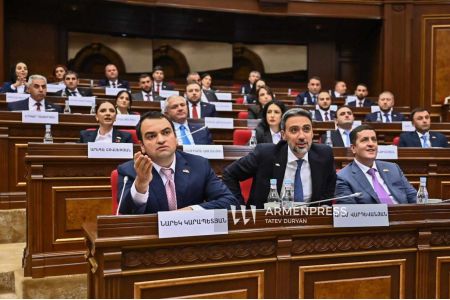 "Strong Armenia": The brawl in parliament was staged to distract public attention from Pashinyan`s failed foreign policy
 Zakharova commented on the scandalous epithets of the governor of Armenia`s Shirak region about "Ivanov"
 Nikolai Bordyuzha proposed excluding Armenia from the CSTO.
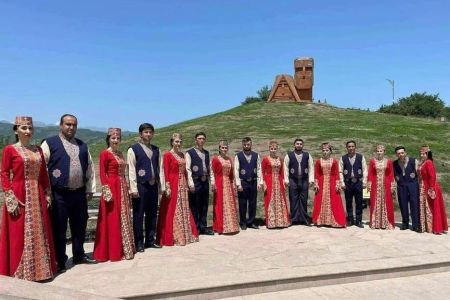 The participation of Artsakh ensembles in an international festival in Vienna was cancelled following the intervention of several foreign embassies
 Expert: It`s time for Armenia to move away from uncertainty and choose between West and East
 The Armenian Foreign Minister commented on the country`s return to work within the CSTO.
 The Artsakh Public Council expressed outrage at the UN Secretary-General`s behavior
 Lukashenko called for Armenia to assume the CIS presidency in 2029
 Dmitry Medvedev predicted a Ukrainian-like fate for Armenia amid the country`s shift in foreign policy
 Russian Security Council: In Armenia, they want to force Russian asset owners to dispose of their assets
 Zakharova: Russia ready to discuss with Armenia the prospects for expanding military cooperation as part of a review of bilateral ties
 Tevanyan: Armenia, like Ukraine and Moldova, is being drawn into the EU’s global war