

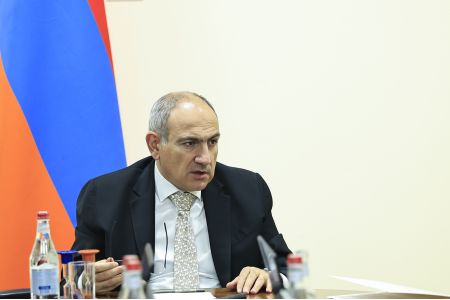
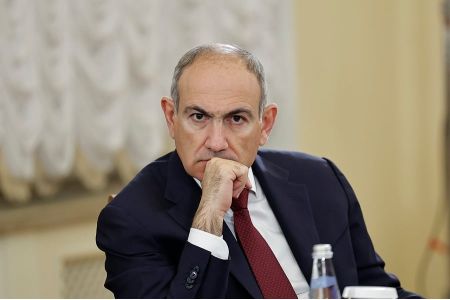
ArmInfo. On November 9, RA Prime Minister Nikol Pashinyan visited the Anti-Corruption Committee and participated in an event dedicated to the Committee's Employee Day and the 5th anniversary of its establishment.
According to the government's press service, the Prime Minister congratulated Anti-Corruption Committee Chairman Artur Nahapetyan, his staff, and employees on the holiday and thanked them for their work. According to Pashinyan, the Anti-Corruption Committee's work is becoming increasingly visible. "Of course, there are two impressions here: one bad, the other good, because corruption always leaves a bad impression. But, as law enforcement officials like to say, more frequent information about corruption detections does not mean it is growing on a larger scale; on the contrary, the principled approach to combating it is becoming more robust." The Anti-Corruption Committee was established in Armenia in 2021, and you can imagine that period with all its complexities. During that period, of course, external security and the current situation were the priority, but it was crucial for us not to deviate from our anti-corruption policy strategies. "I mean, this gives an idea of how important this government decision we made in 2021—the establishment of the Anti-Corruption Committee—was," the head of state said, adding that this speaks to the government's principled approach to anti-corruption policy.
"We're not pretending to fight corruption; we're genuinely fighting it, and for us, this is a truly fundamental issue." "The vision of a corruption-free state is an absolute priority for us," the Prime Minister emphasized, adding that this has both a value-based and practical aspect.
According to Pashinyan, by the end of 2025, the revenue side of the Republic of Armenia's state budget will have more than doubled compared to 2017. A 135% increase has been recorded, and this is also the result of the Anti-Corruption Committee's efforts. Without an anti-corruption policy and a principled political approach to these issues, it is impossible to achieve such indicators, and the government will continue its principled fight against corruption.
"Of course, our priority is preventing corruption, and we are taking quite large-scale steps in this direction. But at the same time, unfortunately, corruption risks cannot be radically eliminated anywhere, and, naturally, registering already recorded cases of corruption, legally assessing them, and holding those responsible accountable is undoubtedly an extremely important and fundamental issue." "The fact that our fight against corruption is more than fundamental in the context of the Anti-Corruption Committee's activities is reflected in the fact that the Committee has had an operational unit since its very first day of establishment, which essentially makes the Anti-Corruption Committee's activities self-sufficient," the Prime Minister said, adding that this allows the Committee to remain extremely focused on its functions and have minimal dependence on other bodies in terms of its effectiveness and the organization of its future activities.
The Head of State noted with satisfaction that the Anti-Corruption Committee's activities are visible in the Republic of Armenia, and this is a fact deserving of satisfaction, since these activities ultimately demonstrate the state, the Republic of Armenia,'s intolerance of corruption. "I would like to emphasize that it is, of course, a very painful fact for me that today, as a result of the Anti-Corruption Committee's activities, representatives of the ruling team and ruling circles are being tried." And this isn't normal in the sense that they were engaged in corruption, but rather that if someone engages in corruption, regardless of whether they represent a political force, ruling or opposition, they must be held accountable, otherwise we won't achieve results. In other words, if there's a selective approach again, if the fight against corruption follows the logic of "ours and yours," it won't work. But there's also the fact: the risks of corruption are borne by those who wield the levers of power. Of course, it's important that these cases be concluded in principle, that those cases that were initiated in 2018, but for reasons that are, at the very least, unclear to me, are closed, and we must quickly turn the page and focus on solving today's problems," the head of state said.
According to the Prime Minister, the Republic of Armenia can become a state free of corruption, and this is the government's vision. "We must follow this path because it is in the interests of our country, our state, and our people," Nikol Pashinyan noted, pointing to reports from the judicial system that in many cases there are problems with the quality of investigations and that cases end up in court. Nikol Pashinyan noted that cases considered by the Anti-Corruption Committee do end up in court and end, for example, in an acquittal. "Ultimately, the public, all of us, should get at least some answer to the question of why this happened: was it due to a poor investigation or because of the judge's bias? The cases I spoke about publicly mainly concern cases investigated by the Anti-Corruption Committee. Okay, the Anti-Corruption Committee investigated the case, the prosecutor's office transferred it to court, that is, the case went to court. The result was an acquittal in a high-profile case.
Ultimately, the public must know what happened that led to the acquittal. Whether the criminal case was unfounded from the outset, whether the investigation was poorly conducted, whether the investigation was deliberately distorted, whether the prosecutor's office failed to take action, or whether the court failed to take action. Ultimately, we must get answers to these questions. I believe the public has a legitimate right to receive answers to these questions, and in the near future, I will also propose and pose these questions to the Armenian Prosecutor's Office. "The esteemed representatives of the judicial system must also have a mechanism for finally clarifying these issues," Pashinyan said.
The prime minister then touched on cases of voter bribery recorded during the elections and the steps being taken to uncover them. "And here our position is unwavering: any pressure on the expression of the political will of citizens of the Republic of Armenia is completely and utterly unacceptable to me, the government, and our political team. Voter bribery, abuse of administrative resources, pressure on people, not to mention intimidation in any way related to voting—such problematic attempts are absolutely unacceptable, but I understand that investigating some of these phenomena already goes beyond the jurisdiction of the Anti-Corruption Committee. I would like to take this opportunity to once again express our political will that the free expression of the will of voters, citizens of the Republic of Armenia, that is, the people, is a fundamental and absolute value for us, and this value and right must be preserved and protected by all possible means," the head of state emphasized.
On the occasion of the 5th anniversary of the establishment of the Anti-Corruption Committee, the Prime Minister presented awards to a group of the Committee's employees for their contribution to strengthening law and order.

















 Orientalist: In 2026, Baku made special efforts to achieve greater diplomatic effect on the issue of victory over Artsakh
 Expert: Official Yerevan should not base its calculations in relations with Ankara on the "crack" in the Turkish-Azerbaijani alliance
 International expert: Trump is entering a "lame duck" period of rule
 Political scientist: The failure of the mission to adopt a new Armenian Constitution could raise the question of Pashinyan`s resignation.
 Opinion: Russia`s involvement in the Organization of Turkic States may increase its international weight, but will force a redistribution of political influence within it
 Drmeyan: The ECHR rejected Azerbaijan`s appeal in the case of Artsakh Defense Army Major Hayk Toroyan
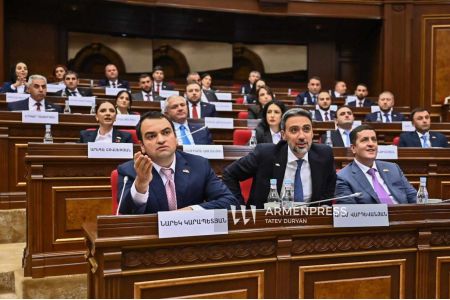 "Strong Armenia": The brawl in parliament was staged to distract public attention from Pashinyan`s failed foreign policy
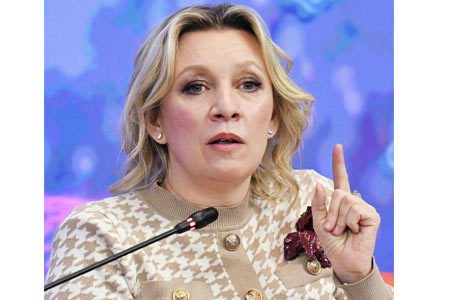 Zakharova commented on the scandalous epithets of the governor of Armenia`s Shirak region about "Ivanov"
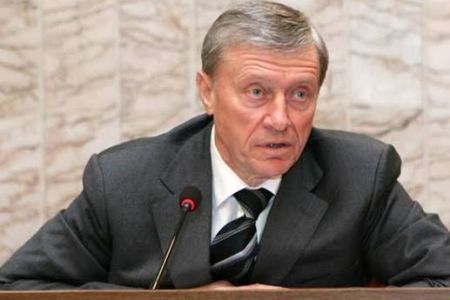 Nikolai Bordyuzha proposed excluding Armenia from the CSTO.
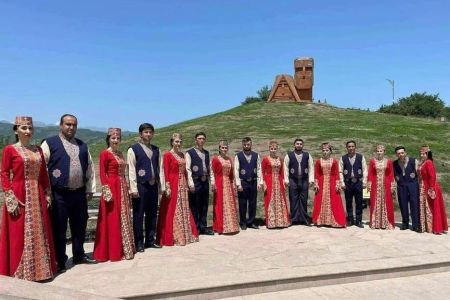 The participation of Artsakh ensembles in an international festival in Vienna was cancelled following the intervention of several foreign embassies
 Expert: It`s time for Armenia to move away from uncertainty and choose between West and East
 The Armenian Foreign Minister commented on the country`s return to work within the CSTO.
 The Artsakh Public Council expressed outrage at the UN Secretary-General`s behavior
 Lukashenko called for Armenia to assume the CIS presidency in 2029
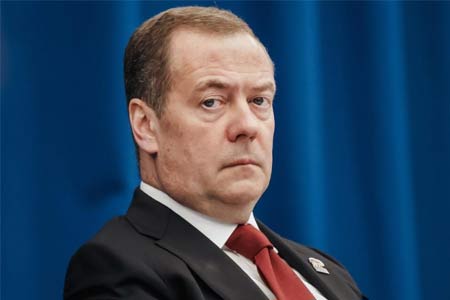 Dmitry Medvedev predicted a Ukrainian-like fate for Armenia amid the country`s shift in foreign policy
 Russian Security Council: In Armenia, they want to force Russian asset owners to dispose of their assets
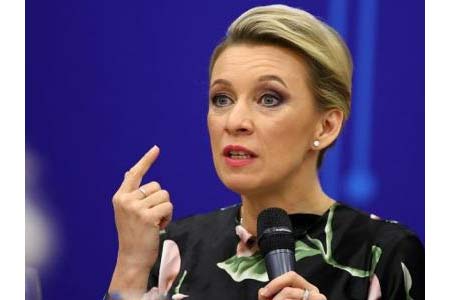 Zakharova: Russia ready to discuss with Armenia the prospects for expanding military cooperation as part of a review of bilateral ties
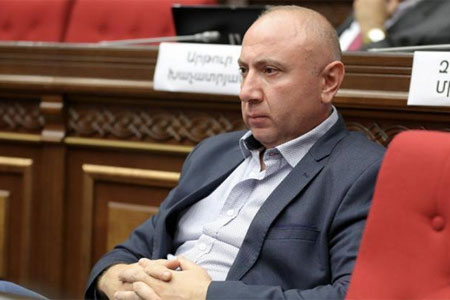 Tevanyan: Armenia, like Ukraine and Moldova, is being drawn into the EU’s global war
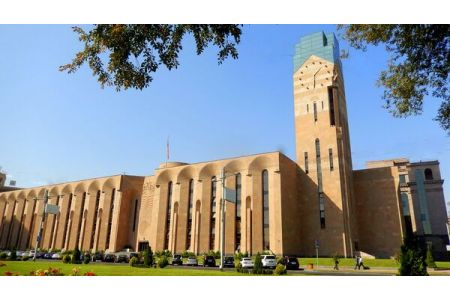 Yerevan City Hall is considering introducing a valet parking system in the city