

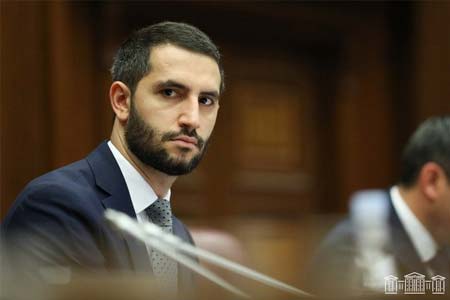
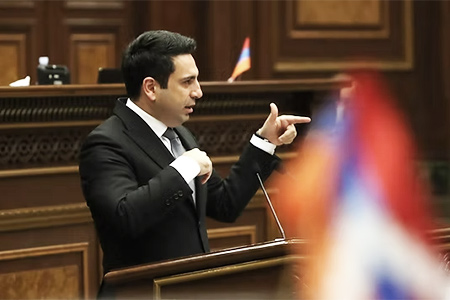
ArmInfo. "We must be able to combine Armenia's potential with international experience and the Diaspora's connections," said Ruben Rubinyan, Speaker of the National Assembly of the Republic of Armenia, at the opening ceremony of the Third World Armenian Summit.
Welcoming the event's participants, the speaker noted that 800 Diaspora representatives from 55 countries are participating in the summit. These include representatives of Armenian communities and organizations, scientists, businessmen, cultural figures, educators, and public figures.
"Your presence testifies to the great potential for dialogue on Armenia's future and, in general, on our common future. The two previous summits have become an important platform for dialogue between Armenia and the Diaspora. Today, our task is not only to strengthen existing ties but also to give new meaning to cooperation." Today, when discussing relations between Armenia and the Diaspora, we cannot ignore the ideology or concept of "Real Armenia." What is Real Armenia? It is our state with its internationally recognized territory, borders, citizens, state institutions, democratic system, and aspiration for development. It is our homeland, where we live, work, create, make decisions, and bear responsibility for our future and the future of generations. Promoting the concept of "Real Armenia" does not mean abandoning our history, national identity, culture, or ties to the Armenian Diaspora. "On the contrary, this means transforming our rich heritage into the foundation of strong statehood and modern development, as well as turning the state into the center of all national dreams and goals," the speaker noted, as quoted by the National Assembly press service.
Pointing to the thousand-year history and significant contribution of the Armenian people to world civilization, Rubinyan noted the existence of a diaspora that has preserved its identity in various countries and achieved great success in science, technology, business, culture, and public life.
"This is our wealth. However, we are also faced with the task of channeling this wealth into the future and into Armenia. I mean both the political and economic, and, yes, the physical sense. And the future is built through a strong, secure, democratic, and developing state. A real Armenia must be a country where peace reigns." This is not a temporary end to the conflict, but an opportunity for development and the foundation for a normal life, where the rule of law, human rights, and democratic institutions are a daily reality. The Diaspora can also contribute to the development of such an Armenia. We do not want to limit relations between Armenia and the Diaspora to patriotic feelings, historical memory, or charity alone. These are important, but our cooperation can and should be much more comprehensive. We want to see the contribution of Armenian specialists, scientists, entrepreneurs, and youth of the Diaspora to the development of Armenia's economy, science, education, sports, healthcare, technology, and culture. And if this contribution takes the form of repatriation, we, the Armenians of Armenia, will be extremely happy, as any brother and sister are happy when they are reunited. We need not only investments, but also knowledge, experience, innovation, professional connections, and joint projects. Armenia must become a platform for international cooperation and new opportunities.
The topics on this summit's agenda—from democracy and regional peace to economics, education, healthcare, artificial intelligence, and environmental protection—reflect precisely this aspiration. The recent COP17 conference held here once again demonstrated that our country is capable of hosting world-class events and contributing to the global agenda. We must be able to combine Armenia's potential with the international experience and connections of the diaspora. At the same time, we must understand that the diaspora is not a unified and homogeneous structure. It has different histories, environments, priorities, and approaches. Our task is to listen to each other, respect differences, and find common ground for cooperation. Relations between Armenia and the diaspora must be based on mutual respect, trust, and real action. I believe this summit should not be limited to good discussions and beautiful formulations. It should become a starting point for concrete ideas, initiatives, and new cooperation programs. Our goal is for the connections and agreements formed during these days to continue after the summit," the head of Armenia's legislative body concluded.










 Orientalist: In 2026, Baku made special efforts to achieve greater diplomatic effect on the issue of victory over Artsakh
 Expert: Official Yerevan should not base its calculations in relations with Ankara on the "crack" in the Turkish-Azerbaijani alliance
 International expert: Trump is entering a "lame duck" period of rule
 Political scientist: The failure of the mission to adopt a new Armenian Constitution could raise the question of Pashinyan`s resignation.
 Opinion: Russia`s involvement in the Organization of Turkic States may increase its international weight, but will force a redistribution of political influence within it
 Lavrov: Armenia will not be expelled from the CSTO
 Drmeyan: The ECHR rejected Azerbaijan`s appeal in the case of Artsakh Defense Army Major Hayk Toroyan
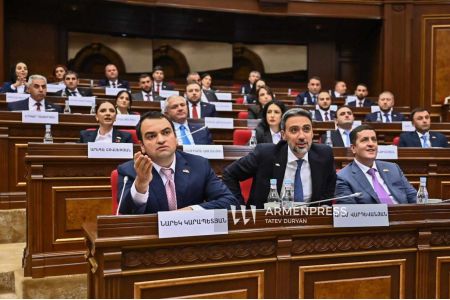 "Strong Armenia": The brawl in parliament was staged to distract public attention from Pashinyan`s failed foreign policy
 Zakharova commented on the scandalous epithets of the governor of Armenia`s Shirak region about "Ivanov"
 Nikolai Bordyuzha proposed excluding Armenia from the CSTO.
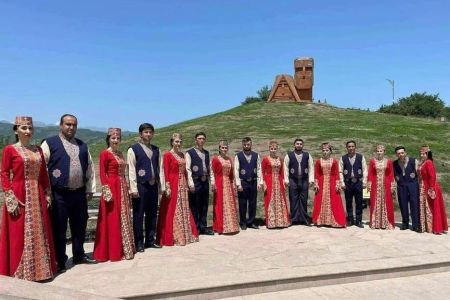 The participation of Artsakh ensembles in an international festival in Vienna was cancelled following the intervention of several foreign embassies
 Expert: It`s time for Armenia to move away from uncertainty and choose between West and East
 The Armenian Foreign Minister commented on the country`s return to work within the CSTO.
 The Artsakh Public Council expressed outrage at the UN Secretary-General`s behavior
 Lukashenko called for Armenia to assume the CIS presidency in 2029
 Dmitry Medvedev predicted a Ukrainian-like fate for Armenia amid the country`s shift in foreign policy
 Russian Security Council: In Armenia, they want to force Russian asset owners to dispose of their assets
 Zakharova: Russia ready to discuss with Armenia the prospects for expanding military cooperation as part of a review of bilateral ties
 Tevanyan: Armenia, like Ukraine and Moldova, is being drawn into the EU’s global war
 Yerevan City Hall is considering introducing a valet parking system in the city