


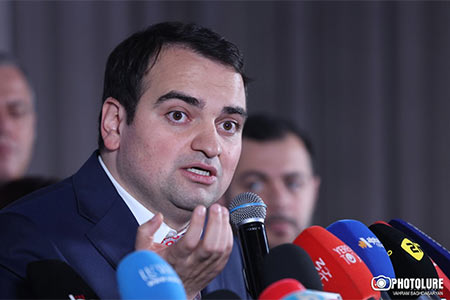
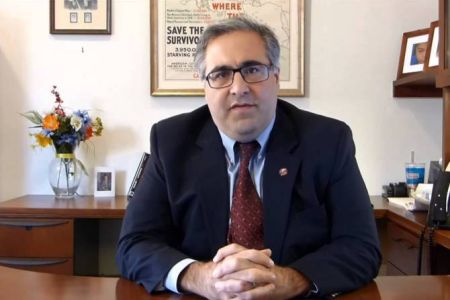
ArmInfo. The defeat of incumbent US President Donald Trump's political camp in the midterm elections for both houses of Congress is more of a historical pattern than an exception, Republican Party board member Artak Zakarian wrote on his Facebook page.
According to him, American voters essentially evaluate the results of the first two years of a president's term, by which time disappointment and dissatisfaction with his performance have already accumulated. In 18 of the last 20 midterm elections in the US (1946-2022), the president's party lost seats in the US House of Representatives, whose entire membership was up for reelection. And in seven of those midterm elections, control of the House passed to the opposition.
As for the Senate, as Zakarian noted, only a third of its members are re-elected, so the pattern is less pronounced. However, in 13 of the last 20 elections, the US president's party has also lost seats, and in six elections, the results led to victories for the opposition, which gained a majority in the Senate.
Note that the Democratic Party will gain control of the US House of Representatives and the Senate, taking the majority from the Republicans. Voting in the midterm congressional elections has concluded in the US. Polls in Alaska were the last to close. Vote counting continues in many precincts, but preliminary results in many states and congressional districts are already showing results that are unlikely to change significantly. According to preliminary results, Democrats will gain a majority of seats in the House of Representatives, where they need to win at least 218 seats. According to preliminary estimates as of 06:00 GMT (10:00 Yerevan time), Democrats won 24 additional mandates, leaving the House with 213 seats for Democrats and 122 for Republicans. According to estimates by the BBC's American partner, CBS, Democrats could gain at least 245 seats in the House, while Republicans could gain at least 166. Preliminary estimates also indicate that Democrats are gaining control of the upper chamber of Congress. In the Senate, Democrats already hold at least 53 of the 100 seats.








































 Opinion: Russia`s involvement in the Organization of Turkic States may increase its international weight, but will force a redistribution of political influence within it
 Expert: Economic pressure on Armenia may be virtually painless for other EAEU members, but not for Armenia itself
 Drmeyan: The ECHR rejected Azerbaijan`s appeal in the case of Artsakh Defense Army Major Hayk Toroyan
 Zakharova commented on the scandalous epithets of the governor of Armenia`s Shirak region about "Ivanov"
 Nikolai Bordyuzha proposed excluding Armenia from the CSTO.
 The participation of Artsakh ensembles in an international festival in Vienna was cancelled following the intervention of several foreign embassies
 Expert: It`s time for Armenia to move away from uncertainty and choose between West and East
 The Armenian Foreign Minister commented on the country`s return to work within the CSTO.
 The Artsakh Public Council expressed outrage at the UN Secretary-General`s behavior
 Lukashenko called for Armenia to assume the CIS presidency in 2029
 Dmitry Medvedev predicted a Ukrainian-like fate for Armenia amid the country`s shift in foreign policy
 Russian Security Council: In Armenia, they want to force Russian asset owners to dispose of their assets
 Zakharova: Russia ready to discuss with Armenia the prospects for expanding military cooperation as part of a review of bilateral ties
 Tevanyan: Armenia, like Ukraine and Moldova, is being drawn into the EU’s global war
 Yerevan City Hall is considering introducing a valet parking system in the city
 Expert: The circus surrounding the “Albanization” of Armenian culture in the presence of foreign ambassadors in occupied Artsakh is genocide