

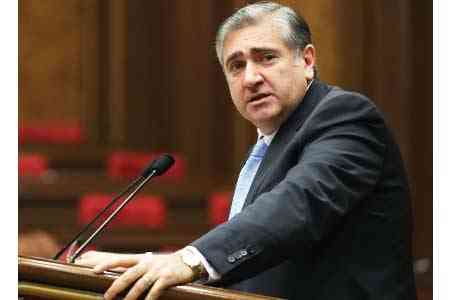
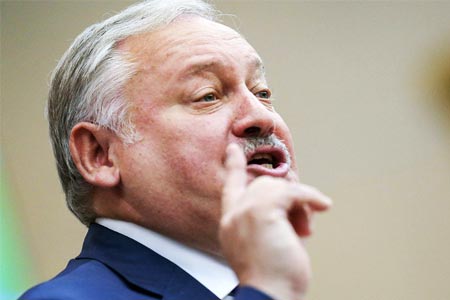
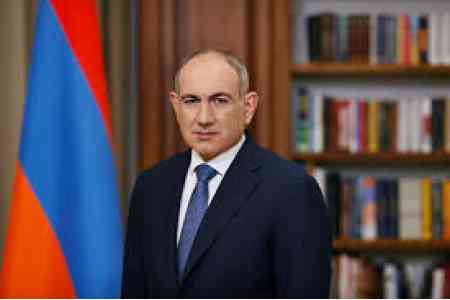
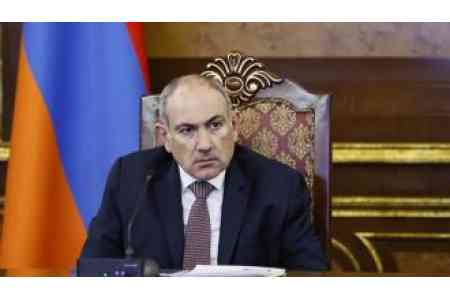
ArmInfo. Armenian Prime Minister Nikol Pashinyan's only remaining option is the threat of force to convince the opposition to put the new constitutional text to a referendum. This is how Artur Khachatryan, a member of the National Assembly from the opposition "Armenia" faction, responded to Pashinyan's statement that if the parliamentary opposition obstructs the adoption of the new Constitution, public pressure could build, leading to the ruling majority.
In this regard, he recalled how Azerbaijan and Turkey openly supported the Armenian prime minister during the election campaign. He noted that this was no coincidence. "They had expectations from Pashinyan, and now they have something to gain." It is no coincidence that the ink on the seal of the Central Election Commission (CEC) decision has not yet dried, and Hikmet Hajiyev, an aide to the Azerbaijani president, has already arrived in Armenia. "It's no coincidence that Pashinyan decided to go cycling in Tavush on those very days," the opposition figure noted in a post on his Facebook page.
That is, as the MP explained, no matter how much Pashinyan says the Constitution is an internal matter, no matter how much he swears that "Armenia's internal agendas are not discussed on the external perimeter and beyond," linking constitutional amendments to the "peace" agreement already means that the amendment is a demand born on the external perimeter. "Or, as Foreign Minister Ararat Mirzoyan would say, a precondition. Read the articles of the previously signed "peace" agreement, and you will see for yourself. Pashinyan has to give something; he is under pressure, which is why Azerbaijan is rushing things. They are now openly threatening Nikol the peacemaker personally. Pashinyan initially tried to persuade the opposition to hold a constitutional referendum. He himself thought he could get 50%+1 of the vote in the referendum, given that many political opponents were in prison, and he would shut down the rest or suspend their activities. It didn't work. He tried to blackmail them, saying that if they didn't agree, I would call new elections. So let him do it—let him resign; by law, there will be new elections. But no, he's afraid," Khachatryan believes.
After all, according to him, Pashinyan knows he doesn't have enough support, no matter how much he threatens, no matter how much he uses administrative resources, no matter how many people he imprisons. "Even with the current composition of the Central Election Commission, he won't win a constitutional majority. He understands this. He understands that he won a 'Pyrrhic victory' in the parliamentary elections, and the path to other victories is blocked. The threat of force remains. He's been nurturing this thought for a week now. Yesterday, he literally declared that pressure would be exerted on the opposition, and that the ruling majority would lead this pressure. And how does he envision this? He'll gather his supporters and, under the leadership of the police, the National Security Service, and the State Security Service of Armenia, storm the National Assembly. I don't rule it out. I've said this many times. He'll say, "You didn't make the revolution, I made it." He'll simply forget the brutality with which he suppressed peaceful protests and that bringing in security forces is an outright coup d'état. But Pashinyan is no stranger. In 1993, Yeltsin also stormed parliament. The consequences are well known," Khachatryan concluded.
As a reminder, the draft of Armenia's new Constitution has not yet been officially published. Initially, the authorities promised to publish the draft constitution before the parliamentary elections, but then the deadline was repeatedly pushed back, and now the deadline is November or December. According to statements, the new constitution will not include references to the Declaration of Independence of Armenia, given that the preamble to the constitution is inviolable and cannot be amended or deleted. The opposition accuses the Armenian authorities of complying with Azerbaijan's demands and has repeatedly emphasized that it will not support the process of amending the country's constitution.
It should be noted that a national referendum will be required to approve the new constitution, and the decision to hold it must be made by the National Assembly of Armenia with a vote of at least two-thirds of the deputies. According to the results of the regular parliamentary elections in Armenia, held on June 7, 2026, the Civil Contract party There is a 3/5 majority, which allows them to pass constitutional laws and make appointments, but the party does not have the 2/3 majority necessary to directly amend the Armenian Constitution. To advance this issue, they must gain the support of the opposition.


























 Expert: Economic pressure on Armenia may be virtually painless for other EAEU members, but not for Armenia itself
 Expert on protests in France: Civilizations fade when society loses a vision of the future
 Turkologist: Azerbaijan is not all-powerful—its vulnerabilities should become part of Armenia’s security strategy
 Opinion: The development of the Amulsar mine near the resort town of Jermuk is the beginning of an environmental disaster in Armenia
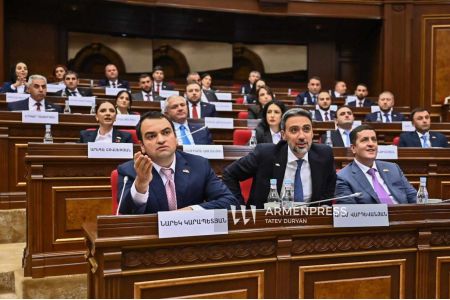 "Strong Armenia": The brawl in parliament was staged to distract public attention from Pashinyan`s failed foreign policy
 Zakharova commented on the scandalous epithets of the governor of Armenia`s Shirak region about "Ivanov"
 Nikolai Bordyuzha proposed excluding Armenia from the CSTO.
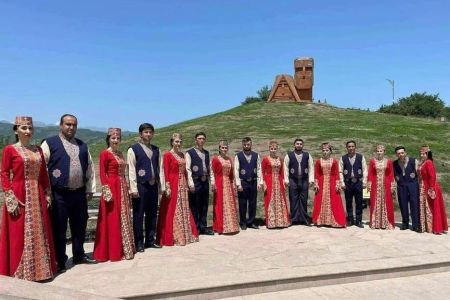 The participation of Artsakh ensembles in an international festival in Vienna was cancelled following the intervention of several foreign embassies
 Expert: It`s time for Armenia to move away from uncertainty and choose between West and East
 The Armenian Foreign Minister commented on the country`s return to work within the CSTO.
 The Artsakh Public Council expressed outrage at the UN Secretary-General`s behavior
 Lukashenko called for Armenia to assume the CIS presidency in 2029
 Dmitry Medvedev predicted a Ukrainian-like fate for Armenia amid the country`s shift in foreign policy
 Russian Security Council: In Armenia, they want to force Russian asset owners to dispose of their assets
 Zakharova: Russia ready to discuss with Armenia the prospects for expanding military cooperation as part of a review of bilateral ties
 Tevanyan: Armenia, like Ukraine and Moldova, is being drawn into the EU’s global war
 Yerevan City Hall is considering introducing a valet parking system in the city
 Expert: The circus surrounding the “Albanization” of Armenian culture in the presence of foreign ambassadors in occupied Artsakh is genocide