

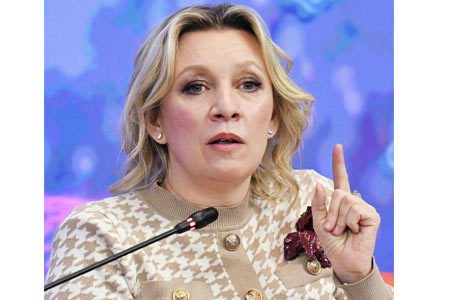
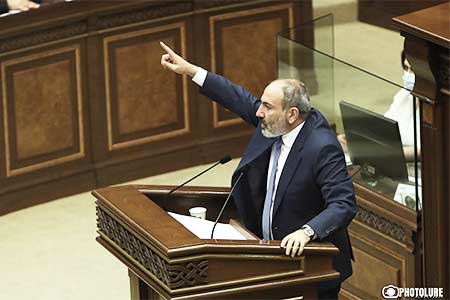
ArmInfo. The preparation of a report on the possible suspension of Armenia's membership in the Eurasian Economic Union (EAEU) and the consequences of this move for the Armenian economy was no news to anyone familiar with the matter, including the Armenian government. This was stated by Russian Foreign Ministry spokesperson Maria Zakharova at a weekly briefing on October 28, in response to a request to comment on Armenian Prime Minister Nikol Pashinyan's statement that this was the third attempt by external forces to change the government in Armenia.
She recalled that the statement by the presidents of Belarus, Kazakhstan, Kyrgyzstan, and Russia was adopted back in May of this year. Therefore, according to her, to say that this is some kind of unexpected, destructive action is simply strange.
"This reaction can be called hasty and even aggressive on the part of the Armenian leadership." "Perhaps this is simply an attempt, by hook or by crook, to somehow divert public attention from pressing issues, once again shifting responsibility to someone else," said the official representative of the Russian Foreign Ministry.
At the same time, she expressed regret that "the new barrage of unfounded accusations from Yerevan against Moscow has still not been followed by any constructive proposals or responsible decisions on the essence of the main issue that concerns both the population and businesses not only in Armenia, but also in other EAEU countries: where is Armenia integrating?" In her words, it's a simple question. She also disagreed with Pashinyan's accusations against Moscow regarding the "metropolis."
"We have repeatedly observed similar manifestations of political thought in Yerevan, when instead of a coherent, substantive response to certain events, there is either outright distortion, manipulation, or name-calling. All of this is built on some kind of painful emotions," she said. She expressed her conviction that such steps are aimed at somehow justifying their failures and miscalculations, including in the security sphere.
"In general, all this rhetoric—aggressive, emotional, and inconsistent with reality—again does not affect us; it misleads Armenian society, its own population, the population of Armenia." "Such rhetoric is based on ignoring economic realities, and even more so, on ignoring the assessments of the course toward EU accession, which are voiced by representatives of Armenia's economic bloc, at the expense of traditional Russian-Armenian ties," the Russian Foreign Ministry spokesperson added. She also called the fact that representatives of Armenia's ruling party have acknowledged the futility of Yerevan's attempts to join the European family significant, although she acknowledged that they are not drawing any public conclusions from this.
"Yerevan, for some reason, is once again trying to cling to the nuances of a report that reflects the general assessments of all of Yerevan's partners in the Eurasian Economic Union (EAEU) and shift responsibility to others, instead of seeing the main message—that the current state of affairs was brought about by Armenia's policy, specifically its legislatively enshrined policy of joining the European Union." "And they're looking for a way out of the current situation in the wrong place – it's outlined in the joint statement of the EAEU leaders on May 29," Zakharova concluded.
On October 20, a report on the possible consequences of suspending the Treaty on the Eurasian Economic Union with respect to Armenia was published on the Russian government's website. It was prepared by members of the Eurasian Intergovernmental Council from Russia, Belarus, Kazakhstan, and Kyrgyzstan. The 72-page report details the benefits Armenia receives from EAEU membership and the risks the republic would face if its membership in this integration union were suspended. The Armenian Prime Minister described this report as the third attempt by external forces to stage a coup in Armenia and overthrow the current government.
It should be added that on May 9, Russian President Vladimir Putin, speaking to journalists, suggested that Armenia decide on its membership in the EU and the EAEU as soon as possible, expressing its readiness to "begin a civilized divorce" if necessary. Yerevan responded by stating that it would leave the EAEU whenever it deemed it necessary. And on May 29, the heads of state of four of the five EAEU member states adopted a resolution recommending that Armenia hold a referendum on its continued membership in the EAEU. On the same day, the Russian president stated that Armenia could not sit on two chairs and needed to make a choice as soon as possible.
It should be noted that on January 9, 2025, the Armenian government approved a draft law on the beginning of the process of joining the European Union, proposed by the "Eurakve" civic initiative. The draft was sent to the Armenian parliament for approval. On March 26, the parliament adopted it in its final reading and sent it to the president for signature. The document was signed on April 4 of that year. Moscow stated that Russia had conveyed to Armenia that simultaneous membership in the Eurasian Economic Union and the European Union was impossible.













 Expert: Economic pressure on Armenia may be virtually painless for other EAEU members, but not for Armenia itself
 Expert on protests in France: Civilizations fade when society loses a vision of the future
 Turkologist: Azerbaijan is not all-powerful—its vulnerabilities should become part of Armenia’s security strategy
 Opinion: The development of the Amulsar mine near the resort town of Jermuk is the beginning of an environmental disaster in Armenia
 Expert: The arrest of opposition figures in Armenia for social media posts is a systematic attempt to intimidate the public and suppress dissent.
 The participation of Artsakh ensembles in an international festival in Vienna was cancelled following the intervention of several foreign embassies
 Expert: It`s time for Armenia to move away from uncertainty and choose between West and East
 The Armenian Foreign Minister commented on the country`s return to work within the CSTO.
 The Artsakh Public Council expressed outrage at the UN Secretary-General`s behavior
 Lukashenko called for Armenia to assume the CIS presidency in 2029
 Dmitry Medvedev predicted a Ukrainian-like fate for Armenia amid the country`s shift in foreign policy
 Russian Security Council: In Armenia, they want to force Russian asset owners to dispose of their assets
 Zakharova: Russia ready to discuss with Armenia the prospects for expanding military cooperation as part of a review of bilateral ties
 Tevanyan: Armenia, like Ukraine and Moldova, is being drawn into the EU’s global war
 Yerevan City Hall is considering introducing a valet parking system in the city
 Expert: The circus surrounding the “Albanization” of Armenian culture in the presence of foreign ambassadors in occupied Artsakh is genocide
 Political scientist: If Russian-Armenian relations are destroyed, Turkey will take Russia`s place
 Political scientist: The Armenian public is simply obliged to significantly change the entire content of public discourse and struggle
 Cross tattoos are being removed from the skin of Christian prisoners in Azerbaijan by fire, according to a human rights activist.