

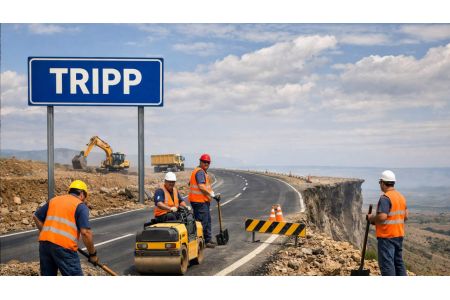
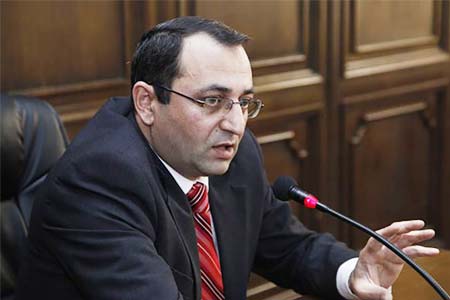
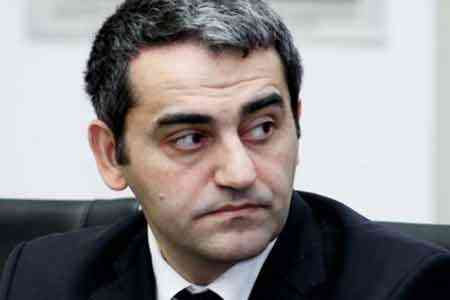
ArmInfo. Artur Khachatryan, a National Assembly member from the opposition Armenia faction, discussed the risks the Trump Route for International Peace and Prosperity (TRIPP) project poses for the country.
The member of parliament acknowledged the need to restore free and unimpeded communication routes in the South Caucasus region. However, as the opposition member emphasized, Azerbaijan and Turkey's policy of using infrastructure projects and blocking roads and other communication routes as a tool of political pressure and coercion is unacceptable and a clear manifestation of hostility towards Armenia. "Transport infrastructure in the South Caucasus region must be unblocked based on the principles of reciprocity and equivalence, while maintaining the territorial integrity and sovereignty of the countries." "Agreements regulating the unblocking of communication routes in the region must have the same legal force and be equivalent in terms of reversibility," Khachatryan wrote on his Facebook page.
However, according to him, neither the joint declaration of Armenian Prime Minister Nikol Pashinyan and Azerbaijani President Ilham Aliyev, signed on August 8, 2025, in Washington (hereinafter referred to as the Declaration), nor the framework agreement on strategic cooperation on the TRIPP project arising from this declaration (hereinafter referred to as the Agreement), comply with the above principles. The MP then gave examples to support his position. Thus, speaking about reciprocity, he noted that, in paragraph 3 of the Declaration, Armenia undertakes to grant Azerbaijan "the right of unimpeded communication" Between the mainland of the Republic of Azerbaijan and Nakhichevan through the territory of Armenia.
"In exchange, Armenia receives 'mutual advantages in international and domestic communications.'" However, the nature of these advantages is not defined. The first section of the preamble to the Agreement confirms that Azerbaijan will be connected to Nakhichevan through the territory of Armenia. However, this section merely 'expects' that 'TRIPP will create mutual benefits for the Republic of Armenia in terms of developing international and domestic communications.'" "That is, Armenia is obligated to grant Azerbaijan the 'right to unimpeded communication,' but in return expects only mutual benefits without any clarification of their essence," Khachatryan explained. This means, as the opposition figure clarified, the legally binding agreement concerns exclusively the 'unimpeded communication' granted to Azerbaijan through Armenia's territory and in no way affects the expectation of mutual benefit 'for the Republic of Armenia in terms of developing international and domestic relations.' Specifically, he noted, there are no clarifications regarding whether Armenia can use the communication routes passing through Armenia under the TRIPP program to travel through its territory, for example, on the Nrnadzor-Agarak section. "The question is also whether Armenia can use TRIPP for access to Nakhchivan and third countries, or for access to the western regions of Azerbaijan and third countries. "And along which section or sections does Azerbaijan commit to providing Armenia with internal communications?" the MP added.
He further noted that, according to the Agreement, the TRIPP project includes rail, road, oil and gas pipeline, fiber-optic, and energy components. However, as Khachatryan noted, the text of the Declaration makes no mention of these components. Therefore, according to him, it is completely unclear whether Armenia will be granted similar rights and opportunities. "It is also unclear whether Armenia will be able to use the pipelines, fiber-optic, and energy components passing through its territory, and whether Armenia needs all of them. Regarding sovereignty, the Declaration and the Agreement state that Armenia grants Azerbaijan the right to 'unimpeded communications.'" By claiming that there are no "obstacles" on the TRIPP railway and road, the Armenian authorities are acknowledging that there are obstacles on other roads, border crossings, and customs checkpoints that Azerbaijan will be free of. The absence of "obstacles" clearly means that a different legal regime will apply to TRIPP than to Armenia's roads, border crossings, and customs checkpoints. "Therefore, TRIPP becomes a corridor in which Armenia's sovereignty is limited," the opposition figure asserts.
As Khachatryan noted, although both the Declaration and the Agreement emphasize the need to preserve Armenia's sovereignty and jurisdiction, he added that the implementation of the "front office - back office" operating model in itself means that Armenia has agreed not to engage in any form of contact with Armenian officials at Azerbaijan's request, thereby ceding the right to exercise its sovereignty to a third party. The MP then touched on Section C, which concerns equivalence and reversibility, and drew attention to the fact that the legally binding Armenian-American agreement is a document that effectively defines how Armenia will fulfill the obligations imposed on it by the non-legally binding Armenian-Azerbaijani declaration. "Therefore, if Armenia and Azerbaijan fail to reach an agreement on the details of the equivalent 'right to unimpeded communication,' Armenia will still be forced to fulfill the obligations assumed under the agreement. Consequently, Armenia's obligations under the declaration are irreversible, while Azerbaijan's obligations are reversible, especially in the case of American investments," Khachatryan asserted.
The agreement, according to him, also does not specify the area of the TRIPP project. As the MP recalled, during the declaration signing ceremony on August 8, 2025, US President Donald Trump called TRIPP a "special transit zone." ("special transit area") and stated that Armenia "is establishing an exclusive partnership with the United States to develop this corridor, which could last up to 99 years". "According to the US President, Pashinyan promised to extend the partnership after 99 years. All questions from the Armenia faction MPs to representatives of the Armenian government to clarify the boundaries of the "corridor" or "special transit zone" remained unanswered. In addition, no assessment of the economic impact of TRIPP was provided. "In particular, it has not been determined which side or in what proportion will invest in the construction of TRIPP infrastructure, and, accordingly, it is unclear what the 74%/26% participation rate is for the next 49 years," the opposition figure concluded.
As a reminder, on August 8, 2025, Armenian Prime Minister Nikol Pashinyan and Azerbaijani President Ilham Aliyev signed a seven-point joint "Declaration of Peace" in Washington. It provides for a joint appeal to the Organization for Security and Cooperation in Europe (OSCE) to terminate the OSCE Minsk Process and related structures, as well as the creation of a transport corridor through Armenian territory that will connect Azerbaijan with its Nakhchivan exclave, surrounded by Armenia, Turkey, and Iran. On January 14, 2026, the Armenian Foreign Ministry published a framework document signed with the American side in Washington for the implementation of the Trump Route for International Peace and Prosperity (TRIPP). The 12-page document presents the main goals of the project and the mechanisms for its operation. Among other things, the document emphasizes that Armenia intends to sanction and support the establishment of the TRIPP Development Company. The company is expected to be responsible for the development of the TRIPP project, having received an initial development right for a period of 49 years. Armenia intends to offer the United States a 74% stake in TRIPP Development Company, retaining 26%. It is expected that this partnership will be extended for another 50 years, with an additional ownership stake granted to the Armenian government, bringing its share to 49%.































 Expert: Economic pressure on Armenia may be virtually painless for other EAEU members, but not for Armenia itself
 Expert on protests in France: Civilizations fade when society loses a vision of the future
 Turkologist: Azerbaijan is not all-powerful—its vulnerabilities should become part of Armenia’s security strategy
 Opinion: The development of the Amulsar mine near the resort town of Jermuk is the beginning of an environmental disaster in Armenia
 Expert: The arrest of opposition figures in Armenia for social media posts is a systematic attempt to intimidate the public and suppress dissent.
 "Strong Armenia": The brawl in parliament was staged to distract public attention from Pashinyan`s failed foreign policy
 Zakharova commented on the scandalous epithets of the governor of Armenia`s Shirak region about "Ivanov"
 Nikolai Bordyuzha proposed excluding Armenia from the CSTO.
 The participation of Artsakh ensembles in an international festival in Vienna was cancelled following the intervention of several foreign embassies
 Expert: It`s time for Armenia to move away from uncertainty and choose between West and East
 The Armenian Foreign Minister commented on the country`s return to work within the CSTO.
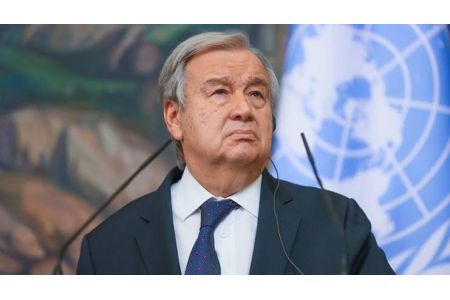 The Artsakh Public Council expressed outrage at the UN Secretary-General`s behavior
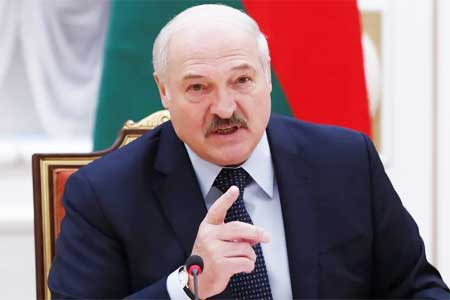 Lukashenko called for Armenia to assume the CIS presidency in 2029
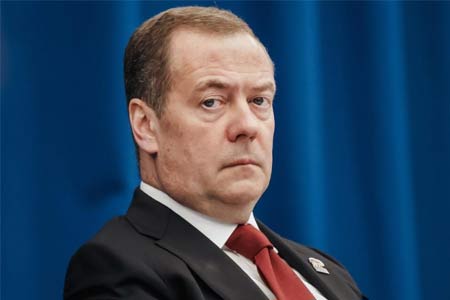 Dmitry Medvedev predicted a Ukrainian-like fate for Armenia amid the country`s shift in foreign policy
 Russian Security Council: In Armenia, they want to force Russian asset owners to dispose of their assets
 Zakharova: Russia ready to discuss with Armenia the prospects for expanding military cooperation as part of a review of bilateral ties
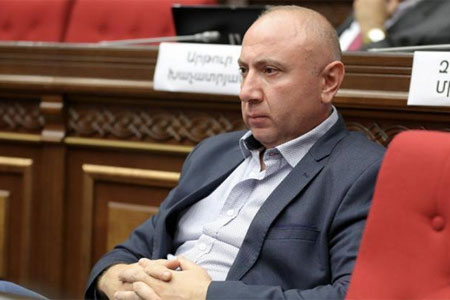 Tevanyan: Armenia, like Ukraine and Moldova, is being drawn into the EU’s global war
 Yerevan City Hall is considering introducing a valet parking system in the city
 Expert: The circus surrounding the “Albanization” of Armenian culture in the presence of foreign ambassadors in occupied Artsakh is genocide
 Political scientist: If Russian-Armenian relations are destroyed, Turkey will take Russia`s place