
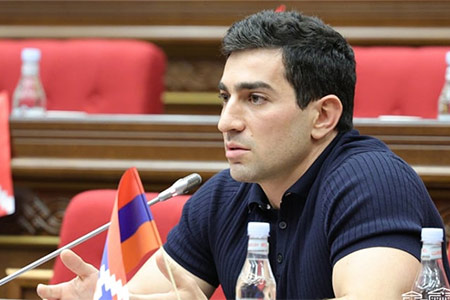
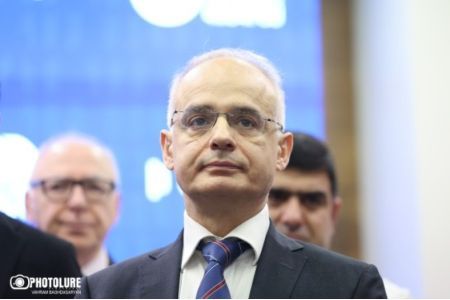
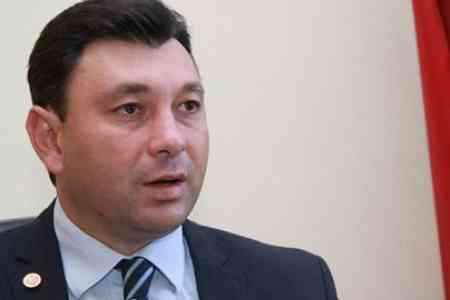
ArmInfo. The current Armenian government is not seeking to solve the October 27, 1999 case, but is trying to link specific individuals to it. Levon Kocharyan, a member of the Armenia faction, stated this on October 27 at the Yerablur military pantheon.
He recalled that after the terrorist attack in the Armenian parliament on October 27, 1999, the investigative actions and the case were carried out under the supervision of individuals, particularly the families who suffered as a result of these events. "The case, if you recall, was investigated by then-military prosecutor Gagik Jhangiryan, who was appointed to this position by Vazgen Sargsyan's family. He held this position for a long time, and held high positions under the current government. "If I'm not mistaken, it was he who stated that the case had been investigated," Kocharyan told reporters.
He noted that for a long time, the question has been posed as if the existence of the mastermind behind the attack was an established fact. "I'll be honest: I don't know if that's true. But I know that on that day, all the scoundrels who committed this atrocity were captured alive, and some of them are still serving their sentences in prison. For me and my family, it is completely unacceptable and insulting that attempts are being made to shift blame in this case. Beyond how difficult that day was for our state, it was a personal tragedy for our family, since... "Friends of our family," the opposition figure emphasized.
Reacting to claims that the events of October 27th benefited Armenia's second president, Robert Kocharyan, the MP noted that such assertions are the height of vileness. "I've already said that I consider this event a personal tragedy for our family. Commenting on such assertions is absurd," Kocharyan noted.
When asked why the current government isn't investigating the case properly, the opposition figure noted that he personally doesn't see a sincere desire to solve anything. "If we assume that something has truly remained unsolved—and I don't know if that's the case—then I don't see the current government truly wanting to solve it. I don't think that's their motivation." As with other cases, such as the events of March 1, 2008, their motivation is not to solve these cases, but to link them to specific individuals. They assign culprits themselves, and then conduct the case in such a way as to provide legal justification for their assumptions in one way or another. Everyone probably knows, and perhaps even saw, the document placed before Robert Kocharyan when he was negotiating with the terrorists to prevent further casualties. While the bodies of the dead, including Vazgen Sargsyan, had not yet been removed, he was presented with a document demanding that specific people be appointed to certain positions. One of them was Andranik Kocharyan, an MP from the Civil Contract party, the opposition leader noted.
Overall, the MP called for no mystical theories to be created around this case. As a reminder, on October 27, 1999, a five-member armed group led by former journalist Nairi Hunanyan stormed the National Assembly of Armenia and shot everyone present. Prominent government and political figures were killed in the attack, including National Assembly Speaker Karen Demirchyan, Prime Minister Vazgen Sargsyan, Vice Speaker of Parliament Yuri Bakhshyan, Vice Speaker of Parliament Ruben Miroyan, Minister of Operational Issues Leonard Petrosyan, and members of Parliament Armenak Armenakyan, Mikhail Kotanyan, and Henrik Abrahamyan. The trial concluded in December 2003. Six defendants were sentenced to life imprisonment, and one (Hamlet Stepanyan) to 14 years in prison.
In December 2019, the resumption of the investigation was announced. Almost seven years later, on October 27, 2026, the Prosecutor General's Office of Armenia reported that more than a dozen interrogations had been conducted and requests for information had been sent as part of the investigation into this case. During this time, the supervisory agency also sent three instructions to the operational body to conduct operational-search measures. By decision of the prosecutor, several classified documents were seized and examined, and confidential investigative actions are being conducted.









 Expert: Economic pressure on Armenia may be virtually painless for other EAEU members, but not for Armenia itself
 Expert on protests in France: Civilizations fade when society loses a vision of the future
 Turkologist: Azerbaijan is not all-powerful—its vulnerabilities should become part of Armenia’s security strategy
 Opinion: The development of the Amulsar mine near the resort town of Jermuk is the beginning of an environmental disaster in Armenia
 Expert: The arrest of opposition figures in Armenia for social media posts is a systematic attempt to intimidate the public and suppress dissent.
 Expert: It`s time for Armenia to move away from uncertainty and choose between West and East
 The Armenian Foreign Minister commented on the country`s return to work within the CSTO.
 The Artsakh Public Council expressed outrage at the UN Secretary-General`s behavior
 Lukashenko called for Armenia to assume the CIS presidency in 2029
 Dmitry Medvedev predicted a Ukrainian-like fate for Armenia amid the country`s shift in foreign policy
 Russian Security Council: In Armenia, they want to force Russian asset owners to dispose of their assets
 Zakharova: Russia ready to discuss with Armenia the prospects for expanding military cooperation as part of a review of bilateral ties
 Tevanyan: Armenia, like Ukraine and Moldova, is being drawn into the EU’s global war
 Yerevan City Hall is considering introducing a valet parking system in the city
 Expert: The circus surrounding the “Albanization” of Armenian culture in the presence of foreign ambassadors in occupied Artsakh is genocide
 Political scientist: If Russian-Armenian relations are destroyed, Turkey will take Russia`s place
 Political scientist: The Armenian public is simply obliged to significantly change the entire content of public discourse and struggle
 Cross tattoos are being removed from the skin of Christian prisoners in Azerbaijan by fire, according to a human rights activist.
 Zakharova: Armenia`s likely introduction of visas with Russia will be a step against Yerevan itself