
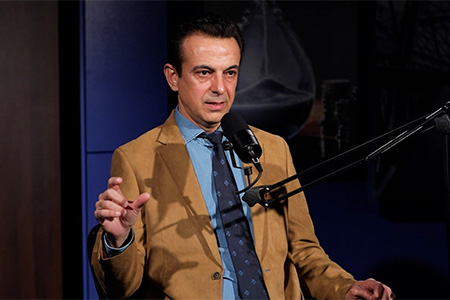
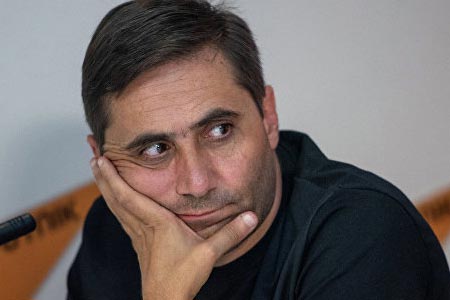
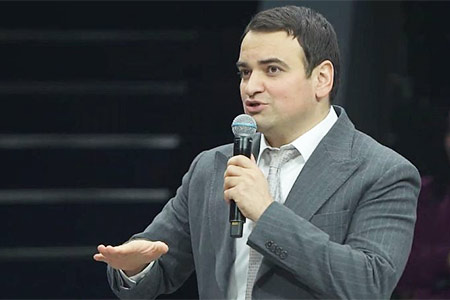
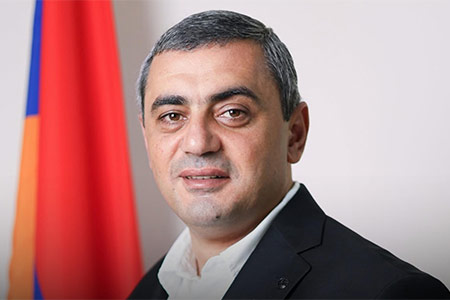
ArmInfo. Armenia is suffering greatly from uncertainty – it doesn't want to break with the East, and it's failing to integrate with the West, according to Stanford University professor and political scientist Artur Khachikyan.
The political scientist is confident that it's time to show willpower and make a decision, end these endless debates, and get down to business.
According to the expert, two important developments unfolding around Armenia need to be monitored today.
"First, the EAEU published a very clear report detailing the consequences of Armenia's withdrawal from the EAEU. There's a lot of information there, but very little that's good." "Everything is as we predicted: a 60% increase in gas prices, a 55-65% reduction in imports and exports, the restoration of customs controls on Armenian products, a tightening of migration regulations for Armenian citizens in Russia, a reduction in transfers from the EAEU to Armenia, a 15% reduction in GDP, and so on. In other words, everything we've been talking about for many years. Now it's clearly stated," Khachikyan noted in his Telegram post.
According to him, it was also stated that Armenia could be expelled from the EAEU based on its law on seeking EU membership, since it is impossible to be a member of two customs unions simultaneously.
"And the adoption of such a law would mean a declaration of withdrawal from the EAEU. Everything is moving in the direction that if a referendum isn't held in Armenia to clarify the opinion of the Armenian people on this crucial issue, a decision will be made without Armenia by the end of the year." Indeed, after years of campaigning for European integration and leaving the Eurasian Economic Union, we need to either take this path or stop feeding the public with empty hopes. Do we want to join Europe? Let's do it. We're all for it. Let's hold a referendum, make it clear, and begin integrating with Europe. After eight years of promises, we can ask our European friends to open their markets to our goods, grant our citizens the right to work in Europe, ensure our security, and then—off to the Champs-Élysées," the political scientist noted.
And the second important event, according to Khachikyan, is the unprecedented wave of protests in Europe, with its epicenter in France. He noted that in Europe and around the world, there is already talk of the defeat of globalism and a return to national politics.
"Italian leader Melone gave a speech about how the protests across Europe signify the desire of people to return to their national values." In France, two leaders of polar opposite political forces, Mélenchon and Le Pen, are building their election platforms on the principles of protecting French producers, the French market, and limiting immigration. So what are we doing? In a world where the center of power is shifting east, we say we're choosing the west. In a world where Europe is ablaze with protests against globalism and uncontrolled migration, where there's talk of limiting imports from third countries and protecting domestic producers, we're abandoning our existing market and striving to enter a place where they want to close the door on us," Khachikyan noted. Based on this, the political scientist is confident that it's time for Armenia to make its final choice, try to follow its own path, and determine from its own experience what's best for it. "It's time to stop empty talk and start making decisions. Either to the right or to the left. Either to the east or to the west." "We need to make a decision," the professor concluded.






 Expert: Economic pressure on Armenia may be virtually painless for other EAEU members, but not for Armenia itself
 Expert on protests in France: Civilizations fade when society loses a vision of the future
 Turkologist: Azerbaijan is not all-powerful—its vulnerabilities should become part of Armenia’s security strategy
 Opinion: The development of the Amulsar mine near the resort town of Jermuk is the beginning of an environmental disaster in Armenia
 Expert: The arrest of opposition figures in Armenia for social media posts is a systematic attempt to intimidate the public and suppress dissent.
 The Artsakh Public Council expressed outrage at the UN Secretary-General`s behavior
 Lukashenko called for Armenia to assume the CIS presidency in 2029
 Dmitry Medvedev predicted a Ukrainian-like fate for Armenia amid the country`s shift in foreign policy
 Russian Security Council: In Armenia, they want to force Russian asset owners to dispose of their assets
 Zakharova: Russia ready to discuss with Armenia the prospects for expanding military cooperation as part of a review of bilateral ties
 Tevanyan: Armenia, like Ukraine and Moldova, is being drawn into the EU’s global war
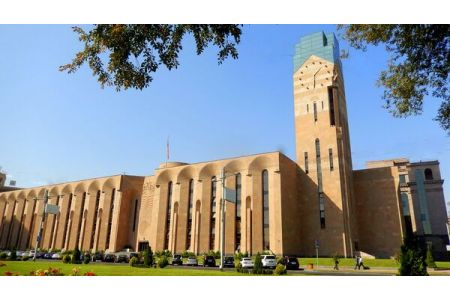 Yerevan City Hall is considering introducing a valet parking system in the city
 Expert: The circus surrounding the “Albanization” of Armenian culture in the presence of foreign ambassadors in occupied Artsakh is genocide
 Political scientist: If Russian-Armenian relations are destroyed, Turkey will take Russia`s place
 Political scientist: The Armenian public is simply obliged to significantly change the entire content of public discourse and struggle
 Cross tattoos are being removed from the skin of Christian prisoners in Azerbaijan by fire, according to a human rights activist.
 Zakharova: Armenia`s likely introduction of visas with Russia will be a step against Yerevan itself
 Putin: Armenia`s recognition of Karabakh as part of Azerbaijan in Prague has given Russia`s position on this issue an ambivalent character
 Putin: Armenia`s adoption of the law on EU accession means an announcement of its withdrawal from the Eurasian Economic Union