
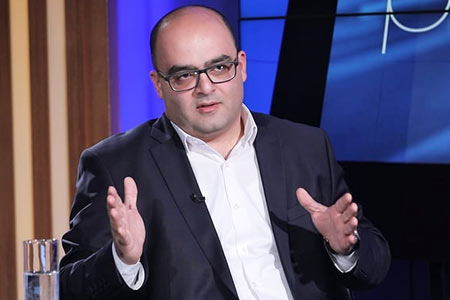
ArmInfo. The political message of the report "on the consequences of suspending Armenia's membership in the EAEU" is quite harsh: economic pressure on Armenia could prove virtually painless for other members of the Eurasian Economic Union, while it would be a severe blow to Armenia itself. This is how political scientist Vahe Davtyan commented on the report on the consequences of suspending Armenia's membership in the EAEU, published on the Russian government website on October 20.
The expert noted that the 72-page report, prepared by representatives of four EAEU states: Russia, Belarus, Kazakhstan, and Kyrgyzstan, directly addresses the possibility of suspending Armenia's membership in the Union. According to him, this regime is proposed to be maintained until a referendum is held in Armenia on the choice between the EAEU and the EU.
"The legal dimension is interesting." The report acknowledges that the EAEU Treaty does not provide for a mechanism for suspending membership. Therefore, the authors turn to the 1969 Vienna Convention on the Law of Treaties, under which other EAEU members are said to have the right to consider a joint decision to temporarily suspend the EAEU Treaty until a referendum is held in Armenia," he noted.
As for economic calculations, Davtyan continued, the picture is quite grim. A potential contraction of Armenia's GDP is estimated at 15.6%, or approximately $4.6 billion, with an additional increase in inflation of 14.9% and a decline in consumption of 14.6%. Trade turnover with EAEU countries is projected to decline by 55.6%, including a 65.8% decline in exports. The expert added that the most serious impact could be on agriculture, the food industry, alcohol production, and light industry.
"The energy component deserves special attention. The report examines a scenario whereby the price of Russian gas increases from the current $177.5 to $300 per 1,000 cubic meters—an increase of almost 69%. Naturally, such a change will impact the cost of electricity production, industrial competitiveness, and overall inflation. However, there is a significant circumstance that the report's authors failed to take into account. Gas supply terms are regulated, among other things, by bilateral Russian-Armenian agreements. Therefore, the suspension of membership in the EAEU does not in itself imply an automatic price adjustment. Therefore, the inclusion of such a scenario in the document can be regarded as a political signal," Davtyan is confident.
According to him, the issue of labor migration also remains sensitive, as Armenian citizens working in EAEU countries may lose their current preferential treatment and face new requirements regarding work permits, social security, and taxation.
"The report also predicts a decrease in remittances from EAEU countries to Armenia from approximately $3.95 billion to $1.85 billion. The total volume of bank transfers is effectively linked to labor migration, although a significant portion of these funds may have a completely different economic origin. Therefore, this estimate also requires additional substantiation.
And, perhaps the most interesting part of the document concerns the possible losses for the remaining EAEU states. According to the calculations provided, the suspension of Armenia's membership will not create significant economic problems for them. In Russia's case, the projected decline in total exports and imports of goods and services will not exceed 1%.
Therefore, the report's political message is quite harsh: economic pressure on Armenia could prove virtually painless for other EAEU members, while it will be a severe blow to Armenia itself," the Armenian expert concluded.

















 Opinion: The development of the Amulsar mine near the resort town of Jermuk is the beginning of an environmental disaster in Armenia
 Expert: The arrest of opposition figures in Armenia for social media posts is a systematic attempt to intimidate the public and suppress dissent.
 The Artsakh Public Council expressed outrage at the UN Secretary-General`s behavior
 Lukashenko called for Armenia to assume the CIS presidency in 2029
 Dmitry Medvedev predicted a Ukrainian-like fate for Armenia amid the country`s shift in foreign policy
 Russian Security Council: In Armenia, they want to force Russian asset owners to dispose of their assets
 Zakharova: Russia ready to discuss with Armenia the prospects for expanding military cooperation as part of a review of bilateral ties
 Tevanyan: Armenia, like Ukraine and Moldova, is being drawn into the EU’s global war
 Yerevan City Hall is considering introducing a valet parking system in the city
 Expert: The circus surrounding the “Albanization” of Armenian culture in the presence of foreign ambassadors in occupied Artsakh is genocide
 Political scientist: If Russian-Armenian relations are destroyed, Turkey will take Russia`s place
 Political scientist: The Armenian public is simply obliged to significantly change the entire content of public discourse and struggle
 Cross tattoos are being removed from the skin of Christian prisoners in Azerbaijan by fire, according to a human rights activist.
 Zakharova: Armenia`s likely introduction of visas with Russia will be a step against Yerevan itself
 Putin: Armenia`s recognition of Karabakh as part of Azerbaijan in Prague has given Russia`s position on this issue an ambivalent character
 Putin: Armenia`s adoption of the law on EU accession means an announcement of its withdrawal from the Eurasian Economic Union