
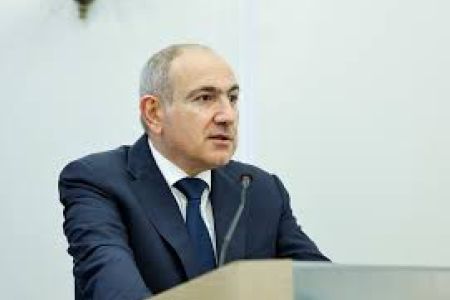
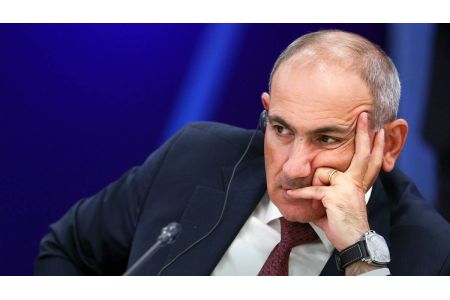
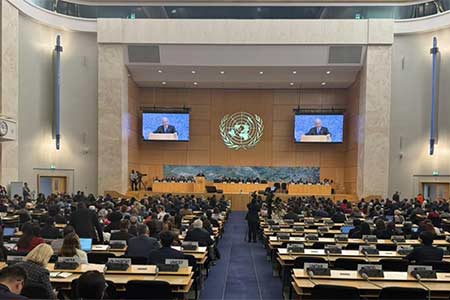
ArmInfo. The Armenian government feels a special responsibility to nature, because during difficult times for Armenians, during difficult times for the Republic of Armenia, it was nature that saved the Armenian people. Armenian Prime Minister Nikol Pashinyan stated this on October 16 in Yerevan during his welcoming speech at the opening plenary session of the "Leaders for Nature" summit, held as part of the 17th Conference of the Parties to the Convention on Biological Diversity (COP17).
In this vein, the Armenian prime minister recalled that in the early 1990s, after Armenia gained independence, the country experienced an energy and socioeconomic crisis caused by the collapse of the Soviet economic system and conflict. Pashinyan noted that the country was under blockade, with shortages of electricity, gas, petroleum products, and coal, and people heating their apartments primarily with firewood, leading to massive tree felling in Armenia.
"In the early 1990s, when import and production chains were effectively disrupted and food shortages arose, the fish resources of Lake Sevan came to the rescue. Without exaggeration, Sevan whitefish was the staple food of the Armenian population for several years. This, in turn, pushed Sevan's fish resources to the brink of depletion. Besides whitefish, Sevan trout, a unique species native to Sevan with four subspecies, also inhabits the lake," he noted.
Pashinyan then spoke about the government's measures to protect forests from deforestation and Lake Sevan's fish stocks, thereby protecting biodiversity. "Over the past 10 years, the total population (biomass) of whitefish in Lake Sevan has increased more than tenfold: from a critical level of several hundred tons in the mid-2010s, i.e., from the brink of extinction, to over 4,500 tons as of July 2026. The government is also implementing a program to restore Sevan trout stocks and develop fish farming in Lake Sevan. A program to restore and develop the red deer population is also being successfully implemented in Armenia's high-mountain rivers.
Our next success story concerns the Caucasian leopard, which was considered extinct in Armenia. Today, an estimated 6-7 individuals live in Armenia, and two cubs were recorded in 2024. "The presence of a leopard is an important indicator of a healthy ecosystem, and the birth of a cub is a testament to its stability," Pashinyan said.
He also acknowledged that despite successes in some areas, illegal deforestation, poaching, and the illegal exploitation of nature continue in Armenia. According to him, to address these problems, just two years ago, the Armenian authorities began creating the Ecoparks Service, essentially an environmental police force.
"The service's mission is to ensure 24/7 environmental protection, and we intend to develop this service both technically and substantively, as well as in terms of the professionalism and conscientious behavior of its employees." "Our forests have a very high potential for restoration. We are simultaneously implementing and must continue to implement reforestation programs, but we must also understand that without protecting forests and instilling environmental awareness in people, it will be very difficult to achieve significant results," the Prime Minister continued.
At the same time, he emphasized that a particular challenge for Armenia is bringing the mining industry into compliance with modern environmental standards, and the country is moving in this direction with difficult but sincere steps.
"Efficient water resource management and the introduction and development of water-saving systems and technologies are among the government's priorities, but here too, it is clearly equally important to instill a water-saving mindset in society. I must say the same about solid waste management, where, unfortunately, our successes have not yet had revolutionary significance." "On the other hand, we must understand that change, especially in people's thinking, occurs very slowly, and the solution here lies in consistency and continuity, and we are determined to follow precisely this path," Pashinyan noted.
He went on to note that the international community has already articulated a vision of "living in harmony with nature" and adopted the Kunming-Montreal Global Biodiversity Framework in 2022, setting goals and clear targets for 2030.
"We are halfway to achieving these goals and must honestly admit that, collectively, we are not yet on the necessary path. Our task now is not to formulate new promises. Our task is to translate the commitments we have already made into real actions. The COP-17 Biodiversity Conference is a good opportunity for us to make decisions that will change the situation." "The Republic of Armenia is pleased to support this opportunity," he concluded.
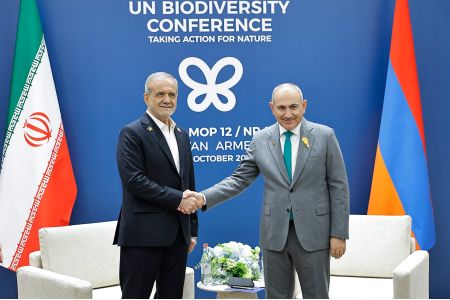
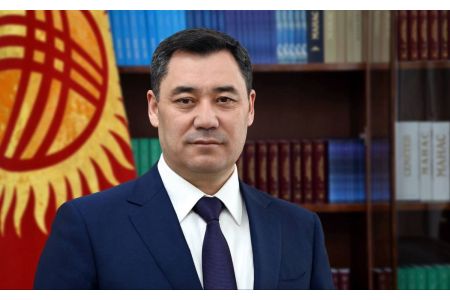
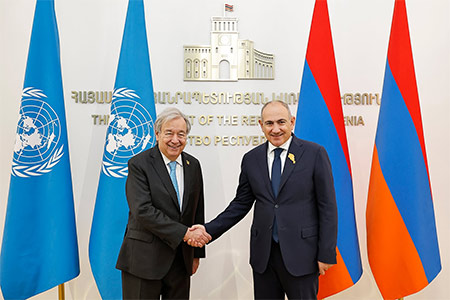
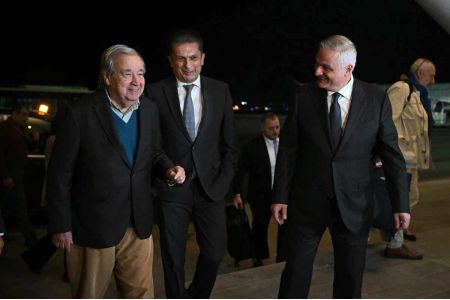
The event is attended by heads of state, government, and international organizations. Guests include: UN Secretary-General Antonio Guterres, UNESCO Director-General Khaled El-Enan, Secretary-General of the International Organization of La Francophonie Louise Mushikiwabo, Vice-President of the European Commission and Commissioner for a Clean, Just, and Competitive Transition Thérèse Rieber, President of the National Council of Algeria Azous Nasri, President of Zanzibar Hussein Ali Mwinyi, President of Turkmenistan Serdar Berdimuhamedov, Prime Minister of Georgia Irakli Kobakhidze, President of Tajikistan Emomali Rahmon, President of Kyrgyzstan Sadyr Japarov, President of Kazakhstan Kassym-Jomart Tokayev, and President of Iran Masoud Pezeshkian.
















 Expert: The arrest of opposition figures in Armenia for social media posts is a systematic attempt to intimidate the public and suppress dissent.
 Azerbaijani Studies Expert: While Azerbaijan Prepares Its Generation for War, Aliyev’s Aide Calls on Armenia to Prepare Armenian Society for “Peace”
 Turkologist: Azerbaijan will never, under any circumstances, stop pressuring the Armenian people
 Political scientist: We need to move away from the question of "when" and replace it with more important questions
 Lukashenko called for Armenia to assume the CIS presidency in 2029
 Dmitry Medvedev predicted a Ukrainian-like fate for Armenia amid the country`s shift in foreign policy
 Russian Security Council: In Armenia, they want to force Russian asset owners to dispose of their assets
 Zakharova: Russia ready to discuss with Armenia the prospects for expanding military cooperation as part of a review of bilateral ties
 Tevanyan: Armenia, like Ukraine and Moldova, is being drawn into the EU’s global war
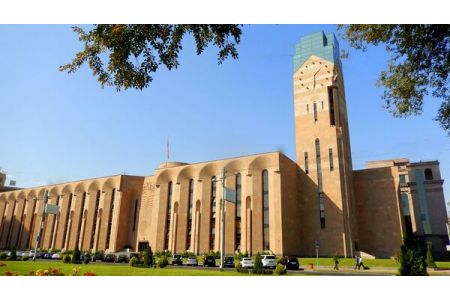 Yerevan City Hall is considering introducing a valet parking system in the city
 Expert: The circus surrounding the “Albanization” of Armenian culture in the presence of foreign ambassadors in occupied Artsakh is genocide
 Political scientist: If Russian-Armenian relations are destroyed, Turkey will take Russia`s place
 Political scientist: The Armenian public is simply obliged to significantly change the entire content of public discourse and struggle
 Cross tattoos are being removed from the skin of Christian prisoners in Azerbaijan by fire, according to a human rights activist.
 Zakharova: Armenia`s likely introduction of visas with Russia will be a step against Yerevan itself
 Putin: Armenia`s recognition of Karabakh as part of Azerbaijan in Prague has given Russia`s position on this issue an ambivalent character
 Putin: Armenia`s adoption of the law on EU accession means an announcement of its withdrawal from the Eurasian Economic Union