

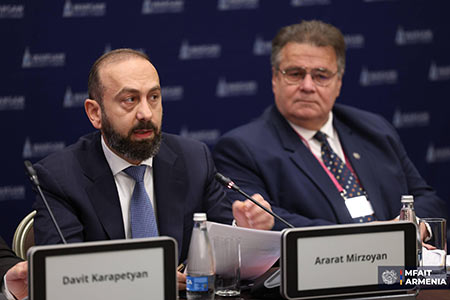
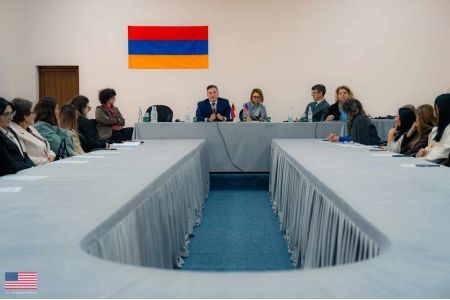
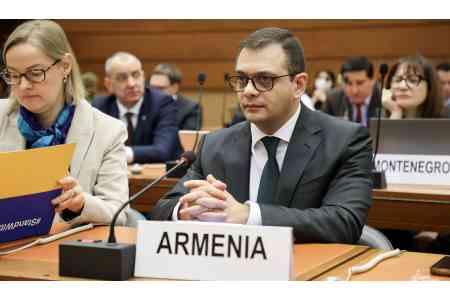
ArmInfo. One of the European Union's most successful political initiatives, the Eastern Partnership, is currently being tested in the new realities of a gradually fragmenting world. This was stated by Armenian Foreign Minister Ararat Mirzoyan during a roundtable discussion entitled "Rethinking the EU's Eastern Partnership," held within the Warsaw Security Forum.
According to him, since its inception in 2009, the Eastern Partnership has been based on the approach that closer engagement with the European Union can contribute to strengthening democracy and institutional reforms in the EU's Eastern Neighborhood, while recognizing that the six Eastern Partner countries do not necessarily have the same aspirations or priorities.
However, he continued, over nearly two decades, profound geopolitical, security, and societal transformations have significantly altered the operational environment of the Eastern Partnership, and the six countries participating in the initiative have chosen different paths of political development and European integration. Mirzolnia expressed his conviction that these events inevitably called into question the original concept underlying the unified partnership model.
Regarding Armenia's approach to further developing the Eastern Partnership, the Armenian diplomat noted that the EaP should continue to emphasize democracy, the rule of law, and institutional resilience.
"From Armenia's perspective, one of the most important achievements of the Eastern Partnership is its contribution to promoting democratic governance and institutional reforms. These reforms are important not only because they bring Armenia closer to European standards, but also
directly strengthen the resilience, effectiveness, and legitimacy of our state institutions. In an era of hybrid threats and disinformation, reliable and accountable institutions are a resource of strategic importance in themselves. Secondly, "Armenia's experience demonstrates the importance of taking into account the aspirations and level of ambition of each partner country in developing bilateral relations with the European Union," he noted, presenting a timeline of the development of the partnership between Armenia and the EU.
"Responding to our ambitions, the European Union is developing an increasingly tailored bilateral partnership with Armenia. Although Armenia does not yet have candidate country status for EU membership, a program for Armenia's sustainability and growth is being implemented." At the same time, we are recording progress in the visa liberalization dialogue, and the recently adopted EU trade autonomy measures create additional opportunities for the diversification of Armenia's foreign trade," he noted.
Mirzoyan named the changing geopolitical situation and interconnectedness in the South Caucasus as the third component of Armenia's approach to further developing the EaP.
"Unlocking and realizing the region's potential in line with Armenia's 'Crossroads of the World' vision, as well as the Armenia-EU connectivity partnership, can contribute to strengthening ties between Europe and its eastern neighbors, while simultaneously providing the European neighborhood with the opportunity to adapt to significantly changed geopolitical realities.
Taking into account all of the above factors and transformations, Armenia's experience suggests that the future of the Eastern Partnership may lie precisely in its ability to evolve and adapt to changing realities, transforming from a general neighborhood framework into a flexible platform that "It will enable the interconnection of various paths to European integration, taking into account the various aspirations and formats of European integration, while preserving democratic principles, cooperation, connectivity, and sustainability at its core.
Ultimately, the goal of a reimagined Eastern Partnership should not be to preserve a model shaped by the realities of the past, but to create a framework aimed at fully realizing current opportunities, one that is flexible enough to accommodate different paths and approaches, and at the same time ambitious enough to ensure the interconnectedness of our regions," he concluded.












 Expert: The arrest of opposition figures in Armenia for social media posts is a systematic attempt to intimidate the public and suppress dissent.
 Azerbaijani Studies Expert: While Azerbaijan Prepares Its Generation for War, Aliyev’s Aide Calls on Armenia to Prepare Armenian Society for “Peace”
 Turkologist: Azerbaijan will never, under any circumstances, stop pressuring the Armenian people
 Political scientist: We need to move away from the question of "when" and replace it with more important questions
 International Law Specialist: Azerbaijan intends to initiate legal proceedings against Armenia by sentencing Armenian prisoners
 Lukashenko called for Armenia to assume the CIS presidency in 2029
 Dmitry Medvedev predicted a Ukrainian-like fate for Armenia amid the country`s shift in foreign policy
 Russian Security Council: In Armenia, they want to force Russian asset owners to dispose of their assets
 Zakharova: Russia ready to discuss with Armenia the prospects for expanding military cooperation as part of a review of bilateral ties
 Tevanyan: Armenia, like Ukraine and Moldova, is being drawn into the EU’s global war
 Yerevan City Hall is considering introducing a valet parking system in the city
 Expert: The circus surrounding the “Albanization” of Armenian culture in the presence of foreign ambassadors in occupied Artsakh is genocide
 Political scientist: If Russian-Armenian relations are destroyed, Turkey will take Russia`s place
 Political scientist: The Armenian public is simply obliged to significantly change the entire content of public discourse and struggle
 Cross tattoos are being removed from the skin of Christian prisoners in Azerbaijan by fire, according to a human rights activist.
 Zakharova: Armenia`s likely introduction of visas with Russia will be a step against Yerevan itself
 Putin: Armenia`s recognition of Karabakh as part of Azerbaijan in Prague has given Russia`s position on this issue an ambivalent character
 Putin: Armenia`s adoption of the law on EU accession means an announcement of its withdrawal from the Eurasian Economic Union
 Aram Vardevanyan: Public demands solutions, not apology scandals in Parliament