

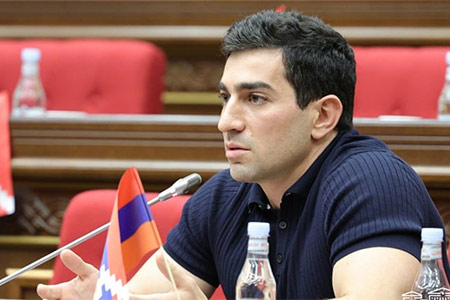
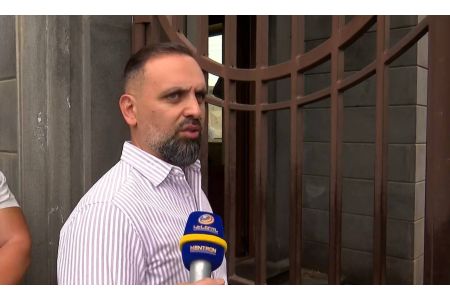
ArmInfo. Armenian authorities have artificially created problems for residents of Armenian villages engaged in agricultural production, without solving any of their other problems. This was stated by Levon Kocharyan, a member of parliament from the Armenia faction, in an interview with journalists after meeting with residents of villages facing a difficult situation due to Russian restrictions on Armenian produce.
According to the opposition MP, farmers at the meeting complained that Armenian authorities are not addressing the problems they have faced due to Russian restrictions, the lack of alternative markets, and the inability to earn a living. They point to ongoing problems with bus service, which prevents them from always delivering their produce to market, and even those delivered to market remain unsold for days due to a lack of demand. Villagers express bewilderment at the authorities' inaction and ask, "Why should their produce now be shipped to Europe instead of Moscow, as was previously the case?"
As the MP explained, in the context of problems with selling agricultural produce, he drew farmers' attention to the fact that if the authorities had paid due attention to these issues, residents of Armenian communities would not be facing such difficulties today. The MP expressed his conviction that the current situation is due, in part, to the deterioration of relations with Russia.
"We, as the opposition, have been warning about this for a very long time, but in response we have only been accused of 'sabotage.'" "We spoke based on the interests of our citizens," Kocharyan said, noting that he had tried to convey this message at a meeting with residents of Armenian villages.
He also recalled that Armenian Prime Minister Nikol Pashinyan promised to reach an agreement with the Russian side after the parliamentary elections. However, as the MP noted, this never happened. The MP also drew attention to the fact that instead of addressing the problems that had arisen, the authorities temporarily introduced subsidies. In his opinion, such measures are incapable of addressing the root causes of the current situation. The opposition leader emphasized that the primary responsibility of any government is to ensure the country's security. In his opinion, the current government has failed in this task as well.
"We are talking about a government under which the country has gone through several wars and suffered human and territorial losses. You can constantly talk about love for the people, but the government must be judged by its actions. "I don't know how much one must dislike one's own people to lead the country to the results we have today," Kocharyan added.
Speaking about the situation in rural communities, the MP noted that, above all, residents must feel safe. Otherwise, he said, people will seek safer places to live and leave their villages. "This problem concerns all villages. Even residents of communities located far from the scene of the incident cannot remain indifferent to reports that an armed Azerbaijani crossed the border and entered the home of an Armenian family. Such incidents cannot but cause concern among the population," the opposition leader asserted.
At the same time, Kocharyan noted that today each village faces its own specific problems. For example, he noted that in the Ararat region, agriculture remains one of the key issues. "We understand the serious difficulties the entire country is facing, especially our citizens engaged in agriculture and exporting their products. This applies, in particular, to peaches, apricots, and other agricultural products, the main market for which is Russia. We are facing serious problems in this area," the deputy noted.
Kocharyan believes that the authorities are directly responsible for the current situation, and the difficulties that have arisen are the result of their "senseless adventure." "This is an artificially created problem. In essence, by creating it, the authorities have not solved any other problem. They created the problem, but in return, they have done nothing to ease the burden on citizens. "As for Europe, these are all just formalities," the MP concluded.
As a reminder, on October 9, residents of the Verin Dvin community in Armenia's Ararat region blocked the Yerevan-Ashtarak highway due to problems with tomato sales after state subsidies were discontinued. This was not the first time residents had blocked the road. A similar action took place back in July of this year. The problems arose against the backdrop of Russia introducing gradual restrictions on the import of Armenian agricultural products in April. The official reason cited was sanitary and phytosanitary violations and a lack of safety oversight by authorized Armenian agencies. The real reason for the restrictions, however, is the overt anti-Russian steps taken by the Armenian leadership against the backdrop of Yerevan's course toward rapprochement with the European Union. These "sanctions" have already led to a reduction in trade turnover: in the first five months of 2026, mutual trade volumes between Armenia and Russia fell by 21.5% compared to the same period last year. Difficulties have begun in agricultural exports: due to the blockage of supplies during the summer peak season, exports of Armenian fruits, vegetables, and flowers showed a sharp drop of 74.5%. According to experts, financial losses for businesses amount to tens of millions of dollars, creating the threat of mass bankruptcy for hundreds of greenhouse and farm enterprises.


















 Expert: The arrest of opposition figures in Armenia for social media posts is a systematic attempt to intimidate the public and suppress dissent.
 Azerbaijani Studies Expert: While Azerbaijan Prepares Its Generation for War, Aliyev’s Aide Calls on Armenia to Prepare Armenian Society for “Peace”
 Turkologist: Azerbaijan will never, under any circumstances, stop pressuring the Armenian people
 Political scientist: We need to move away from the question of "when" and replace it with more important questions
 International Law Specialist: Azerbaijan intends to initiate legal proceedings against Armenia by sentencing Armenian prisoners
 Lukashenko called for Armenia to assume the CIS presidency in 2029
 Dmitry Medvedev predicted a Ukrainian-like fate for Armenia amid the country`s shift in foreign policy
 Russian Security Council: In Armenia, they want to force Russian asset owners to dispose of their assets
 Zakharova: Russia ready to discuss with Armenia the prospects for expanding military cooperation as part of a review of bilateral ties
 Tevanyan: Armenia, like Ukraine and Moldova, is being drawn into the EU’s global war
 Yerevan City Hall is considering introducing a valet parking system in the city
 Expert: The circus surrounding the “Albanization” of Armenian culture in the presence of foreign ambassadors in occupied Artsakh is genocide
 Political scientist: If Russian-Armenian relations are destroyed, Turkey will take Russia`s place
 Political scientist: The Armenian public is simply obliged to significantly change the entire content of public discourse and struggle
 Cross tattoos are being removed from the skin of Christian prisoners in Azerbaijan by fire, according to a human rights activist.
 Zakharova: Armenia`s likely introduction of visas with Russia will be a step against Yerevan itself
 Putin: Armenia`s recognition of Karabakh as part of Azerbaijan in Prague has given Russia`s position on this issue an ambivalent character
 Putin: Armenia`s adoption of the law on EU accession means an announcement of its withdrawal from the Eurasian Economic Union
 Aram Vardevanyan: Public demands solutions, not apology scandals in Parliament