
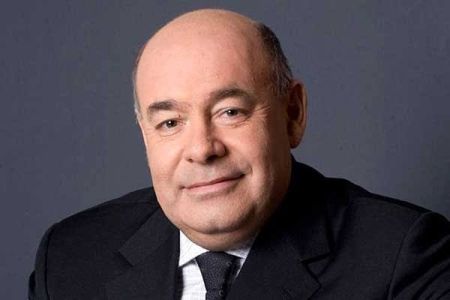
ArmInfo. Cultural relations between Armenia and Russia are not dependent on political conflicts, believes Mikhail Shvydkoy, Special Representative of the President of the Russian Federation for International Cultural Cooperation.
On September 30, in a conversation with journalists on the sidelines of the opening of the Days of Spiritual Culture of the Russian Federation in Armenia, when asked whether Armenia and Russia were managing to maintain cultural dialogue despite political upheavals, a Russian official expressed confidence that no one would question whether they should or should not be maintained. He said this dialogue will take place, whether Moscow and Yerevan want it or not, as long as the Armenian and Russian peoples, and the Russian peoples, exist. "This dialogue will exist, not even dialogue, this mutual connection will exist. No one will question politicians, believe me. This does not depend on political conflicts. It is the will of the people." "I am confident that the will of the Russian and Armenian peoples coincide here," Shvydkoy added.
Regarding the Days of Russian Spiritual Culture in Armenia, he noted that this is an event that the Russian side regularly holds around the world. "We hold them in a variety of countries, and I think that for Armenia, the Days of Spiritual Culture have special meaning because Armenia is a country of high spirituality. And the attitudes toward words, language, and faith in Armenia and Russia are largely the same. We look forward to welcoming Armenian artists and cultural figures to our country. And I hope that the Days of Armenian Culture in Russia will be a success. Apparently, this should happen this year," he said.
Shvydkoy added that he always says that just as the Days of Russian Culture never end in Armenia, so too do the Days of Armenian Culture never end in Russia.
"Because we constantly listen to Khachaturian, Babajanyan, watch Nalbandian, watch Saryan, naturally, read Saroyan, and so on and so forth. Therefore, I will say right away that the communication between peoples is so closely intertwined, and I am confident that no political conflicts, no matter how complex, will separate us," he continued.
Shvydkoy also emphasized that Russia's position regarding cultural relations with Armenia is very simple. "We are open to communication with the Armenian people, the Armenian intelligentsia, and the Armenian states, just as much and even more so as the Armenian state, the Armenian people, and the Armenian intelligentsia are willing to communicate with the Russians. Given that 2 million Armenians live in Russia, it was, one might say, communication between relatives," he concluded.
In turn, the Minister of Education, Science, Culture, and Sports of Armenia, Zhanna Andreasyan, at the opening of the Days of Spiritual Culture of the Russian Federation in Armenia, expressed her conviction that such events provide an opportunity not only to learn about each other's cultures but also to appreciate the universal values that unite different peoples: love for humanity, kindness, peace, creativity, and spiritual beauty.
"In this sense, spiritual culture is of particular importance. It is preserved and passed down from generation to generation through music, singing, fine art, literature, and other creative forms, becoming an expression of a person's inner world, their value system, and historical memory." Today we welcome the large academic choir "Masters of Choral Singing," whose art gives Armenian audiences the opportunity to experience the rich legacy of the Russian choral tradition and its contemporary interpretations. Armenia, with its centuries-old cultural and spiritual heritage, has always placed great importance on strengthening human ties through culture. "In our country, every initiative for cultural dialogue is especially valuable when it promotes understanding of the cultural heritage of peoples, deepens respect for art, and disseminates humanistic values," she stated.
She expressed confidence that the art presented these days will be warmly received by Armenian audiences and will become another opportunity to unite around beauty, spirituality, and creative inspiration. "Let art continue to build bridges between people and cultures, and let the best values of spiritual culture serve the ideals of goodness, mutual understanding, and peace," she concluded.
On September 30 and October 1, Days of Russian Spiritual Culture will be held in Armenia. The events will take place in Yerevan and Gyumri. The highlight was a performance by the Academic Grand Choir "Masters of Choral Singing" of the Orpheus Television and Radio Broadcasting Center, one of the oldest Russian choral groups. This is the choir's first performance in Armenia. The opening ceremony was held at the Yerevan State Russian Drama Theater named after K. Stanislavsky. On October 1, a performance will take place in Gyumri at the "Hayordats Tun" Spiritual and Educational Center of the Mother See of Holy Etchmiadzin. The diverse program, prepared specifically for the concerts in Armenia, includes works by Russian composers, including those who wrote sacred music—Pyotr Tchaikovsky, Sergei Rachmaninoff, and Pavel Chesnokov—and Western classics—Wolfgang Amadeus Mozart, Johann Sebastian Bach, and Charles-François Gounod—as well as Russian and Armenian folk songs in both ancient and modern arrangements.
Also on display as part of the Days of Russian Spiritual Culture in Armenia is the photo exhibition "About the Peace of the Whole World," dedicated to the 80th anniversary of His Holiness Kirill, Patriarch of Moscow and All Rus'. The exhibition explores the role of the Church as the guardian of historical memory and moral values, which are especially important in an era of global challenges and change.








 International Law Specialist: Azerbaijan intends to initiate legal proceedings against Armenia by sentencing Armenian prisoners
 An Armenian Turkologist spoke out against attempts to deny the value of Artsakh and the liberation of Armenia.
 Russian political scientist: Moscow`s reaction to the TRIPP project will largely depend on the trend in Russian-American relations
 Armenian Political Scientist: The approaches, methods, rmphases and content of today’s struggle in Armenia Cannot Remain the Same
 Russian Security Council: In Armenia, they want to force Russian asset owners to dispose of their assets
 Zakharova: Russia ready to discuss with Armenia the prospects for expanding military cooperation as part of a review of bilateral ties
 Yerevan City Hall is considering introducing a valet parking system in the city
 Expert: The circus surrounding the “Albanization” of Armenian culture in the presence of foreign ambassadors in occupied Artsakh is genocide
 Political scientist: If Russian-Armenian relations are destroyed, Turkey will take Russia`s place
 Political scientist: The Armenian public is simply obliged to significantly change the entire content of public discourse and struggle
 Cross tattoos are being removed from the skin of Christian prisoners in Azerbaijan by fire, according to a human rights activist.
 Zakharova: Armenia`s likely introduction of visas with Russia will be a step against Yerevan itself
 Putin: Armenia`s recognition of Karabakh as part of Azerbaijan in Prague has given Russia`s position on this issue an ambivalent character
 Putin: Armenia`s adoption of the law on EU accession means an announcement of its withdrawal from the Eurasian Economic Union
 Medvedev: Yerevan will never become an EU member, but it will permanently damage relations with the Eurasian Economic Union, including with Moscow.
 Arrested Armenian oligarch on economy and new jobs
  "In Baku, we gave a worthy rebuff to the false claims regarding the past and present of our people" – Former Artsakh Parliament Speaker from Baku captivity