

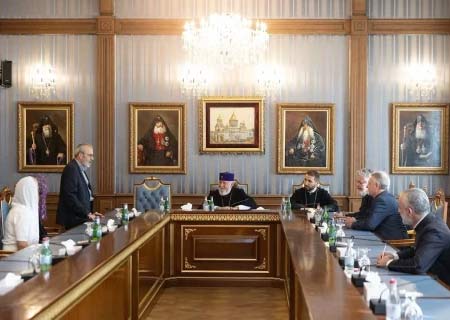
ArmInfo. The heads of the Armenian Apostolic Church's (AAC) dioceses abroad have proposed convening a Council of Bishops in the Mother See of Holy Etchmiadzin no later than mid-2027, following the publication of a report on the situation in the Armenian Church by the Armenian government.
In a statement published by Bishops Armash Nalbandian (Primate of the Armenian Diocese of Damascus), Serovbe Isaakhanian (Primate of the Armenian Diocese of Germany), and Oshakan Gyulgyulian (Primate of the Iraqi Diocese of the AAC), they noted that, in their opinion, the published report should not be approached from the standpoint of political passions or preferences, nor from a position of blind defense or outright denial. They noted that the report raises numerous questions and makes a number of accusations, some of which cannot be ignored.
"It is equally important to be guided by another principle: an accusation is not yet a proven fact. Many of the allegations contained in the report are based on public statements, media publications, as well as testimonies and rumors from various individuals. While they may serve as a basis for discussion, they cannot, especially in the case of serious or criminal charges, replace a proper legal investigation and a court decision," the bishops noted.
They noted that neither political authority, nor Church leadership, nor public opinion, nor the media should assume the role of a court. "It is to be expected that competent courts will impartially examine each such accusation, naturally respecting the presumption of innocence of each accused—whether lay or clergy. Taking into account all of the above, we wish to particularly emphasize that the state or state authorities must be wary of crossing a dangerous line. The Holy Armenian Apostolic Church is not an administrative subdivision of the state. The internal canonical life of the Church, the structure of spiritual authority, and the activities of canonical bodies must remain within the framework of the Church's autonomy and its own canonical jurisdiction," the bishops' statement notes.
It further emphasizes that the state should not become the bearer of the Church's canonical authority or determine who should be the Catholicos of All Armenians. In this regard, it is recalled that the election of the Catholicos or his possible retirement, if there are canonical grounds for this, must be carried out exclusively by the competent organs of the Church—in accordance with and within the framework of the canonical order of the Church. "In this regard, it is extremely important to ensure the restoration of the normal activities of the canonical bodies of the Church as soon as possible. As a first practical step, we propose convening a Council of Bishops in the Mother See of Holy Etchmiadzin in the near future, but no later than mid-2027. We rightly expect the Armenian authorities to ensure unimpeded entry into Armenia for bishops serving in the Diaspora dioceses, as well as their unimpeded return from Armenia to the countries where they serve. Today, we face an enormous spiritual and national responsibility. We are convinced that only in this way can we defuse the current extremely tense situation and find legal and canonical solutions," the bishops concluded.
As a reminder, the Public Relations and Information Center of the Office of the Prime Minister of Armenia published a report on the situation in the Armenian Apostolic Church and possible solutions. The report, "On the Crisis that Has Arised in the Armenian Apostolic Church as a Result of the Activities of the De facto Leader of the Church and Several High-Ranking Clergy, and Ways to Resolve It," was prepared as part of the Armenian government's 2026-2031 program, at the instruction of Prime Minister Nikol Pashinyan. The document's purpose is to document, through a study of open sources, the circumstances that its authors characterize as a crisis in the Armenian Apostolic Church and to propose ways to overcome it. The authors of the report propose a five-step "roadmap" for overcoming the situation, which they characterize as a crisis.


















 Armenian Political Scientist: The approaches, methods, rmphases and content of today’s struggle in Armenia Cannot Remain the Same
 Political scientist: Armenians will live peacefully in their homeland only when they can once again set national goals for themselves, such as Artsakh
 Russian Security Council: In Armenia, they want to force Russian asset owners to dispose of their assets
 Zakharova: Russia ready to discuss with Armenia the prospects for expanding military cooperation as part of a review of bilateral ties
 Tevanyan: Armenia, like Ukraine and Moldova, is being drawn into the EU’s global war
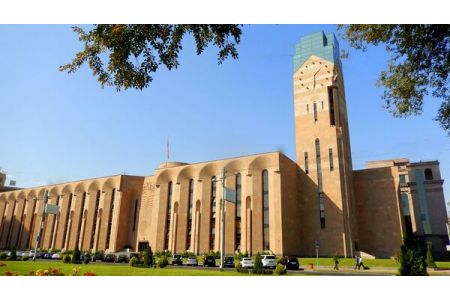 Yerevan City Hall is considering introducing a valet parking system in the city
 Expert: The circus surrounding the “Albanization” of Armenian culture in the presence of foreign ambassadors in occupied Artsakh is genocide
 Political scientist: If Russian-Armenian relations are destroyed, Turkey will take Russia`s place
 Political scientist: The Armenian public is simply obliged to significantly change the entire content of public discourse and struggle
 Cross tattoos are being removed from the skin of Christian prisoners in Azerbaijan by fire, according to a human rights activist.
 Zakharova: Armenia`s likely introduction of visas with Russia will be a step against Yerevan itself
 Putin: Armenia`s recognition of Karabakh as part of Azerbaijan in Prague has given Russia`s position on this issue an ambivalent character
 Putin: Armenia`s adoption of the law on EU accession means an announcement of its withdrawal from the Eurasian Economic Union
 Medvedev: Yerevan will never become an EU member, but it will permanently damage relations with the Eurasian Economic Union, including with Moscow.
 Aram Vardevanyan: Public demands solutions, not apology scandals in Parliament
 Arrested Armenian oligarch on economy and new jobs
  "In Baku, we gave a worthy rebuff to the false claims regarding the past and present of our people" – Former Artsakh Parliament Speaker from Baku captivity