
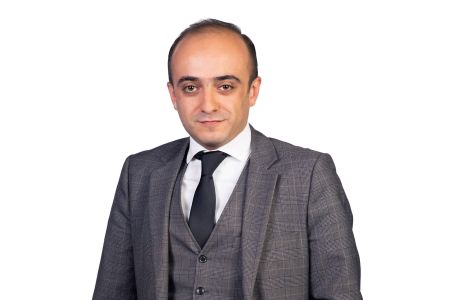
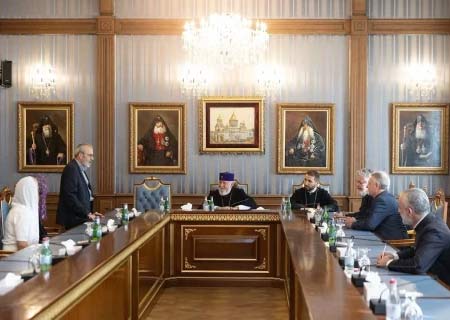
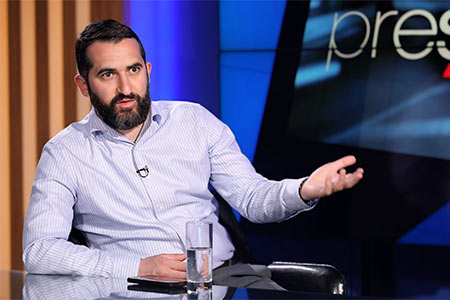
ArmInfo. Azerbaijan intends to use the sentences against Armenian prisoners of war to initiate legal proceedings against Armenia. This was stated on September 28 at a press conference in Yerevan entitled "Three Years in Prison: Peace and Armenian Prisoners," by Taron Simonyan, an international law specialist and founding partner of the law firm ELL PARTNERSHIP.
According to him, all these trials against Armenian prisoners of war pursued a much broader goal from the very beginning. "In particular, they were intended to serve as the basis for subsequent legal proceedings against Armenia." "It's no coincidence that in this context, the indictment is based on the assertion that the Republic of Artsakh is a terrorist organization financed by Armenia," the expert noted.
According to him, if we examine the case of philanthropist and former Artsakh State Minister Ruben Vardanyan separately, we can see that approximately 100 pages of the verdict are devoted to events that took place from 1988 to the late 1990s. All of them, as Simonyan noted, are presented as actions committed by a single "organization" (Azerbaijan calls Artsakh a terrorist organization - ed.). According to him, such an interpretation can essentially be applied to any official in the Artsakh government and even to ordinary citizens.
"Thus, everyone who participated in the governance of the Republic to one degree or another, including participating in elections, according to the Azerbaijani interpretation, is effectively implicated in the activities of a terrorist organization and, therefore, becomes subject to criminal prosecution. Even without a thorough analysis, it is obvious that all of this is being done with one goal in mind: to accuse Armenia of inciting crimes and portray it as the organizer of the events, and Artsakh as a tool used against Azerbaijan," the international law specialist explained.
He also noted that the sentences handed down have not only numerous legal problems but also technical flaws. "Representatives of the Azerbaijani judicial system even committed technical errors, which could have serious consequences for our compatriots," Simonyan emphasized.
In turn, international expert and specialist in peacebuilding and conflict resolution Hrayr Palean noted that sentencing prisoners is also an act of revenge. According to him, Azerbaijan is avenging the defeat it suffered in the 1990s. Thus, as Palean noted, attempts are being made to humiliate Armenians and deprive them of their dignity.
Speaking about the peace process, he noted that in his 30 years of professional practice, he has never encountered a situation where two countries continued to hold prisoners as part of a peace process, especially given the declarations of peace and the signing of the Washington Declaration of Peace. In this regard, Palean noted that, if events unfold in this way, the country will ultimately receive only a "cold peace."
"Cold peace" in the context of conflict resolution is a concept that describes a situation in which a peace treaty is formally concluded between countries and peace is established, but in reality, this peace remains fragile and temporary," the expert explained.
It should be noted that the exact number of Armenian prisoners of war and hostages held in Azerbaijani prisons is still unknown. Experts estimate the number to be several hundred. Today, Azerbaijani authorities confirm the presence of 19 Armenians in their custody. Among those held in Azerbaijani captivity are eight former and current members of the military-political leadership of Artsakh. These include former Artsakh presidents Arkady Ghukasyan, Bako Sahakyan, and Arayik Harutyunyan; former Foreign Minister Davit Babayan; as well as Parliament Speaker Davit Ishkhanyan; former Commander of the Artsakh Defense Army General Levon Mnatsakanyan; General David Manukyan; and former State Minister Ruben Vardanyan.
In February, a Baku puppet court sentenced Arayik Harutyunyan, Davit Babayan, Davit Ishkhanyan, Davit Manukyan, and Levon Mnatsakanyan to life imprisonment on trumped-up charges, and Bako Sahakyan, Arkady Ghukasyan, and Ruben Vardanyan to 20 years in prison. The so-called court sentenced the remaining Artsakh residents to up to 15 years in prison.

















 Armenian Political Scientist: The approaches, methods, rmphases and content of today’s struggle in Armenia Cannot Remain the Same
 Political scientist: Armenians will live peacefully in their homeland only when they can once again set national goals for themselves, such as Artsakh
 Zakharova: Russia ready to discuss with Armenia the prospects for expanding military cooperation as part of a review of bilateral ties
 Tevanyan: Armenia, like Ukraine and Moldova, is being drawn into the EU’s global war
 Yerevan City Hall is considering introducing a valet parking system in the city
 Expert: The circus surrounding the “Albanization” of Armenian culture in the presence of foreign ambassadors in occupied Artsakh is genocide
 Political scientist: If Russian-Armenian relations are destroyed, Turkey will take Russia`s place
 Political scientist: The Armenian public is simply obliged to significantly change the entire content of public discourse and struggle
 Cross tattoos are being removed from the skin of Christian prisoners in Azerbaijan by fire, according to a human rights activist.
 Zakharova: Armenia`s likely introduction of visas with Russia will be a step against Yerevan itself
 Putin: Armenia`s recognition of Karabakh as part of Azerbaijan in Prague has given Russia`s position on this issue an ambivalent character
 Putin: Armenia`s adoption of the law on EU accession means an announcement of its withdrawal from the Eurasian Economic Union
 Medvedev: Yerevan will never become an EU member, but it will permanently damage relations with the Eurasian Economic Union, including with Moscow.
 Aram Vardevanyan: Public demands solutions, not apology scandals in Parliament
 Arrested Armenian oligarch on economy and new jobs
  "In Baku, we gave a worthy rebuff to the false claims regarding the past and present of our people" – Former Artsakh Parliament Speaker from Baku captivity