
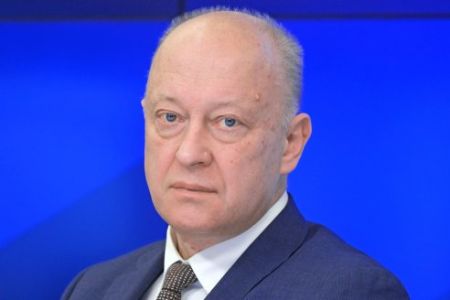
ArmInfo. Moscow's position on the Trump Route Project (TRIPP) will largely depend on the direction of Russian-American relations, Russian political scientist Andrei Kortunov stated in an interview with CivilNet.
That is, as the expert clarified, Russia's reaction to American initiatives will be positive if dialogue with US President Donald Trump leads to practical results, and the United States, at least through the Trump administration, is perceived as a strategic partner. "If these relations collapse, for example, if there is no progress in resolving the Russian-Ukrainian conflict through American mediation, and at the same time the scope and breadth of sanctions increase, then we will simply slide back into our usual rut, where everything America proposes is bad because it's proposed by America," Kortunov explained.
The political scientist noted that at the moment, he sees opportunities for Russia to approve this project, and even participate in it. Because, as Kortunov explained, this project is closely linked to other Russian initiatives, in particular the ongoing North-South project. "And it would be good for other countries, particularly Armenia, to be involved in this corridor. But much will depend on how the Russian corporation Russian Railways (RZD) continues to operate in Armenia, and whether it will operate at all." "We know that there have been cases where solutions to such issues were found," the expert noted.
Speaking about whether Armenian-Russian relations could be irrevocably damaged, the political scientist urged a recollection of what happened with Georgia. "There were more difficulties in those relations, particularly 2008, the war, Abkhazia, and South Ossetia. And of course, this trauma still lingers in Georgian society—resentment toward Russia remains, there are hundreds of thousands of refugees, and negotiations are at a standstill. Nevertheless, we see that even in this rather difficult situation, relations have not completely ceased. You can see Russian relocators and tourists in Tbilisi, trade continues, and Georgia remains a transit country. Of course, there are no diplomatic relations, nor is there a visa regime. And these relations, of course, are not an ideal to strive for.
Therefore, I would really not want something similar to happen to Armenia in a couple of years," the expert noted.
However, at the same time, he expressed conviction that relations between the governments of the two countries, as well as between the peoples of Armenia and Russia, cannot be ruined in a few years, nor can they be restarted. "There are many factors related to history, culture, and personal contacts. There is a huge Armenian diaspora in Russia, and there are many Russian relocated people in Armenia. Therefore, I think we should not write off these relations, or at least we should try to prevent this from happening," the political scientist emphasized.
Regarding the sanctions, Kortunov noted that these are rather symbolic actions. "Since phytosanitary control issues have arisen with many other countries, I can't say this is an effective way to improve relations, but nevertheless, we should not overestimate the significance of such complications," the expert concluded.
As a reminder, on August 8, 2025, Armenian Prime Minister Nikol Pashinyan and Azerbaijani President Ilham Aliyev signed a seven-point joint "Declaration of Peace" in Washington. It provides for a joint appeal to the Organization for Security and Cooperation in Europe (OSCE) to terminate the OSCE Minsk Process and related structures, as well as the creation of a transport corridor through Armenian territory that will connect Azerbaijan with its Nakhichevan exclave, surrounded by Armenia, Turkey, and Iran. And on January 14, 2026, the Armenian Foreign Ministry published the framework document signed with the American side in Washington for the implementation of the "Trump Route for International Peace and Prosperity" (TRIPP). The 12-page document presents the main objectives of the project and the mechanisms for its operation. Among other things, the document emphasizes that Armenia intends to sanction and support the establishment of the TRIPP Development Company. The company is expected to be responsible for the development of the TRIPP project, receiving an initial development right for a period of 49 years. Armenia offered the United States a 74% stake in the TRIPP Development Company, retaining 26%. This partnership is expected to be extended for an additional 50 years, with an additional ownership stake granted to the Armenian government, bringing its stake to 49%.













 Armenian Political Scientist: The approaches, methods, rmphases and content of today’s struggle in Armenia Cannot Remain the Same
 Political scientist: Armenians will live peacefully in their homeland only when they can once again set national goals for themselves, such as Artsakh
 Armenian Historian: People Like Magdalena Grono Should Be Kept Away from the Thresholds of Armenian Shrines
 Azerbaijani studies expert: Armenia’s Foreign Ministry could use the ICC against Aliyev’s Armenophobic statements
 Zakharova: Russia ready to discuss with Armenia the prospects for expanding military cooperation as part of a review of bilateral ties
 Tevanyan: Armenia, like Ukraine and Moldova, is being drawn into the EU’s global war
 Yerevan City Hall is considering introducing a valet parking system in the city
 Expert: The circus surrounding the “Albanization” of Armenian culture in the presence of foreign ambassadors in occupied Artsakh is genocide
 Political scientist: If Russian-Armenian relations are destroyed, Turkey will take Russia`s place
 Political scientist: The Armenian public is simply obliged to significantly change the entire content of public discourse and struggle
 Cross tattoos are being removed from the skin of Christian prisoners in Azerbaijan by fire, according to a human rights activist.
 Zakharova: Armenia`s likely introduction of visas with Russia will be a step against Yerevan itself
 Putin: Armenia`s recognition of Karabakh as part of Azerbaijan in Prague has given Russia`s position on this issue an ambivalent character
 Putin: Armenia`s adoption of the law on EU accession means an announcement of its withdrawal from the Eurasian Economic Union
 Medvedev: Yerevan will never become an EU member, but it will permanently damage relations with the Eurasian Economic Union, including with Moscow.
 Aram Vardevanyan: Public demands solutions, not apology scandals in Parliament
 Arrested Armenian oligarch on economy and new jobs
  "In Baku, we gave a worthy rebuff to the false claims regarding the past and present of our people" – Former Artsakh Parliament Speaker from Baku captivity