

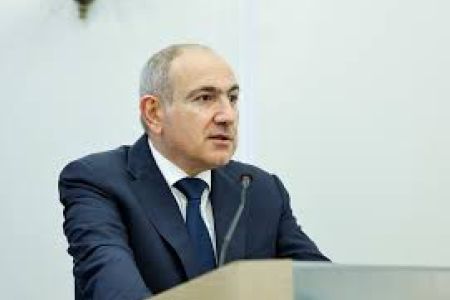
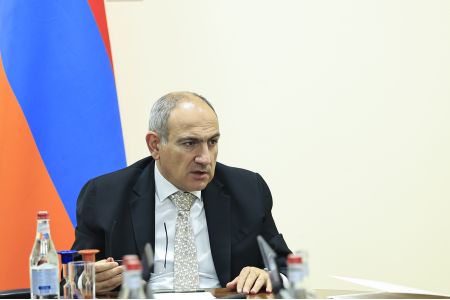
ArmInfo. The peace between Armenia and Azerbaijan, established on August 8, 2025, with the support and personal involvement of US President Donald Trump, has opened up new opportunities for the South Caucasus region. This was stated by RA Prime Minister Nikol Pashinyan, speaking from the UN podium.
"In this regard, I would first like to address what President Trump said from this podium two days ago. I said and I repeat now that a breakthrough in establishing peace between Armenia and Azerbaijan would simply be impossible without President Trump's personal involvement and his steadfast commitment to peace. President Trump's personal presence also has practical and symbolic expression on the ground." The fourth paragraph of the Declaration of Peace adopted at the White House Peace Summit on August 8, 2025, states: "The Republic of Armenia will cooperate with the United States of America and mutually agreed third parties to define a framework for the implementation of the Trump Pathway to International Peace and Prosperity (TRIPP) communications program in the territory of the Republic of Armenia. We reaffirm our determination to take all necessary measures in good faith to achieve this goal as soon as possible." Thus, the implementation of the TRIPPP project is becoming a reality with tangible steps. The Framework Agreement on Strategic Cooperation on the Trump Pathway to International Peace and Prosperity signed between Armenia and the United States of America will soon be ratified by the National Assembly of the Republic of Armenia. We are currently working with the United States Government to establish the TRIPP Development Company and sign a shareholder agreement. Thus, Armenia will initially own a 26 percent stake in the TRIPP Development Company, and the United States will own 74 percent. The agreement stipulates that, if extended, the Republic of Armenia's share will increase to 49 percent in 2050 without additional investments," the Prime Minister noted, as quoted by the government press service. Pashinyan emphasized that one of the practical manifestations of the TRIPP project will be the implementation of paragraph 3 of the Declaration of Peace, adopted by the President of Azerbaijan and the Prime Minister of the Republic of Armenia on August 8, 2025, and signed by the President of the United States as a witness. Paragraph 3 of the Declaration states: "We reaffirm the importance of opening communications between the two countries (Armenia and Azerbaijan) for domestic, bilateral, and international transportation, based on respect for the sovereignty, territorial integrity, and jurisdiction of each state, in order to promote peace, stability, and prosperity in the region." These efforts will include unimpeded communication between the mainland of the Republic of Azerbaijan and the Nakhchivan Autonomous Republic through the territory of the Republic of Armenia, with mutual benefit for the Republic of Armenia in terms of international and domestic communications."
"The implementation of the TRIPP project will be of historic significance for the Republic of Armenia. For the first time since the early 1990s, Armenia will have a railway connection with Azerbaijan, and consequently with Russia, Central Asia, and China. However, it should be emphasized that following the peace summit on August 8, 2025, Azerbaijan opened its railway to Armenia, and we now have a railway connection with Azerbaijan through Georgia." The implementation of the TRIPP project will create a direct rail link between Armenia and Azerbaijan, as well as a rail link from Azerbaijan to Azerbaijan through Armenia, and from Armenia to Armenia through Azerbaijan. Armenia lacks a rail link between its northern and southern regions, and this is practically only possible through the territory of the Nakhchivan Autonomous Republic of Azerbaijan. Azerbaijan lacks a rail link with the Nakhchivan Autonomous Republic, and this is practically only possible through Armenia. In the near future, we will restore the Meghri and Yeraskh railway sections in the Republic of Armenia, which existed during the Soviet era and were subsequently destroyed, and we will reopen these railway links. This will also have enormous international significance, as we anticipate the opening of the Armenia-Turkey railway in parallel with the construction of these railways. Together with the TRIPP project, this could become one of the most important developments in international logistics in recent decades, as it will open a new rail link between China, Central Asia, Turkey, and the European Union. This all marks another turning point for international logistics, as the restoration of rail service between Armenia and the Nakhchivan Autonomous Republic of Azerbaijan also restores rail service between the Persian Gulf and the Black Sea. This is an important nuance, as it shows why and how this is happening," the Armenian head of state said.
Continuing on this topic, Nikol Pashinyan noted that after nearly 35 years of conflict, the construction of pipelines, power lines, and roads from east to west is currently being discussed within the framework of the TRIPP project, in addition to the railway, and this will allow not only the Republic of Armenia, but the entire South Caucasus to become a crossroads of peace. "All of this reflects the optimism that has prevailed in our region and in the Republic of Armenia since the Washington Peace Summit on August 8, 2025. The citizens of Armenia confirmed their optimism in the parliamentary elections held on June 7 of this year, where the overwhelming majority of voters voted for the slogan "Be the Master of the World," giving the Civil Contract Party the opportunity to form a parliamentary majority. The elections were held in an environment of targeted external information manipulation, and a number of external and internal forces developed and implemented a plan for state capture, using mass disinformation, hybrid and other tools, as well as the distribution of massive electoral bribes. However, the democratic and institutional reforms we have carried out in recent years have proven themselves, and Armenia's state institutions have demonstrated high resilience, preventing state capture and giving the people of Armenia the opportunity to express their opinion. The people of Armenia have come out in favor of peace, and we must consistently work to further strengthen and institutionalize peace. The issue of the fate of several thousand missing persons, on which we have reached a cooperation agreement with Azerbaijan, must be resolved in relations between Armenia and Azerbaijan. Armenia is ready to continue and deepen cooperation with Azerbaijan on mine clearance. And, of course, the Republic of Armenia awaits the return of Armenians imprisoned in Azerbaijan as a result of the conflict. While these issues remain unresolved, another factor fueling pessimism is the periodic use of contradictory rhetoric in certain circles in Armenia and Azerbaijan, sometimes at the official level. I believe that we, that is, Armenia and Azerbaijan, have achieved more than sufficient results, which should be more valuable to us than the use of conflictual discourses, be it history, historical and cultural monuments, or anything else. Concern for peace, its strengthening, and institutionalization should become the main topic of cooperation between Armenia and Azerbaijan. For two and a half years now, there have been no casualties or injuries as a result of exchanges of fire between Armenia and Azerbaijan, and this, I believe, is the greatest asset created by cooperation in recent years. Never before have we experienced such a period in the relations between independent Armenia and independent Azerbaijan, although Armenians and Azerbaijanis have centuries-long experience of peaceful coexistence. However, our task is not to restore this historical experience, but to build interstate relations based on this national experience, based on respect for each other's territorial integrity, sovereignty, and political independence. Incidentally, this is precisely what Armenia and Azerbaijan have already agreed on and signed the Agreement on the Establishment of Peace and Interstate Relations between the Two Countries. "The signing and ratification of this agreement, signed at the Washington Peace Summit, is the next important item on the joint agenda of Armenia and Azerbaijan, and we will consistently continue working in this direction," the RA Prime Minister emphasized.
He also noted that Armenia's balanced foreign policy is based on the logic of multipolarity, which is one of the key principles of the United Nations. In recent years, strategic relations have been established with Georgia, France, China, the Netherlands, Kazakhstan, Germany, Luxembourg, the United Kingdom, Bulgaria, Croatia, Lithuania, the United States, and the European Union. Incidentally, today the European Commission approved the decision to introduce autonomous trade measures for Armenia, which forms the basis for the development of Armenia-EU relations.
Nikol Pashinyan also touched upon the topic of Armenian-Russian relations. According to him, now that peace has been established with Azerbaijan, Armenian-Russian relations will naturally change, and Yerevan wants these relations to develop based on the principles of friendship and mutual respect. We will, of course, continue to develop relations with our partners who are more or less distant from Armenia, and in this regard, I would like to especially note the countries of Central Asia, with which our relations are also very dynamic. But I cannot help but emphasize that the normalization and deepening of relations with our neighbors, nevertheless, are of key importance for our foreign policy ideas. I have already spoken about the dynamics of our relations with Azerbaijan. We are conducting a high-level dialogue with Turkey, and I want to reiterate what President Erdogan said from this podium the other day that we are decisively advancing the process of normalizing relations between Armenia and Turkey. Our relations with our two other neighbors, the Islamic Republic of Iran and Georgia, remain of exceptional importance to us, and our good-neighborly relations continue to develop and deepen. The Republic of Armenia considers its contribution to the stability and development of the region its key contribution to international peace, stability and development,” the Prime Minister of the Republic of Armenia concluded his speech, inviting the participants of the meeting to the 17th Conference of the Parties to the Convention on Biological Diversity.





















 Armenian Political Scientist: The approaches, methods, rmphases and content of today’s struggle in Armenia Cannot Remain the Same
 Political scientist: Armenians will live peacefully in their homeland only when they can once again set national goals for themselves, such as Artsakh
 Armenian Historian: People Like Magdalena Grono Should Be Kept Away from the Thresholds of Armenian Shrines
 Azerbaijani studies expert: Armenia’s Foreign Ministry could use the ICC against Aliyev’s Armenophobic statements
 Zakharova: Russia ready to discuss with Armenia the prospects for expanding military cooperation as part of a review of bilateral ties
 Tevanyan: Armenia, like Ukraine and Moldova, is being drawn into the EU’s global war
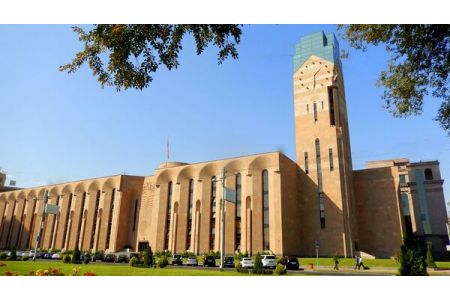 Yerevan City Hall is considering introducing a valet parking system in the city
 Expert: The circus surrounding the “Albanization” of Armenian culture in the presence of foreign ambassadors in occupied Artsakh is genocide
 Political scientist: If Russian-Armenian relations are destroyed, Turkey will take Russia`s place
 Political scientist: The Armenian public is simply obliged to significantly change the entire content of public discourse and struggle
 Cross tattoos are being removed from the skin of Christian prisoners in Azerbaijan by fire, according to a human rights activist.
 Zakharova: Armenia`s likely introduction of visas with Russia will be a step against Yerevan itself
 Putin: Armenia`s recognition of Karabakh as part of Azerbaijan in Prague has given Russia`s position on this issue an ambivalent character
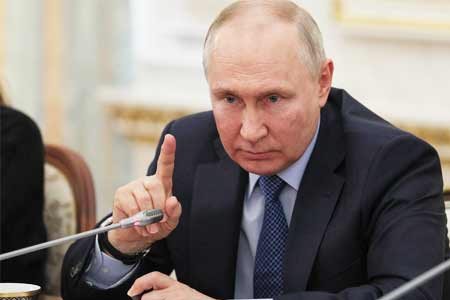 Putin: Armenia`s adoption of the law on EU accession means an announcement of its withdrawal from the Eurasian Economic Union
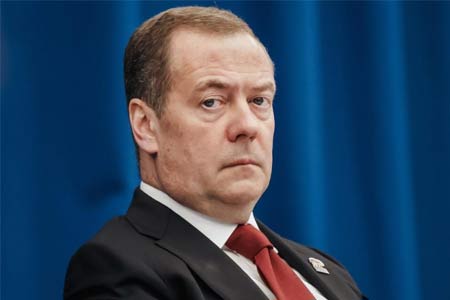 Medvedev: Yerevan will never become an EU member, but it will permanently damage relations with the Eurasian Economic Union, including with Moscow.
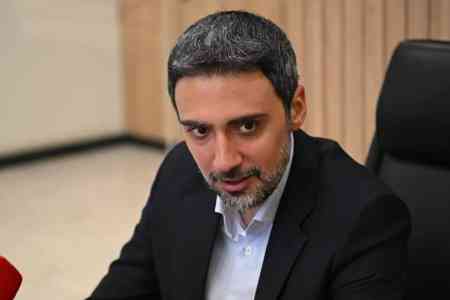 Aram Vardevanyan: Public demands solutions, not apology scandals in Parliament
 Arrested Armenian oligarch on economy and new jobs
  "In Baku, we gave a worthy rebuff to the false claims regarding the past and present of our people" – Former Artsakh Parliament Speaker from Baku captivity