
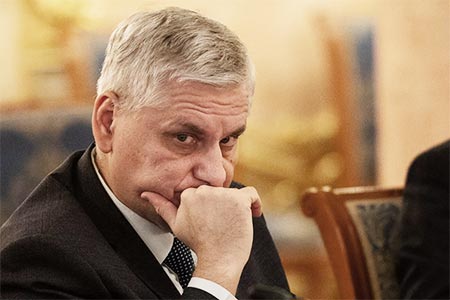
ArmInfo. In the post-election period, the Armenian government continues to flesh out what it defines as the "diversification" of international contacts. Old patterns of allied cooperation have been shelved, and new ones are being implemented before our eyes. Sergey Markedonov, a leading senior researcher at the MGIMO Institute of International Relations, writes about this in his Telegram channel, "Don Cossack."
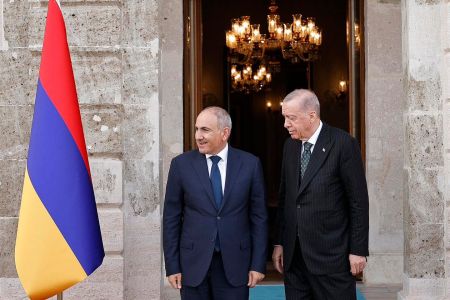
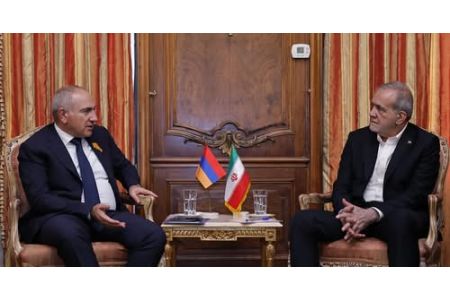
In this context, he drew attention to two meetings between Nikol Pashinyan on the sidelines of the 81st session of the UN General Assembly in New York: with Turkish President Recep Tayyip Erdogan on September 23 and with Iranian President Masoud Pezeshkian on September 24, 2026. "These two events clearly highlight the two different lines of Armenia's foreign policy in its 'near abroad.'" The key here isn't protocol or adherence to politically correct phrases, but rather the substantive aspect. Let's first note a certain asymmetry in the negotiating agenda. During Pashinyan's meeting with Erdogan, the TRIPP/"Trump Route" was directly linked to the unblocking of communications and Armenian-Turkish normalization. In the Armenian prime minister's talks with Pezeshkian, things appear much more cautious. Trade, economic cooperation, peace, and stability—TRIPP wasn't specifically mentioned. Recently, Iran's Ambassador to Yerevan, Khalil Shirgolami, outlined Iran's "red lines." In New York, the parties decided "not to escalate." The two sideline meetings reveal different geoeconomic directions. In the Turkish track, the Armenia-Turkey-Azerbaijan axis and broader East-West communications are becoming central. On the Iranian track, the discussion focuses on movement along the Armenia-Iran line and north-south communications (Persian Gulf-Black Sea). The only thing left is how to reconcile all this? Pashinyan has announced the concept of a "balanced and equilibrating" foreign policy. Perhaps, if Yerevan had the resources and capabilities of Washington or Beijing, it would make sense to discuss balancing algorithms. But without them, Armenia will be required to "be clear." And not only with Moscow's characteristic directness, but with characteristic Persian subtle hints about "thick circumstances," Markedonov noted.
Be that as it may, the expert continued, the Armenian government prefers to "stick to its guns." Pashinyan needed two meetings in New York to show that Turkey is not against Iran, just as Iran is not against Turkey. With Ankara, Yerevan is trying to create something that has practically not existed for decades. With Tehran, the task is the opposite: Maintain and expand existing ties, while simultaneously reassuring the partner that the new transport architecture in the South Caucasus does not undermine the Armenian-Iranian border and established routes.
"The most telling indicators, however, are not new statements by leaders per se, but practical steps. Will the Armenian-Turkish border actually open? When will the Kars-Gyumri railway begin operating? How will TRIPP be implemented? And what public position will Tehran take on its specific parameters? Politically, Iran is currently making the prospects of the 'Trump Route' contingent on the specific conditions of its implementation. The answers to these questions will determine whether Yerevan will be able to reconcile breakthroughs in the Turkish direction with relations with Iran. The EU-EAEU pairing isn't working out so well yet!" concluded Sergey Markedonov.






 Armenian Political Scientist: The approaches, methods, rmphases and content of today’s struggle in Armenia Cannot Remain the Same
 Political scientist: Armenians will live peacefully in their homeland only when they can once again set national goals for themselves, such as Artsakh
 Armenian Historian: People Like Magdalena Grono Should Be Kept Away from the Thresholds of Armenian Shrines
 Azerbaijani studies expert: Armenia’s Foreign Ministry could use the ICC against Aliyev’s Armenophobic statements
 An Armenian political analyst exposed Hajiyev’s lies and attempts to mislead diplomats accredited in Azerbaijan in occupied Artsakh
 Russian Security Council: In Armenia, they want to force Russian asset owners to dispose of their assets
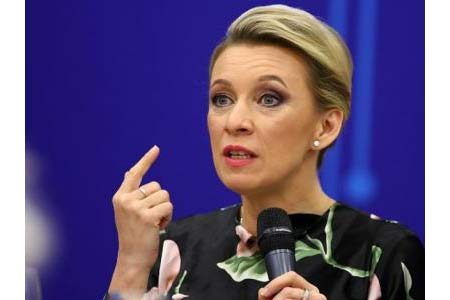 Zakharova: Russia ready to discuss with Armenia the prospects for expanding military cooperation as part of a review of bilateral ties
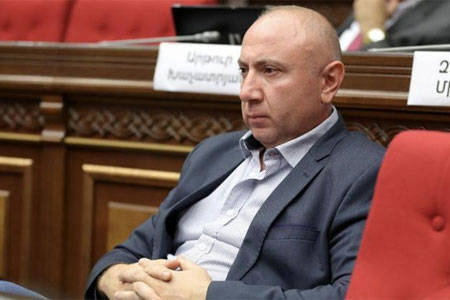 Tevanyan: Armenia, like Ukraine and Moldova, is being drawn into the EU’s global war
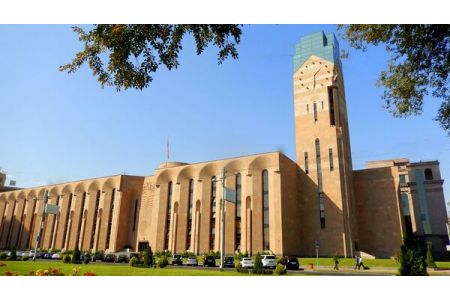 Yerevan City Hall is considering introducing a valet parking system in the city
 Expert: The circus surrounding the “Albanization” of Armenian culture in the presence of foreign ambassadors in occupied Artsakh is genocide
 Political scientist: If Russian-Armenian relations are destroyed, Turkey will take Russia`s place
 Political scientist: The Armenian public is simply obliged to significantly change the entire content of public discourse and struggle
 Cross tattoos are being removed from the skin of Christian prisoners in Azerbaijan by fire, according to a human rights activist.
 Zakharova: Armenia`s likely introduction of visas with Russia will be a step against Yerevan itself
 Putin: Armenia`s recognition of Karabakh as part of Azerbaijan in Prague has given Russia`s position on this issue an ambivalent character
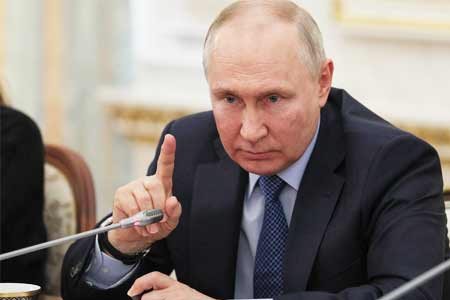 Putin: Armenia`s adoption of the law on EU accession means an announcement of its withdrawal from the Eurasian Economic Union
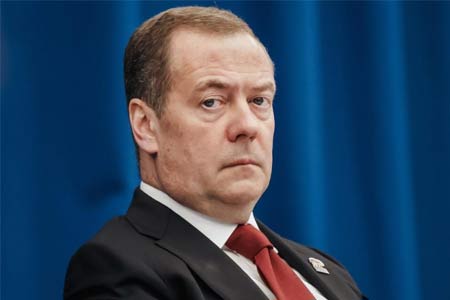 Medvedev: Yerevan will never become an EU member, but it will permanently damage relations with the Eurasian Economic Union, including with Moscow.
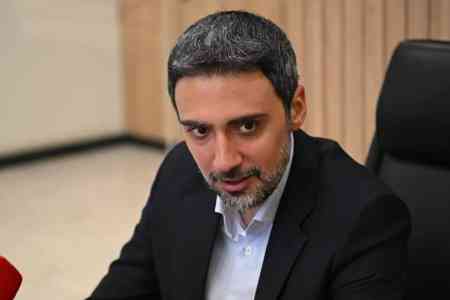 Aram Vardevanyan: Public demands solutions, not apology scandals in Parliament
 Arrested Armenian oligarch on economy and new jobs
  "In Baku, we gave a worthy rebuff to the false claims regarding the past and present of our people" – Former Artsakh Parliament Speaker from Baku captivity