

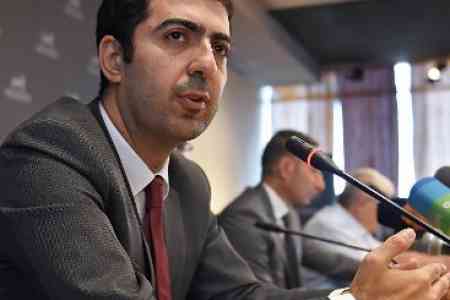
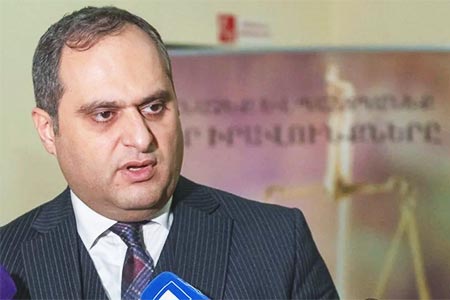
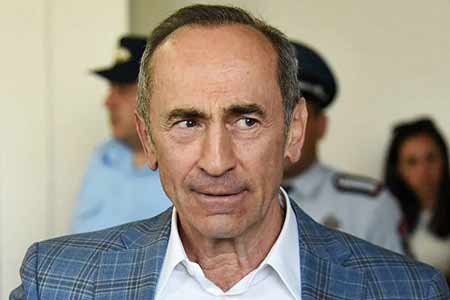
ArmInfo. The arrest of Armenia’s second president, Robert Kocharyan, is linked to an attempt to obstruct his political activities amid the threats facing the country. Lawyer Aram Orbelyan stated this on September 18 outside the Anti-Corruption Court, where a hearing in the case of Armenia’s second president is being held.
According to him, there are a number of serious problems in the case, mainly of a technical nature, which the defense is currently addressing. "However, the most serious problem is the attempt to obstruct the political activities of Armenia’s second president. Meetings with representatives of his political force are currently restricted. At the same time, the defense proceeds from the fact that Kocharyan should have the opportunity to communicate with lawmakers and discuss domestic and foreign policy issues, especially in view of the threats facing the country today," Orbelyan noted.
He recalled that the defense had appealed the decision to arrest Armenia’s second president. As Orbelyan noted, the charge brought against Kocharyan has no connection to the elements of a crime. "Kocharyan is being held accountable for ratifying a government decision in accordance with the Constitution of Armenia while exercising his constitutional powers. In other words, Kocharyan had no possibility of not ratifying the relevant decisions. Overall, within the framework of this case, we are facing a large number of manipulations," the lawyer remarked.
Orbelyan also said that the case is being considered by several international bodies. "One of the avenues to which the defense also intends to turn is the European Court of Human Rights (ECHR). At the same time, an obligatory requirement for applying to the ECHR is to exhaust domestic remedies. As for international political and legal bodies, in particular the Parliamentary Assembly of the Council of Europe (PACE), active work will be carried out in this direction. Similar work will also be conducted with various international human rights organizations. In the case, we clearly see that significant public resources are being used, as well as extralegal instruments, since it is obvious that they are unable to achieve a result through legal means," the lawyer concluded.
It should be recalled that the Prosecutor General’s Office of Armenia accuses Robert Kocharyan of involvement in the events of March 1, 2008 (mass riots and clashes between protesters and the police - ed.). In addition to Robert Kocharyan, former Defense Minister Seyran Oganian, former CSTO Secretary General Yuri Khachaturov and former Deputy Prime Minister Armen Gevorgyan are also defendants. Earlier, the Constitutional Court declared unconstitutional the provision of the Criminal Code under which the defendants were being prosecuted. The first two judicial instances terminated the criminal prosecution against the defendants, while the Court of Cassation referred the case to the Anti-Corruption Court for retrial, arguing that the provisions of the Criminal Code had been interpreted incorrectly and that, given the large number of victims, those responsible should be punished.
It should be added that on August 25, Robert Kocharyan was charged with the laundering of funds on an especially large scale, abuse of official position and accepting a large bribe. Charges were also brought against 9 other individuals as part of the case. On August 27, Kocharyan was arrested for two months by a decision of the Anti-Corruption Court. At the same time, the political force of Armenia’s second president links his arrest to an attempt to neutralize one of the main opposition figures amid the Armenian authorities’ readiness to make new concessions to Azerbaijan.















 Armenian Historian: People Like Magdalena Grono Should Be Kept Away from the Thresholds of Armenian Shrines
 Azerbaijani studies expert: Armenia’s Foreign Ministry could use the ICC against Aliyev’s Armenophobic statements
 An Armenian political analyst exposed Hajiyev’s lies and attempts to mislead diplomats accredited in Azerbaijan in occupied Artsakh
 Expert: The circus surrounding the “Albanization” of Armenian culture in the presence of foreign ambassadors in occupied Artsakh is genocide
 Zakharova: Russia ready to discuss with Armenia the prospects for expanding military cooperation as part of a review of bilateral ties
 Tevanyan: Armenia, like Ukraine and Moldova, is being drawn into the EU’s global war
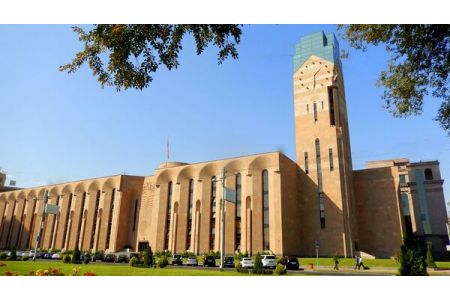 Yerevan City Hall is considering introducing a valet parking system in the city
 Political scientist: If Russian-Armenian relations are destroyed, Turkey will take Russia`s place
 Political scientist: The Armenian public is simply obliged to significantly change the entire content of public discourse and struggle
 Cross tattoos are being removed from the skin of Christian prisoners in Azerbaijan by fire, according to a human rights activist.
 Zakharova: Armenia`s likely introduction of visas with Russia will be a step against Yerevan itself
 Putin: Armenia`s recognition of Karabakh as part of Azerbaijan in Prague has given Russia`s position on this issue an ambivalent character
 Putin: Armenia`s adoption of the law on EU accession means an announcement of its withdrawal from the Eurasian Economic Union
 Medvedev: Yerevan will never become an EU member, but it will permanently damage relations with the Eurasian Economic Union, including with Moscow.
 Aram Vardevanyan: Public demands solutions, not apology scandals in Parliament
 Arrested Armenian oligarch on economy and new jobs
  "In Baku, we gave a worthy rebuff to the false claims regarding the past and present of our people" – Former Artsakh Parliament Speaker from Baku captivity