

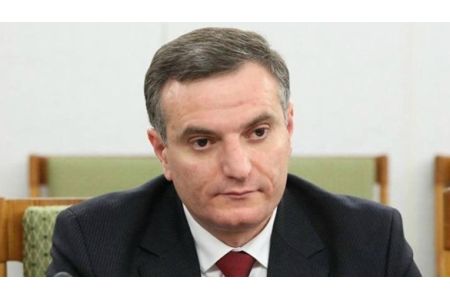
ArmInfo. If today the "victory" over Artsakh is considered the pride of the entire Turkic world, then tomorrow this world may strive for greater "pride and victories." Artak Zakaryan, a member of the board of the Republican Party, writes about this in his article.
Yesterday, in Ankara, in front of the Shushi center at the Azerbaijani embassy, a third monument dedicated to the Caucasian Islamic Army was unveiled. The first two are located in Baku and Gandzak. The Caucasian Islamic Army (under the command of Nuri Pasha) was formed in Ottoman Turkey, which captured Baku on September 15, 1918, and massacred the city's Christian and Jewish population. In Baku alone, this army robbed and killed approximately 30,000 Armenians (according to Oxford scholarly sources). Of course, the unveiling of such monuments has a clear historical and political significance and purpose. When a monument dedicated to the Caucasian Islamic Army is erected in Turkey, it is perceived as a tribute to the Turkish soldiers who captured Baku in 1918 and as a symbol of the Turkish-Azerbaijani military alliance. This is a clear signal to the Middle East and its neighbors. And from the perspective of our Armenians, it is perceived as a glorification of the army that committed massacres against the Armenian population of Baku 108 years ago. In his speech at the unveiling of the monument in Ankara, the Turkish Minister of Defense said: "Today, the Azerbaijani flag flies freely in Shusha, Khankendi, and throughout Karabakh. This victory is a source of immense pride not only for Azerbaijan, but for the entire Turkic world. As Turkey, we supported our Azerbaijani brothers with all our strength and resources at every stage of the Patriotic War and together shared the joy of this glorious victory." As we see, it is perhaps impossible to give a clearer picture of the significance of Pan-Turkism. Turkey directly views the capture of Artsakh as a source of pride for the entire Turkic world. Very soon, the TRIP and other similar projects will also be considered a shared achievement of the Turkic world. Obviously, all this is not just for Armenia," the politician noted. He added that the consistent Turkification of regional policy would logically conflict with the interests of many countries. "But is all this acceptable from the perspective of the medium- and long-term interests of Russia, Iran, India, Greece, Cyprus, Israel, Georgia, Armenia, and even China?" If today "victory" over Artsakh is considered the pride of the entire Turkic world, then tomorrow this world may strive for greater "pride and victories." Is there a guarantee that, for example, the absorption of the Republic of Armenia, aggression against the State of Israel, the dismemberment of the Islamic Republic of Iran, territorial encroachment on Greece and Cyprus, the collapse of the Russian Federation, and other similar hypothetical situations will no longer be considered a joint achievement of the Turkic world? Why do I formulate my concerns this way? Because five or six years ago, no one in the world could imagine that Artsakh could be completely depopulated. No one could believe that Russia and Ukraine could enter into a protracted war, etc.: Today, the biggest problem is the instability of the geopolitical situation, as well as the presence of hidden threats and dangerous ambitions," concluded Artak Zakaryan.















 Armenian Historian: People Like Magdalena Grono Should Be Kept Away from the Thresholds of Armenian Shrines
 Azerbaijani studies expert: Armenia’s Foreign Ministry could use the ICC against Aliyev’s Armenophobic statements
 An Armenian political analyst exposed Hajiyev’s lies and attempts to mislead diplomats accredited in Azerbaijan in occupied Artsakh
 Expert: The circus surrounding the “Albanization” of Armenian culture in the presence of foreign ambassadors in occupied Artsakh is genocide
 Zakharova: Russia ready to discuss with Armenia the prospects for expanding military cooperation as part of a review of bilateral ties
 Tevanyan: Armenia, like Ukraine and Moldova, is being drawn into the EU’s global war
 Yerevan City Hall is considering introducing a valet parking system in the city
 Political scientist: If Russian-Armenian relations are destroyed, Turkey will take Russia`s place
 Political scientist: The Armenian public is simply obliged to significantly change the entire content of public discourse and struggle
 Cross tattoos are being removed from the skin of Christian prisoners in Azerbaijan by fire, according to a human rights activist.
 Zakharova: Armenia`s likely introduction of visas with Russia will be a step against Yerevan itself
 Putin: Armenia`s recognition of Karabakh as part of Azerbaijan in Prague has given Russia`s position on this issue an ambivalent character
 Putin: Armenia`s adoption of the law on EU accession means an announcement of its withdrawal from the Eurasian Economic Union
 Medvedev: Yerevan will never become an EU member, but it will permanently damage relations with the Eurasian Economic Union, including with Moscow.
 Aram Vardevanyan: Public demands solutions, not apology scandals in Parliament
 Arrested Armenian oligarch on economy and new jobs
  "In Baku, we gave a worthy rebuff to the false claims regarding the past and present of our people" – Former Artsakh Parliament Speaker from Baku captivity
  NA Vice Speaker candidate believes his wife`s salary as director of HayPost is the lowest in the company`s history
