
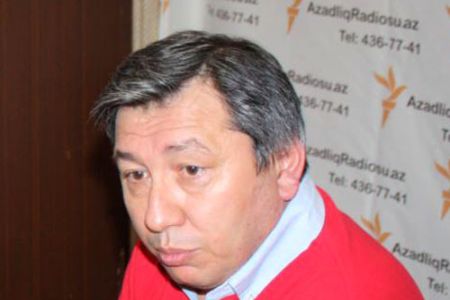
ArmInfo. Researcher at the Baku Scientific Research Institute Altay Goyushov reacted to a post by the EU Special Representative for the South Caucasus Magdalena Grono regarding her visit to the occupied territories of Artsakh.
Thus, in her Twitter (X) account, the European official posted about her visit to occupied Artsakh, using not the internationally accepted names of this territory, but exclusively toponyms invented by Azerbaijan. In particular, she wrote: "On September 11-12, I participated for the first time in a trip organized by the Azerbaijani authorities for the diplomatic corps to the conflict-affected areas of Karabakh and Eastern Zangezur, in order to familiarize myself with the situation on the ground."
An Azerbaijani historian, sharing Grono's post, wrote that no one in the history of Azerbaijan had called this part of the country "Eastern Zangezur."
"Aliyev introduced this term into circulation immediately after the 2020 war. This alone demonstrated how hollow his rhetoric about peace was: if there is an "Eastern Zangezur," then, logically, there must also be a "Western Zangezur"—and we all understand perfectly well which territory is meant by that.
Azerbaijani history textbooks also claim that the whole of Zangezur (i.e. Armenian Syunik—Ed.) is sacred Azerbaijani land. European diplomats are not so uninformed as to be unaware of this context. And yet they continue to encourage and reproduce this rhetoric," Goyushov noted.
In this regard, the expert wondered how, after this, one could believe that such a Europe truly wants peace in the South Caucasus.
"In this respect, I see little difference between the Russian and European approaches to the region: the same principle of "divide and rule," the same cultivation of enmity, and the same imperial logic. This does not mean that by supporting Aliyev's rhetoric today, Europeans necessarily "take Azerbaijan's side." Today they may support Aliyev's irredentist rhetoric, and tomorrow—with the same enthusiasm—take the directly opposite position. But in any case, it will be local residents who suffer. And sometimes it seems that their suffering is perceived as an acceptable price for the interests, development, and prosperity of those who call themselves the "civilized world," the expert added.
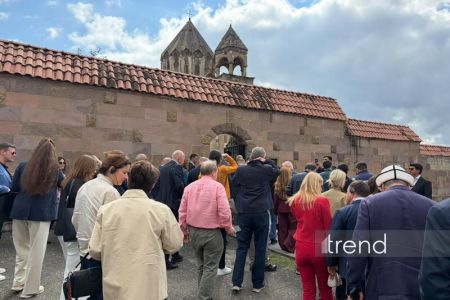
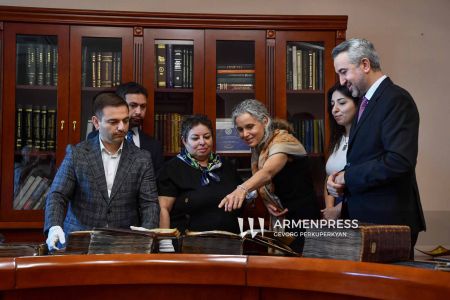
It should be noted that at the end of last week it became known that representatives of the foreign diplomatic corps accredited in Baku had visited occupied Artsakh. They visited Shushi and Stepanakert, where the Azerbaijani occupation regime is erasing all Armenian presence with the silent encouragement of the so-called civilized international community. They then visited the Armenian monasteries of Dadivank and Gandzasar and listened with admiration to the tales told by Azerbaijani presidential aide Hikmet Hajiyev that these were supposedly Albanian holy sites. Among the participants was also the EU Special Representative for the South Caucasus, Magdalena Grono, who also witnessed the show put on by Azerbaijani presidential aide Hikmet Hajiyev. The latter, in particular, attempted to accuse Armenia of falsifying history, choosing as his instrument models of ancient manuscripts displayed at the museum of occupied Gandzasar.








 An Armenian political analyst exposed Hajiyev’s lies and attempts to mislead diplomats accredited in Azerbaijan in occupied Artsakh
 Expert: The circus surrounding the “Albanization” of Armenian culture in the presence of foreign ambassadors in occupied Artsakh is genocide
 An Armenian historian harshly criticized the visit of Western coalition diplomats to occupied Artsakh
 Armenian expert: TRIPP and European integration are incompatible
 Azerbaijani studies expert : Ruben Vardanyan’s wife threatened with arrest if she visits Baku
 Political scientist: If Russian-Armenian relations are destroyed, Turkey will take Russia`s place
 Political scientist: The Armenian public is simply obliged to significantly change the entire content of public discourse and struggle
 Cross tattoos are being removed from the skin of Christian prisoners in Azerbaijan by fire, according to a human rights activist.
 Zakharova: Armenia`s likely introduction of visas with Russia will be a step against Yerevan itself
 Putin: Armenia`s recognition of Karabakh as part of Azerbaijan in Prague has given Russia`s position on this issue an ambivalent character
 Putin: Armenia`s adoption of the law on EU accession means an announcement of its withdrawal from the Eurasian Economic Union
 Medvedev: Yerevan will never become an EU member, but it will permanently damage relations with the Eurasian Economic Union, including with Moscow.
 Aram Vardevanyan: Public demands solutions, not apology scandals in Parliament
 Arrested Armenian oligarch on economy and new jobs
  "In Baku, we gave a worthy rebuff to the false claims regarding the past and present of our people" – Former Artsakh Parliament Speaker from Baku captivity
  NA Vice Speaker candidate believes his wife`s salary as director of HayPost is the lowest in the company`s history
 RF Permanent Representative: There is no CSTO-Armenia conflict
 Moscow: NATO seeking to "Pull" Armenia away from CSTO Allies
  Political analyst: Russia intends to determine which "Camp" Armenia will choose through a referendum
 Narek Karapetyan will give up his parliamentary salary in favor of charitable contributions.