

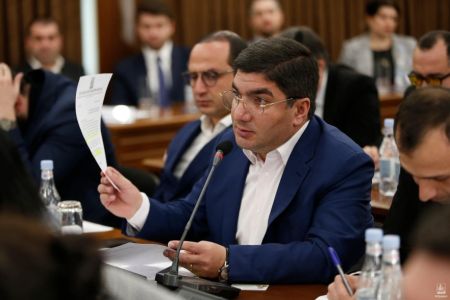
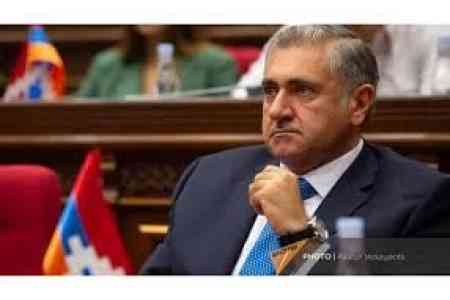
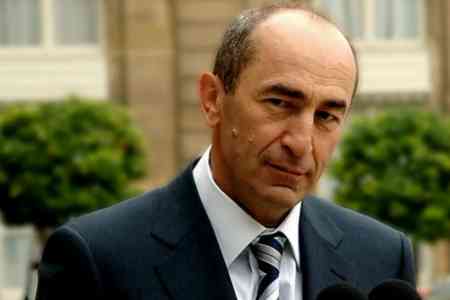
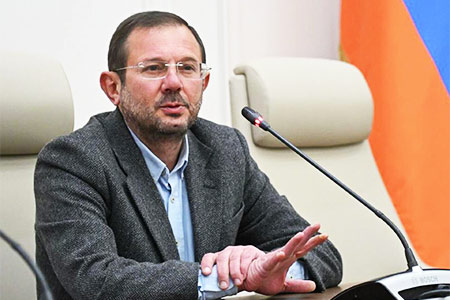
Arminfo. The persecution of Armenia’s second president, Robert Kocharyan, is обусловлено by the serious challenges facing the country. This was stated by Mesrop Manukyan, a member of the “Armenia” parliamentary faction, at a press conference in Yerevan on September 14.
He expressed the conviction that Kocharyan was arrested not for corruption, not for “robbery,” and not because of the events of March 1, 2008, but for fulfilling his official duties. In particular, as Manukyan recalled, for signing government decisions that, as president, he could not have refused to sign. “Today, Prime Minister of Armenia Nikol Pashinyan also signs numerous documents and government decisions. And I must be objective. Regardless of my attitude, regardless of what assessment I give to all this, we must ask the question: who should bear responsibility in this case? When there is already a government decision, all that remains for the prime minister is to sign it. No one should put him on trial for that; those who presented and submitted a particular draft for discussion should be held accountable,” the parliamentarian believes.
Taking the above into account, he expressed the conviction that the persecution of Armenia’s second president is connected with the serious challenges facing the country. First and foremost, as the parliamentarian noted, this is the issue of the “enclaves” being promoted by Pashinyan and Azerbaijani President Ilham Aliyev. “Initially, there were no enclaves, nor were there any legal grounds for them, but after some time it suddenly turned out that such an issue did exist. I want to point out that Aliyev always speaks first, and Pashinyan repeats it afterward. There has never been a case where it was the other way around,” Manukyan stressed.
In addition, as the parliamentarian noted, there has not been a single discussion about the fact that the delimitation and demarcation of the border should begin from the southern section, where Armenian territories are occupied. As the opposition figure pointed out, only those territories targeted by Azerbaijan are being discussed. In particular, as the parliamentarian explained, this concerns the Azerbaijani side’s intention to have a presence on two interstate roads of strategic importance to Armenia—in Tigranashen and Kirants.
The parliamentarian named the demands to amend Armenia’s Constitution as another threat. In this case, as Manukyan noted, the demand once again comes from the Azerbaijani side, while the Armenian authorities are making every effort to implement it. “And the most offensive thing about all this is that a representative of another country (Russian President Vladimir Putin—editor’s note) is asking for a referendum to be held, meaning that no leader takes him (Pashinyan—editor’s note) seriously or considers him worth anything. Meanwhile, it is accepted that representatives of other countries should discuss such issues with the head of state. But today Russia is demanding that a referendum be held, and Azerbaijan is demanding the same. This is already absurd,” the opposition figure noted.
According to him, the implementation of the “Trump Route for International Peace and Prosperity” (TRIPP) project could also create new challenges for the country. In this regard, he recalled statements coming from Iran. “We must understand that when implementing such projects, we cannot ignore the position of our neighbors. Moreover, the Russian side also has problems here,” Manukyan concluded.
It should be recalled that on August 25, employees of the National Security Service conducted searches at the apartment of Levon Kocharyan, a member of the opposition “Armenia” faction and the son of second president Robert Kocharyan, as well as at companies affiliated with the Kocharyan family. Robert Kocharyan and Sedrak Kocharyan were then detained and taken to the Anti-Corruption Committee for questioning. However, the condition of Robert Kocharyan, who underwent heart surgery in early August, sharply deteriorated, and he was hospitalized. On the same day, Robert Kocharyan was charged with the particularly large-scale laundering of funds, abuse of official position, and accepting a large bribe. Charges were brought against nine other individuals as part of the case. On August 27, Kocharyan was remanded in custody for two months by a decision of the Anti-Corruption Court.
We should add that the political force of Armenia’s second president links his arrest to an attempt to neutralize one of the opposition’s main representatives amid the Armenian authorities’ readiness to make new concessions to Azerbaijan.


















 Azerbaijani studies expert : Ruben Vardanyan’s wife threatened with arrest if she visits Baku
 Political scientist: If Russian-Armenian relations are destroyed, Turkey will take Russia`s place
 Political scientist: The Armenian public is simply obliged to significantly change the entire content of public discourse and struggle
 Cross tattoos are being removed from the skin of Christian prisoners in Azerbaijan by fire, according to a human rights activist.
 Zakharova: Armenia`s likely introduction of visas with Russia will be a step against Yerevan itself
 Putin: Armenia`s recognition of Karabakh as part of Azerbaijan in Prague has given Russia`s position on this issue an ambivalent character
 Putin: Armenia`s adoption of the law on EU accession means an announcement of its withdrawal from the Eurasian Economic Union
 Medvedev: Yerevan will never become an EU member, but it will permanently damage relations with the Eurasian Economic Union, including with Moscow.
 Aram Vardevanyan: Public demands solutions, not apology scandals in Parliament
 Arrested Armenian oligarch on economy and new jobs
  "In Baku, we gave a worthy rebuff to the false claims regarding the past and present of our people" – Former Artsakh Parliament Speaker from Baku captivity
  NA Vice Speaker candidate believes his wife`s salary as director of HayPost is the lowest in the company`s history
 RF Permanent Representative: There is no CSTO-Armenia conflict
 Moscow: NATO seeking to "Pull" Armenia away from CSTO Allies
  Political analyst: Russia intends to determine which "Camp" Armenia will choose through a referendum
 Narek Karapetyan will give up his parliamentary salary in favor of charitable contributions.