
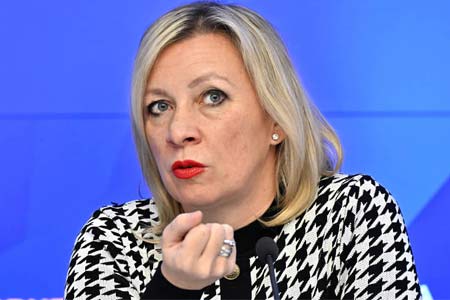
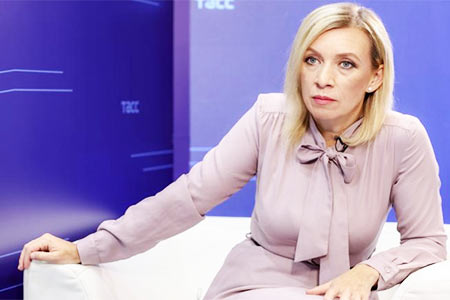
ArmInfo.Yerevan's dual policy toward the EU and the EAEU has neither political nor economic basis and, in principle, cannot be implemented. This was stated by Russian Foreign Ministry spokesperson Maria Zakharova during a briefing on August 27, responding to a question regarding Yerevan's intention to apply for EU membership.
"The question of Armenia's possible accession to the European Union, I believe, simply exposes fundamental contradictions. These are primarily due to the direct incompatibility of the EU and EAEU (Eurasian Economic Union) legal frameworks. At the same time, Yerevan has still not deemed it necessary to coordinate its European integration aspirations with its EAEU partners, demonstratively attempting to simultaneously reap the benefits of Eurasian integration and move toward the European Union," she noted.
Zakharova called the Armenian authorities' tactics downright inappropriate. She noted that the Republic intends to gain the benefits of EU membership without sacrificing its privileges within the EAEU. "And perhaps, if the EU weren't pursuing a completely destructive policy, directly focused on undermining integration, economic, and cooperative ties precisely in the aforementioned space, the EAEU, we could perhaps consider some possibilities. There are no possibilities here because the EU makes no secret of the fact that for it, the EAEU is a target for defeat," the Russian diplomat said.
"This dual course has neither a political nor an economic basis and, in principle, cannot be implemented.
If Armenia chooses to join the EU, it will inevitably have to give up its EAEU preferences. Moreover, after submitting its application for EU membership, Armenia will face profound contradictions within the EAEU, with Armenia bearing the brunt of the blow. Moscow has repeatedly, very clearly, thoroughly, and very patiently warned Yerevan that pursuing European integration will inevitably complicate relations with the EAEU, including with Russia," she said. She cited Turkey, which has been waiting decades for accession approval, as a clear example of Armenia's lack of prospects for EU membership. She added that in Armenia's case, the risks are even greater due to the direct clash of economic regimes.
"Therefore, the conflictual nature of this issue is not situational, but systemic," she concluded.
As a reminder, Armenian Prime Minister Nikol Pashinyan announced from the parliamentary rostrum on August 24 that the country intends to apply for EU membership in the near future. He also expressed his belief that the country should hold a referendum on its membership in the EU or the EAEU only after applying for EU membership and receiving a response.
On January 9, 2025, the Armenian government approved a draft law on the start of the EU accession process, proposed by the "Eurakve" civic initiative. The draft law was submitted to the Armenian parliament for approval. On March 26, the parliament adopted it in its final reading and sent it to the president for signature. The document was signed on April 4 of that year. Moscow stated that Russia had communicated to Armenia that simultaneous membership in the Eurasian Economic Union and the European Union was impossible.








 Expert: The arrest of opposition figures in Armenia for social media posts is a systematic attempt to intimidate the public and suppress dissent.
 Azerbaijani Studies Expert: While Azerbaijan Prepares Its Generation for War, Aliyev’s Aide Calls on Armenia to Prepare Armenian Society for “Peace”
 Turkologist: Azerbaijan will never, under any circumstances, stop pressuring the Armenian people
 Political scientist: We need to move away from the question of "when" and replace it with more important questions
 Lukashenko called for Armenia to assume the CIS presidency in 2029
 Dmitry Medvedev predicted a Ukrainian-like fate for Armenia amid the country`s shift in foreign policy
 Russian Security Council: In Armenia, they want to force Russian asset owners to dispose of their assets
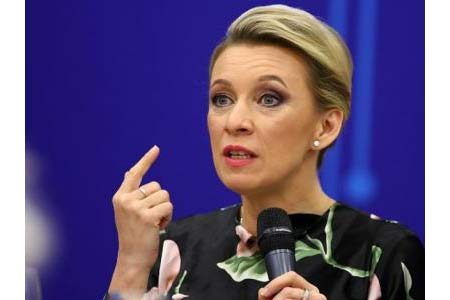 Zakharova: Russia ready to discuss with Armenia the prospects for expanding military cooperation as part of a review of bilateral ties
 Tevanyan: Armenia, like Ukraine and Moldova, is being drawn into the EU’s global war
 Yerevan City Hall is considering introducing a valet parking system in the city
 Expert: The circus surrounding the “Albanization” of Armenian culture in the presence of foreign ambassadors in occupied Artsakh is genocide
 Political scientist: If Russian-Armenian relations are destroyed, Turkey will take Russia`s place
 Political scientist: The Armenian public is simply obliged to significantly change the entire content of public discourse and struggle
 Cross tattoos are being removed from the skin of Christian prisoners in Azerbaijan by fire, according to a human rights activist.
 Zakharova: Armenia`s likely introduction of visas with Russia will be a step against Yerevan itself
 Putin: Armenia`s recognition of Karabakh as part of Azerbaijan in Prague has given Russia`s position on this issue an ambivalent character
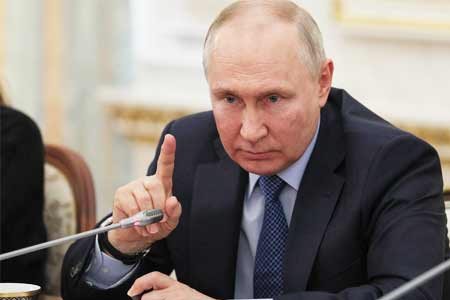 Putin: Armenia`s adoption of the law on EU accession means an announcement of its withdrawal from the Eurasian Economic Union