
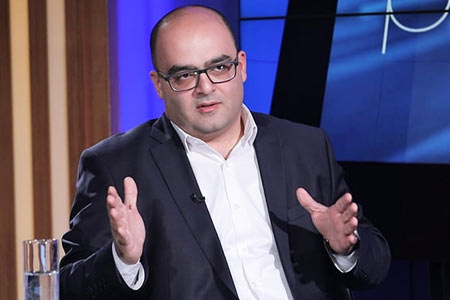
ArmInfo.Today, the key issue on Armenia's political agenda should be the future of Tigranashen. However, as we see, the ongoing discussions around it seem to have been relegated to the background. This is what political scientist Vahe Davtyan writes in his article.
"One could spend a long time calculating how many square kilometers Tigranashen occupies, how many Artsvashen occupies, and ultimately even arrive at a 'positive' territorial balance for Armenia. But geopolitics is not a cadastre. Tigranashen's value lies not in its area, but in its geographic location. By handing over Tigranashen, Armenia is effectively granting Baku sovereign territory at the immediate junction of the Yerevan-Vayots Dzor-Syunik-Iran strategic communications network. About 4.5 kilometers of the M2 interregional highway runs here. In other words, the problem isn't the loss of the village, but the creation of additional vulnerability to its own territorial communications," the political scientist noted, wondering what Armenia would gain in return.
And in return, he said, the republic would gain Artsvashen-a large territory, but surrounded by Azerbaijani territory and cut off from Armenia's main communications system. In other words, a territorial acquisition with very limited functional value in exchange for a communication concession of high strategic value.
"Furthermore, the new configuration does not simplify the Armenian-Azerbaijani border, but rather complicates it. It creates the need for new checkpoints, special regimes, detours, security guarantees, and constant negotiations. And all this in a context where strategic trust between the parties is, to put it mildly, very low. The purpose of border demarcation should be to deconflict borders, not to create new conflict zones. Therefore, the Tigranashen-Artsvashen issue should not be considered according to the simplified formula of "ours is us, yours is you," but from the perspective of geopolitical and geo-economic value. Because 1 kilometer on a map is always 1 kilometer. In geopolitics, never," Vahe Davtyan emphasized.













 Opinion: The development of the Amulsar mine near the resort town of Jermuk is the beginning of an environmental disaster in Armenia
 Expert: The arrest of opposition figures in Armenia for social media posts is a systematic attempt to intimidate the public and suppress dissent.
 Azerbaijani Studies Expert: While Azerbaijan Prepares Its Generation for War, Aliyev’s Aide Calls on Armenia to Prepare Armenian Society for “Peace”
 Turkologist: Azerbaijan will never, under any circumstances, stop pressuring the Armenian people
 Political scientist: We need to move away from the question of "when" and replace it with more important questions
 Lukashenko called for Armenia to assume the CIS presidency in 2029
 Dmitry Medvedev predicted a Ukrainian-like fate for Armenia amid the country`s shift in foreign policy
 Russian Security Council: In Armenia, they want to force Russian asset owners to dispose of their assets
 Zakharova: Russia ready to discuss with Armenia the prospects for expanding military cooperation as part of a review of bilateral ties
 Tevanyan: Armenia, like Ukraine and Moldova, is being drawn into the EU’s global war
 Yerevan City Hall is considering introducing a valet parking system in the city
 Expert: The circus surrounding the “Albanization” of Armenian culture in the presence of foreign ambassadors in occupied Artsakh is genocide
 Political scientist: If Russian-Armenian relations are destroyed, Turkey will take Russia`s place
 Political scientist: The Armenian public is simply obliged to significantly change the entire content of public discourse and struggle
 Cross tattoos are being removed from the skin of Christian prisoners in Azerbaijan by fire, according to a human rights activist.
 Zakharova: Armenia`s likely introduction of visas with Russia will be a step against Yerevan itself
 Putin: Armenia`s recognition of Karabakh as part of Azerbaijan in Prague has given Russia`s position on this issue an ambivalent character
 Putin: Armenia`s adoption of the law on EU accession means an announcement of its withdrawal from the Eurasian Economic Union
 Aram Vardevanyan: Public demands solutions, not apology scandals in Parliament