
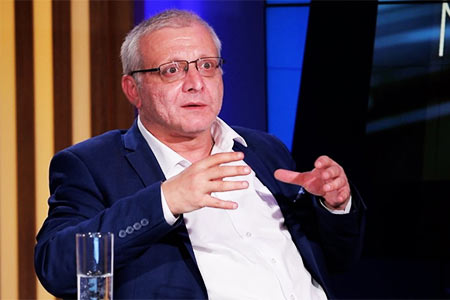
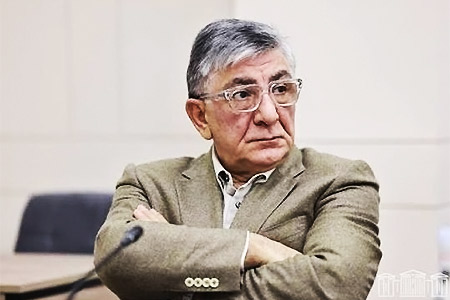
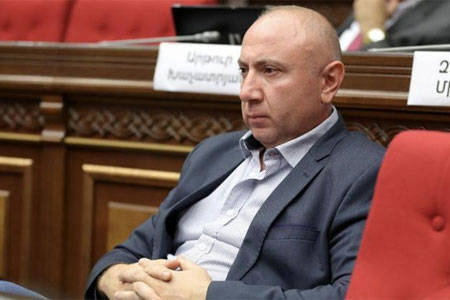
ArmInfo. In a democratic state, an electoral victory grants a political force a mandate to govern the country, rather than the right to transform its own worldview into a state ideology, according to analyst Suren Surenyants.
He recalled statements made by Prime Minister Nikol Pashinyan during a government session on August 20, 2026. While presenting the draft government program for the 2026–2031 term, the Prime Minister stated that the ideology of "Real Armenia" had triumphed in the parliamentary elections, establishing itself as the "official ideology" of the Republic of Armenia.
Surenyants noted that this was followed by another notable declaration: Pashinyan asserted that Armenia is entering a new historical chapter known as the Fourth Republic. According to the Prime Minister, the fundamental distinction lies in the fact that the Third Republic was anchored "on the logic of conflict and confrontation" from its inception, whereas the Fourth Republic is being built on the "logic of peace."
According to the analyst, these formulations signal an attempt to reframe Armenian statehood, historical continuity, and national identity, raising several fundamental concerns.
The primary issue, Surenyants emphasizes, is the very concept of an "official ideology." In a democratic framework, citizens vote for a governing administration, not to relinquish ideological pluralism. Elevating the ruling party's doctrine to the level of state ideology crosses a dangerous line. Under such a premise, the political majority transcends governance and presumes the authority to dictate the "correct" interpretation of Armenia's past, present, and future—a path that risks sliding toward ideological monopoly and authoritarianism.
"The second problem the administration's attempt to characterize the entire historical and political legacy of the Third Republic solely through the "logic of conflict." he Third Republic emerged in the context of the Soviet Union's collapse, the restoration of Armenian independence, and the existential struggle for national self-determination and security. While the Artsakh (Karabakh) movement was a seminal component of this process, the analyst contends that the foundations of the Third Republic extend far beyond that singular movement. We are talking about the history of more than three decades of Armenia's independent statehood. When this entire period is presented as the result of the "logic of conflict," not only the Karabakh movement, but also the political foundations and history of the Third Republic are subject to historical re- evaluation. Moreover, such a formulation comes dangerously close to the narrative of official Baku, according to which responsibility for the outbreak of the Armenian-Azerbaijani conflict and war is unilaterally placed on the Armenian side. The Karabakh movement was not just a manifestation of the abstract idea of "restoring historical justice." It was a struggle for self-determination, security, and later for physical existence, "Self-defense. Placing this story within the 'logic of conflict' means reassessing the foundations of one's own statehood within the political lexicon of the enemy," he noted.
The third problem he identified was the foreign policy consequences of such a reinterpretation. "When the leader of Armenia declares that the previous republic was founded on 'conflict', and the new one is called upon to overcome this legacy, this can be perceived as a willingness to reconsider not only the political assessments of the past, but also the state and legal positions that follow from them. Such an approach expands the political space for the maximalist demands of Azerbaijan and Turkey. If the Armenian side itself delegitimizes its previous state and political concept, the enemy naturally has a question: what next border is Armenia ready to concede? Here the historical shadow of Alexandropol becomes visible. Of course, this is not a mechanical identification of the 1920s and 2026.
However, the historical experience of Alexandropol reminds us of a simple pattern: the consistent belittlement of one's own state positions after defeat does not soften the enemy's demands, but may even push for the emergence of new ones. The Treaty of Alexandropol of 1920 became a symbol of the political reality imposed on the defeated and extremely weakened Armenia. Its historical lesson is that the continuous retreat from one's own rights and state identity The continuation of a historical foundation after defeat does not guarantee peace. The enemy may see this not as the "logic of peace," but as weakness and a willingness to make further concessions. And here, perhaps, the most important question arises: what, ultimately, is the Fourth Republic? A change of republics usually implies a fundamental transformation of the state or constitutional order. However, in the case of Armenia, what legal and political reality has changed so that the Third Republic can be considered complete and the Fourth—a beginning? The Republic of Armenia continues to function within the same framework of state continuity; state institutions are preserved, the international structure remains," Suren Surenyants concluded.

















 Expert: The arrest of opposition figures in Armenia for social media posts is a systematic attempt to intimidate the public and suppress dissent.
 Azerbaijani Studies Expert: While Azerbaijan Prepares Its Generation for War, Aliyev’s Aide Calls on Armenia to Prepare Armenian Society for “Peace”
 Turkologist: Azerbaijan will never, under any circumstances, stop pressuring the Armenian people
 Political scientist: We need to move away from the question of "when" and replace it with more important questions
 International Law Specialist: Azerbaijan intends to initiate legal proceedings against Armenia by sentencing Armenian prisoners
 Dmitry Medvedev predicted a Ukrainian-like fate for Armenia amid the country`s shift in foreign policy
 Russian Security Council: In Armenia, they want to force Russian asset owners to dispose of their assets
 Zakharova: Russia ready to discuss with Armenia the prospects for expanding military cooperation as part of a review of bilateral ties
 Tevanyan: Armenia, like Ukraine and Moldova, is being drawn into the EU’s global war
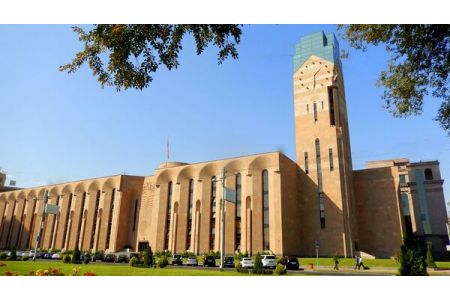 Yerevan City Hall is considering introducing a valet parking system in the city
 Expert: The circus surrounding the “Albanization” of Armenian culture in the presence of foreign ambassadors in occupied Artsakh is genocide
 Political scientist: If Russian-Armenian relations are destroyed, Turkey will take Russia`s place
 Political scientist: The Armenian public is simply obliged to significantly change the entire content of public discourse and struggle
 Cross tattoos are being removed from the skin of Christian prisoners in Azerbaijan by fire, according to a human rights activist.
 Zakharova: Armenia`s likely introduction of visas with Russia will be a step against Yerevan itself
 Putin: Armenia`s recognition of Karabakh as part of Azerbaijan in Prague has given Russia`s position on this issue an ambivalent character
 Putin: Armenia`s adoption of the law on EU accession means an announcement of its withdrawal from the Eurasian Economic Union