
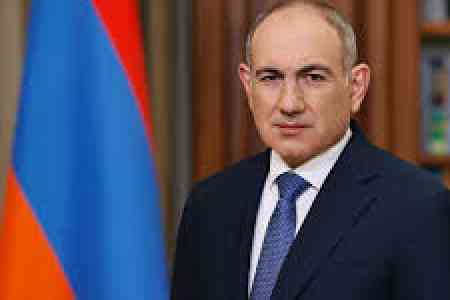
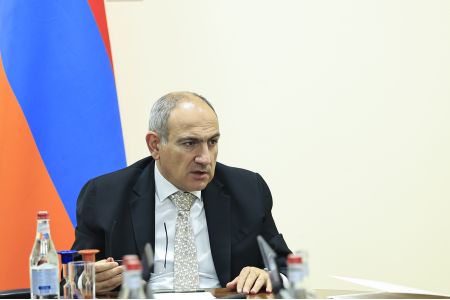
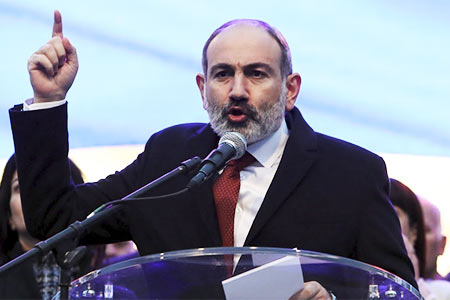
ArmInfo. The joint statement issued by the leaders of Russia, Kazakhstan, Kyrgyzstan, and Belarus regarding the holding of a referendum in Armenia should be perceived as a friendly gesture rather than a demand. Prime Minister Nikol Pashinyan made this statement during a briefing on August 20.
Recall, on May 29, the leaders of the four EAEU countries adopted a joint statement regarding Armenia's European aspirations. The document addressed the holding of a referendum in Armenia concerning EU accession or continued EAEU membership within a compressed timeframe, though without specifying a concrete date.
In this context, Nikol Pashinyan disagreed with a journalist's assertion that the move constituted a formal demand on official Yerevan.
"You say it's a demand. Where is this demand recorded? The joint statement by the heads of state of the EAEU nations states that they support the idea of holding a referendum, but initially this idea belonged to us—we stated that at a certain stage we would take this step," he said.
The Prime Minister expressed conviction that the EAEU leaders essentially share this position and do not object to Armenia deepening its relations with the European Union, up to and including adopting an EU accession agenda. Pashinyan noted that in international practice, it is standard for states to raise questions with one another and receive responses. Armenia's balanced and measured foreign policy is a direct reflection of this approach, aimed at diversifying ties and mitigating security risks through cooperation with multiple power centers.
Pashinyan emphasized that Armenia maintains strategic relationships with the United States, Georgia, China, France, the Netherlands, and Kazakhstan while simultaneously remaining a member of the EAEU. This represents a distinct departure from past policies characterized by a single-vector orientation, with strategic cooperation now advancing across numerous fronts.
As an illustration, Pashinyan pointed to defense cooperation. Previously, 85% to 90% of all military- technical cooperation was channeled in a single direction, whereas today partnerships span dozens of states—a shift underscored by the military hardware showcased during the May 28 parade.














 Political analyst: Uncertainty filled with Hope differs fundamentally from uncertainty filled with despair
 Expert: Israel strikes at Turkey`s military ambitions in Syria
 Expert: Current process is not about peace, but implementing Azerbaijan`s wishlist
 Expert: Real peace unattainable until Armenia-Azerbaijan agreement is signed and ratified
 TRIPP`s proximity to Iranian border could slow its implementation - expert
  Aram Vardevanyan: Public demands solutions, not apology scandals in Parliament
 Arrested Armenian oligarch on economy and new jobs
  "In Baku, we gave a worthy rebuff to the false claims regarding the past and present of our people" – Former Artsakh Parliament Speaker from Baku captivity
  NA Vice Speaker candidate believes his wife`s salary as director of HayPost is the lowest in the company`s history
 RF Permanent Representative: There is no CSTO-Armenia conflict
 Moscow: NATO seeking to "Pull" Armenia away from CSTO Allies
  Political analyst: Russia intends to determine which "Camp" Armenia will choose through a referendum
 Narek Karapetyan will give up his parliamentary salary in favor of charitable contributions.
 Armenian analyst: Developing relations with Europe and the U.S. must not jeopardize relations with regional powers
 Armenia and France discuss further development of strategic partnership and EU cooperation
  To overcome risks Armenia must reduce domestic escalation - expert
  Zatulin: Pashinyan was eager to get back to Russia because he actually lost the elections
 Human rights activist Ruben Melikyan dismissed from YSU
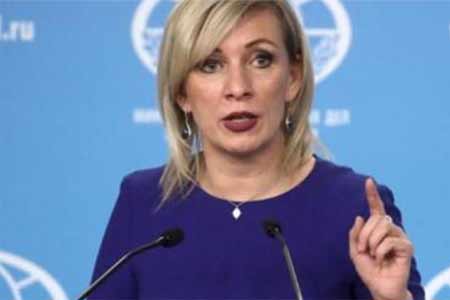 Zakharova: Armenia`s pro-EU pivot poses economic security risks to EAEU member states