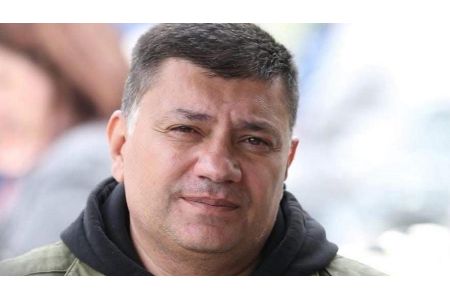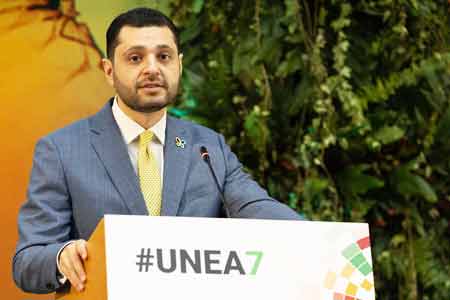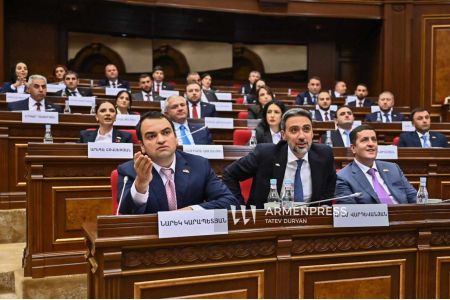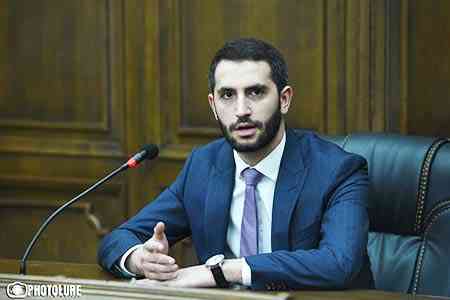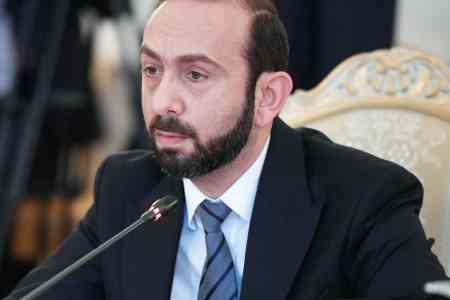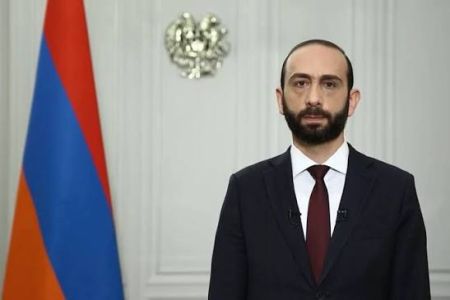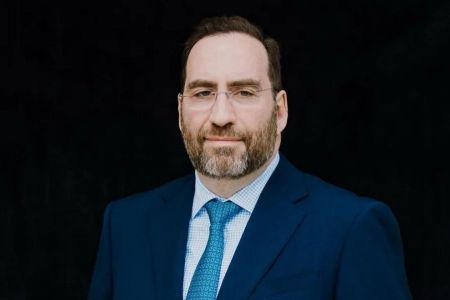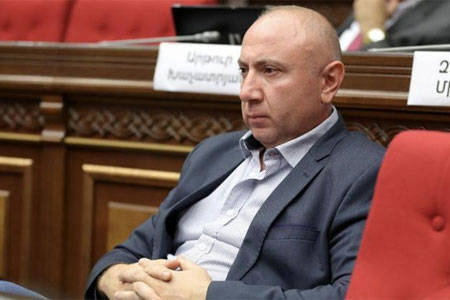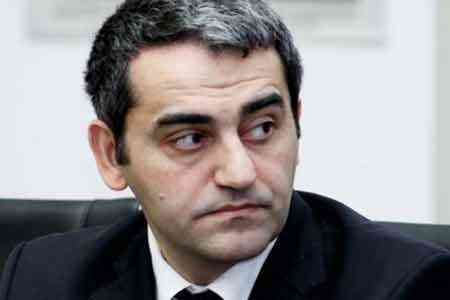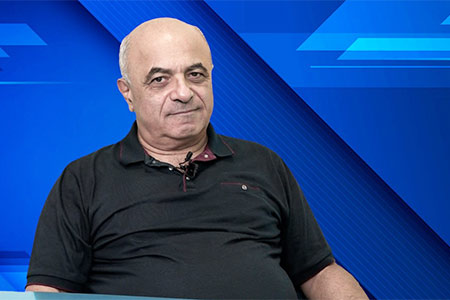

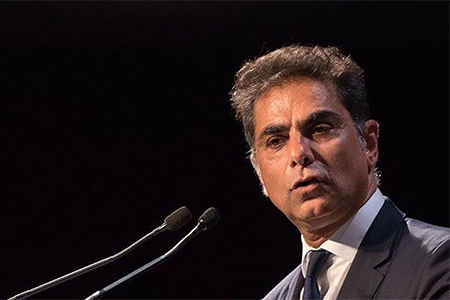
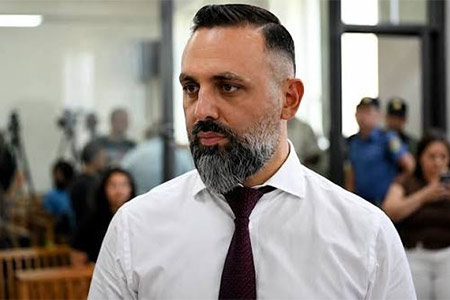
ArmInfo.For Nikol Pashinyan's regime, weakening the Diaspora means weakening Armenia. Franck Mourad Papazian, Co-Chair of the Coordinating Council of Armenian Organizations in France (CCAF), made this statement in response to remarks by Arman Yeghoyan, a member of the Armenian Parliament from the ruling Civil Contract faction, who asked from the legislative rostrum who Aram Hambaryan (Executive Director of the Armenian National Committee of America), Gaspar Karampetian (Director of the Office of Armenian Affairs in Brussels), and himself were.

"During his speech, the aforementioned member of parliament deliberately tried to devalue the Diaspora, underestimate its usefulness, and ultimately defend the absurd thesis that a stronger Diaspora means a weaker Armenia. Our personal factor is not the main issue here. The real problem lies in their perception of the Armenian nation, its history, and its future. We have never claimed to speak on behalf of all Armenians. We speak on behalf of our convictions, the responsibility entrusted to us, and decades of public activity dedicated to serving Armenia, Artsakh, and the Armenian cause," Papazyan stated.
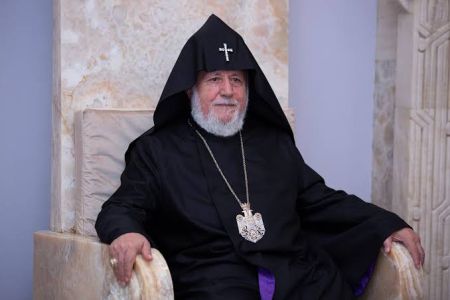
He emphasized that legitimacy is not limited to an electoral mandate alone: it also stems from service, consistency, the ability to unite, and the results achieved. The Dashnaktsiakan added that the government is temporary, the state is permanent. And the Armenian nation is even more inclusive. He also noted that the modern Armenian diaspora did not arise by choice and is largely a consequence of the genocide, expulsion, deportation, and destruction of Armenian communities in the Ottoman Empire. "After 1915, the survivors, dispossessed of land, property, and often their families, rebuilt collective life in Lebanon, Syria, France, the United States, Canada, Argentina, Uruguay, Greece, Cyprus, Iran, Egypt, Australia, and dozens of other countries. They built churches, schools, cultural centers, youth centers; they founded newspapers, social and charitable organizations. They transmitted the Armenian language, especially the now endangered Western Armenian, our faith, culture, memory, and sense of belonging to one nation. The Armenian Apostolic, Armenian Catholic, and Armenian Evangelical Churches, the Mother See of Holy Etchmiadzin and the Catholicosate of the Great House of Cilicia, the Armenian General Benevolent Union, the Armenian Revolutionary Federation "Dashnaktsutyun", "Hamazgayin", the General Armenian Physical Culture Union "Homenetmen", the Armenian "The Blue Cross and the Armenian Relief Society, as well as thousands of educational, cultural, sports, and charitable organizations, prevented the diaspora from disappearing," Papazian recalled.
He added that these structures are not perfect, as no human institution is. At the same time, the Dashnaktsakan believes that denying their historical role would mean erasing an entire century of cultural and national resistance. He is convinced that without these structures, most of the diaspora would have disappeared through assimilation, and millions of descendants of those who survived would have retained neither the language, nor memory, nor a living connection to Armenia.
Papazyan noted that during the Soviet years, the Armenian Soviet Socialist Republic lacked sovereign diplomacy capable of freely defending the national rights of the Armenian people. He stated that under these conditions, the Armenian Revolutionary Federation and the global network of "Hay Dat" committees assumed the role of unofficial diplomacy. "In Washington, Paris, Brussels, Ottawa, London, Buenos Aires, Beirut, Tehran, and many other capitals, they kept the memory of the Armenian Genocide, the rights of the Armenian people, and Armenia's very existence on the international public and political agenda. This work did not cease after the declaration of independence in 1991. It served the Republic of Armenia, its security, development, and international reputation. The diaspora rallied after the 1988 earthquake, during the blockade, and during the difficult period of war to defend Artsakh, support refugees, fund humanitarian programs, attract investment, and open the doors of foreign political institutions to Armenian representatives. Opposition to any state policy in Armenia has never meant opposition to the Armenian state. Sometimes, opposing the government itself is the best way to serve the state in the long term," the Dashnaktsakan added.
Papazian also noted that international recognition of the Armenian Genocide was no accident; This is the result of decades of work by survivors, their descendants, historians, churches, and diaspora organizations, among which the Hay Dat committees played a decisive role. According to him, an organized diaspora transforms endangered memory into an internationally recognized truth.
"We also fought against Turkey's accession to the European Union as long as Ankara continued to deny the Armenian Genocide, blockade Armenia, occupy Cyprus, and violate the fundamental principles of the European project. This struggle was not directed against the Turkish people; it was aimed at defending Europe's authority and the values of truth, justice, democracy, and respect for peoples. In 2005, the European Parliament itself established that recognition of the Armenian Genocide must be a precondition for Turkey's accession. This position would never have been adopted without the years of consistent work of European Armenian organizations," the Dashnaktsakan noted. He then drew attention to the role of the Armenian diaspora in strengthening the exceptional relations between Armenia and France, emphasizing that everything that exists today is the result of decades of painstaking work by the Armenian community.
Armenian authorities' goals
"Nikol Pashinyan's government is currently attempting to circumvent the historical structures of the Diaspora and replace them with its own chosen interlocutors and 'commissars.' The Armenian government certainly has the right to organize its relations with the Diaspora, but it has no right to decide who represents free citizens living in democratic countries. The Diaspora is neither Nikol Pashinyan's constituency nor an administrative appendage of the Yerevan government. It does not engage in dialogue with the Diaspora, electing only those who approve of the government and expelling those who criticize it. This is not a dialogue; it is an attempt at subjugation. This attempt will fail. The core institutions of the Diaspora existed before the current government and will exist after it. Their legitimacy stems from their history, members, and activities, not from the approval of any cabinet," Papazyan added. He further recalled that Azerbaijani leader Ilham Aliyev publicly called the global "Armenian lobby" Azerbaijan's number one enemy, while Turkish President Recep Tayyip Erdogan accused the Armenian diaspora in France and the United States of hindering his vision of normalizing relations, calling on the Armenian government to neutralize their influence. "When the Armenian authorities attack the Diaspora's historical organizations, attempt to discredit Hay Dat activists, and replace pluralism with submissiveness, they are objectively realizing what Ankara and Baku have been pursuing for decades. There's no need to imagine a secret chain of command to recognize this coincidence. The political outcome is before our eyes. The attempt to weaken the memory of the Genocide, the rights of Artsakh, and the structures that protect Armenia's interests directly serves the strategies of Erdogan and Aliyev. The pan-Turkic project fears not a silent, fragmented, and disorganized Diaspora, but a Diaspora that is conscious, organized, influential, and capable of operating in large democratic countries," the Dashnaktsakan asserts.
"The Pashinyan regime's logic is based on a fundamental error: it confuses demographic power with political power. The Diaspora doesn't become stronger simply because Armenians leave Armenia. It becomes stronger when it organizes existing communities, passes on its language to new generations, trains politicians, scientists, journalists, lawyers, and entrepreneurs, creates expert networks, and strengthens its economic and diplomatic potential. None of these actions displaces a single person from Armenia. Armenia and the Diaspora are not two communicating vessels, one of which must be emptied to fill the other. They are two dimensions of the same nation. Armenia is a sovereign state for its citizens, but it is also the homeland of the entire Armenian nation," Papazyan said. He added that this nation will never forget Artsakh, the 120,000 Armenians forcibly displaced in 2023, their right to live in security on their land, and the Armenian cultural and religious heritage that is now under threat; the former leaders of Artsakh, military personnel, civilians, and other Armenian prisoners still held hostage in Baku prisons.
"Their immediate and unconditional release must be the central, public, and non-negotiable demand of any negotiations with Azerbaijan. It is unacceptable that Nikol Pashinyan's government does not place this issue at the center of negotiations. A peace built on abandoning prisoners, erasing Artsakh, and silencing the Diaspora will be neither just nor sustainable," he continued. "Mr. Yeghoyan, your mandate and that of your colleagues is temporary, but the Armenian people are eternal. You ask, 'Who is Murad Papazyan?' I am one of millions of Armenians, the heir to a history that no one can erase, and I serve a homeland that no one can take from me. I am not asking Nikol Pashinyan's government for permission to be Armenian, and I am certainly not asking for permission to defend Armenia, Artsakh, the Armenians held in Baku prisons, or the historical truth about the Armenian Genocide," the Dashnaktsakan emphasized.
He then declared his intention to continue fighting for the independence, sovereignty, and security of the Republic of Armenia. "We will continue to defend the Armenian people, their heritage, and their interests in all countries where we are present. A strong diaspora poses no threat to Armenia. It is strategic depth, an indispensable diplomatic, cultural, economic, and political force. Weakening the diaspora means weakening Armenia. Pitting them against each other serves the interests of those who seek to silence the Armenian people. We will resist this agenda, relying on our memory, our unity, and our resolve. Governments come and go, but Armenia and the Armenian people remain," Papazian concluded.