
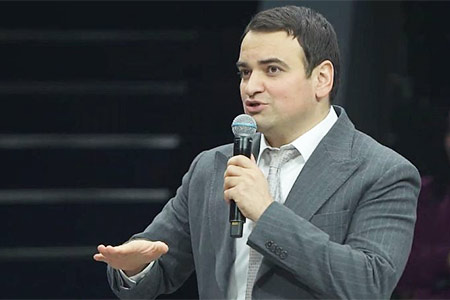
ArmInfo. At the plenary session of the National Assembly on August 19, active discussions continued on the question of which path Armenia should take. The parliamentarians' speeches took place against the backdrop of discussions regarding the candidacy of Arega Hovsepyan, chair of the NA Committee on European Integration, nominated by the opposition "Strong Armenia" faction.
Addressing the assembly, "Strong Armenia" faction leader Narek Karapetyan reflected on the practical meaning of European integration, pointing to European nations like Norway, Switzerland, and the United Kingdom as examples of countries that chose not to join the EU politically while deeply integrating their institutions into the European free economic zone and governance models.
"What has this led to? Switzerland remains free from conflicts, Norway stays clear of contradictions, and the UK chose another path," Karapetyan said, contrasting this with Armenia's complex geopolitical positioning.
"We see and understand that all Armenian institutions must be localized according to European models. While there are certain things we disagree with—as a conservative force, we disagree with certain family- oriented models—our judicial system, economic policy, and educational system must develop and work in this direction. Armenia must be a country living by European standards in every sense. However, before making a political choice, we must consider whether that choice will trigger a confrontation between regional powers and the European Union. Will we receive a heavy blow as a result? One of our country's most critical challenges is preventing a clash at our doorstep," the politician stated.
Addressing Armenia's economic relations with Russia, Karapetyan noted that last year, exports of Armenian goods to Russia totaled $3.2 billion, compared to $600 million to Europe. Funds generated through trade with Russia support pensions, military salaries, and social programs—resources the country cannot afford to lose.
"A pro-Armenian policy means ensuring we do not surrender our economic positions to others, allowing Uzbeks, Turks, or Belarusians to take our place on the Russian market," he concluded.






 Expert: Economic pressure on Armenia may be virtually painless for other EAEU members, but not for Armenia itself
 Expert on protests in France: Civilizations fade when society loses a vision of the future
 Turkologist: Azerbaijan is not all-powerful—its vulnerabilities should become part of Armenia’s security strategy
 Opinion: The development of the Amulsar mine near the resort town of Jermuk is the beginning of an environmental disaster in Armenia
 Expert: The arrest of opposition figures in Armenia for social media posts is a systematic attempt to intimidate the public and suppress dissent.
 The Armenian Foreign Minister commented on the country`s return to work within the CSTO.
 The Artsakh Public Council expressed outrage at the UN Secretary-General`s behavior
 Lukashenko called for Armenia to assume the CIS presidency in 2029
 Dmitry Medvedev predicted a Ukrainian-like fate for Armenia amid the country`s shift in foreign policy
 Russian Security Council: In Armenia, they want to force Russian asset owners to dispose of their assets
 Zakharova: Russia ready to discuss with Armenia the prospects for expanding military cooperation as part of a review of bilateral ties
 Tevanyan: Armenia, like Ukraine and Moldova, is being drawn into the EU’s global war
 Yerevan City Hall is considering introducing a valet parking system in the city
 Expert: The circus surrounding the “Albanization” of Armenian culture in the presence of foreign ambassadors in occupied Artsakh is genocide
 Political scientist: If Russian-Armenian relations are destroyed, Turkey will take Russia`s place
 Political scientist: The Armenian public is simply obliged to significantly change the entire content of public discourse and struggle
 Cross tattoos are being removed from the skin of Christian prisoners in Azerbaijan by fire, according to a human rights activist.
 Zakharova: Armenia`s likely introduction of visas with Russia will be a step against Yerevan itself
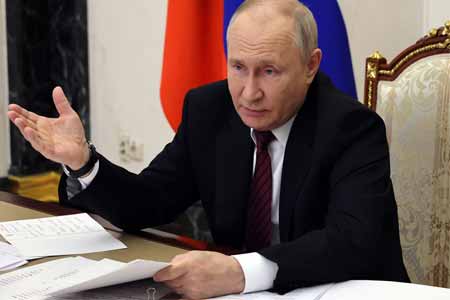 Putin: Armenia`s recognition of Karabakh as part of Azerbaijan in Prague has given Russia`s position on this issue an ambivalent character
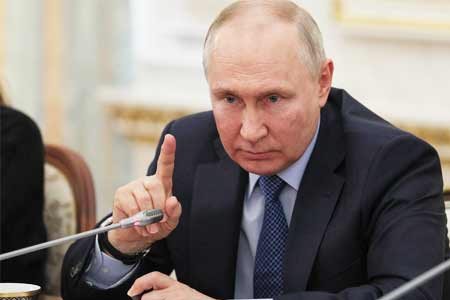 Putin: Armenia`s adoption of the law on EU accession means an announcement of its withdrawal from the Eurasian Economic Union