

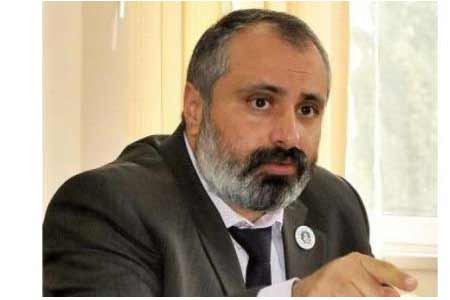
ArmInfo. Former Foreign Minister of Artsakh Davit Babayan, who is in Azerbaijani captivity, has appealed to all human rights activists and people of good will. The audio message was transmitted to NEWS.am through David Babayan's family.
Here is the text of the appeal, slightly abridged: "Dear compatriots, dear friends, sisters and brothers, Armenians around the world, all our sisters and brothers of other nationalities, and people of good will: you know that the appeal phase of our so-called trial has also ended. What trial? This was a theater, the script of which was written in advance. They did not even dare to correct elementary mistakes. For example, during the presentation of those in attendance at the final court session—where they upheld the previous verdicts—they listed my defense counsel using the old roster, even though my lawyers had changed repeatedly throughout the trial. In other words, not only did they fail to verify the facts, but they also lacked the courage to alter their pre-written script, leaving glaring errors intact. This was purely a formal stage we had to endure so that we could later use it to appeal to an international court.
In the Azerbaijani Court of Appeals, ordinary citizens did not participate in the proceedings. By contrast, during the court of first instance, about 200 to 300 people were brought in for each session, selectively transported in special buses and reportedly well-paid. But this time, no one was there. One of the reasons is that these people witnessed the blatant abuses being committed, the weakness of the prosecution's case, our steadfast self-defense, and our persistence. Naturally, the reality of all this inevitably penetrates their own society.
It is remarkable how absurd the narratives being circulated have become—things that are simply beyond imagination. For instance, a crime committed by a single individual is automatically attributed to everyone. Moreover, they introduced legal charges and added two life imprisonment articles to my case that had never existed or even been mentioned during the entire trial. I only discovered this a week after the proceedings concluded, when we were finally provided with the written summary. I asked them to review our statements—whether from the closing arguments in the court of first instance or the main remarks of this trial—and to provide video footage to their own human rights defender, but they refused. They claim it is an 'open trial,' yet they refuse to share the documentation or recordings even with their own human rights ombudsman.
One of the most notable phenomena is the constant turnover of defense attorneys; five to six lawyers have been replaced during this period. One was substituted right at the start of the appeal trial. When I inquired about the reason, I was told it was due to health issues. In court, I requested, 'Contact them via video call; I want to check on them personally.' Naturally, they were completely perplexed, refused to connect me, and merely stated that there was no risk to their lives.
Another noteworthy development is that one of the defense attorneys stated they do not want the case to reach an international court because more than 95% of the accusations are fabricated and completely baseless. That is genuinely the case. Let me give a specific example: I was sentenced to life imprisonment under an article of the Azerbaijani Criminal Code alleging that I tried to overthrow the government and constitution here. I posed a question to the court: "Is there any evidence that, while I was here, I participated in a struggle for power? If so, I must have had supporters and organizational cells throughout your country. Naturally, there was no answer.
Furthermore, all of our appeals in the appellate court—100% of them—were ruled in favor of the prosecution. In the court of first instance, the figure was 99.4%. I expressed my gratitude for such a staggering volume and quality of judicial errors, as this is immensely important for us and will contribute to the restoration of justice when we submit all of this to an international court."
David Babayan also noted that he is facing health issues, which he formally addressed in court, requesting that his condition be placed on the record.
"Of course, it is understandable that they will not want me to go to an international court. I am not the only one struggling with health problems; a number of our friends also face serious health concerns. To some extent, this is to be expected, because we are fighting for justice, freedom, and human rights in this harsh world, and such things do not come easily. It is one thing to fight for justice, and quite another to sit in prison for it. But know that although we are behind bars, we are not on our knees—let everyone understand that. Everything else is normal. Be strong, dear compatriots and people of good will; difficult trials still await our homeland," Babayan concluded.

















 Azerbaijani Studies Expert: While Azerbaijan Prepares Its Generation for War, Aliyev’s Aide Calls on Armenia to Prepare Armenian Society for “Peace”
 Turkologist: Azerbaijan will never, under any circumstances, stop pressuring the Armenian people
 Political scientist: We need to move away from the question of "when" and replace it with more important questions
 International Law Specialist: Azerbaijan intends to initiate legal proceedings against Armenia by sentencing Armenian prisoners
 Dmitry Medvedev predicted a Ukrainian-like fate for Armenia amid the country`s shift in foreign policy
 Russian Security Council: In Armenia, they want to force Russian asset owners to dispose of their assets
 Zakharova: Russia ready to discuss with Armenia the prospects for expanding military cooperation as part of a review of bilateral ties
 Tevanyan: Armenia, like Ukraine and Moldova, is being drawn into the EU’s global war
 Yerevan City Hall is considering introducing a valet parking system in the city
 Expert: The circus surrounding the “Albanization” of Armenian culture in the presence of foreign ambassadors in occupied Artsakh is genocide
 Political scientist: If Russian-Armenian relations are destroyed, Turkey will take Russia`s place
 Political scientist: The Armenian public is simply obliged to significantly change the entire content of public discourse and struggle
 Cross tattoos are being removed from the skin of Christian prisoners in Azerbaijan by fire, according to a human rights activist.
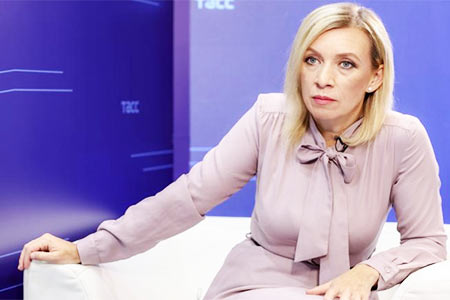 Zakharova: Armenia`s likely introduction of visas with Russia will be a step against Yerevan itself
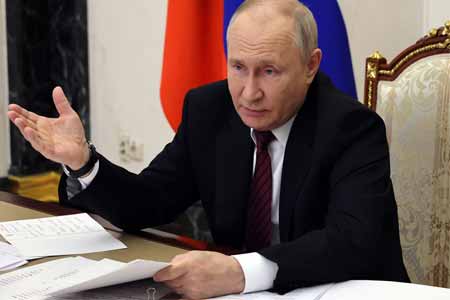 Putin: Armenia`s recognition of Karabakh as part of Azerbaijan in Prague has given Russia`s position on this issue an ambivalent character
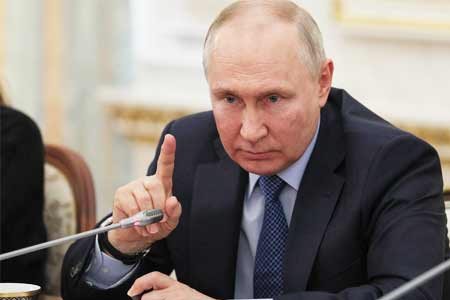 Putin: Armenia`s adoption of the law on EU accession means an announcement of its withdrawal from the Eurasian Economic Union
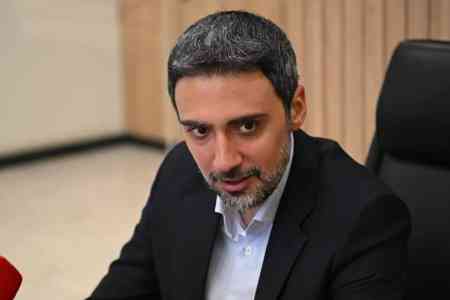 Aram Vardevanyan: Public demands solutions, not apology scandals in Parliament
 Arrested Armenian oligarch on economy and new jobs