
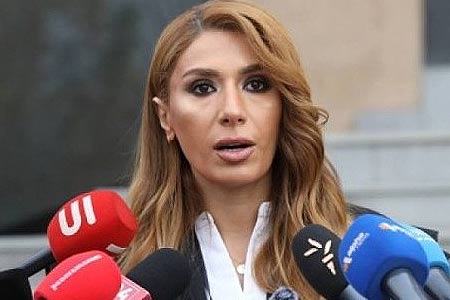
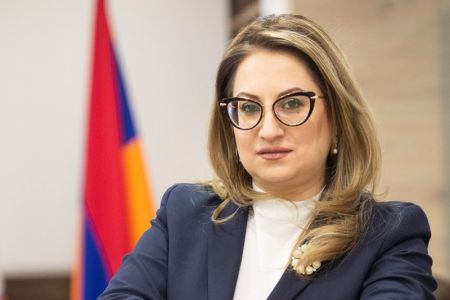
ArmInfo. No matter how many violations of internal church canons the ruling "Civil Contract" party in Armenia believes it has identified, it has no legal or moral right to interfere in internal church affairs, according to constitutional law expert Gohar Meloyan in her social media post.
She noted that the opposition has the right to hold a protest when ruling deputies address the Catholicos of All Armenians by his secular name. This, according to the expert, is not only disrespectful to the Constitution of the Republic of Armenia and the legal system, but also a manifestation of political immaturity or deliberate harassment, as well as disrespect for the entire Armenian people and Christians. "Firstly, no matter how many violations of internal church canons the Civil Contract party may perceive, it has no right to interfere in internal church matters this is a constitutional requirement.
Furthermore, unfortunately, they are not ordinary citizens, but officials, and are obligated to adhere to this requirement. Any interference not only constitutes disrespect for the national faith and the institution of the Church, but is also illegal. Karekin II is not only the secular name of the Catholicos of All Armenians, but also the name indicated in his passport as a citizen of the Republic of Armenia. In other words, a clearly established legal fact is violated and distorted, which constitutes not only disrespect for the national faith and the institution of the Church, but also disrespect for the passport of a citizen of the Republic of Armenia and is illegal. Canonical decisions of the Armenian Apostolic Holy Church declaring a person defrocked and/or dismissing a diocesan primate pertain to internal church matters, not civil law matters. relations, which is also enshrined in international law," Gohar Meloyan emphasized.
She recalled that, according to Article 17 of the Constitution, religious organizations are separate from the state. According to Article 41 of the Constitution, religious organizations are equal and enjoy autonomy. The Law "On Relations between the Republic of Armenia and the Armenian Apostolic Holy Church" recognizes the self-governance of the Armenian Apostolic Holy Church within its hierarchical structure. The European Convention for the Protection of Human Rights and Fundamental Freedoms enshrines freedom of thought, conscience, and religion.
In the ECHR decision in the case of Hasan and Chaush v. Bulgaria, the court emphasized that religious communities have an autonomous existence and that the role of the state must remain neutral. The state cannot determine which religious leadership is legitimate simply because it favors another. In the case of The Holy Synod of the Bulgarian Orthodox Church (Metropolitan Innocent) and Others v. Bulgaria, the ECHR found a violation of Article 9, noting that conflicts within religious communities must remain within the jurisdiction of the religious community itself. In Mirolubovs and Others v. Latvia, the ECHR also found a violation of Article 9, characterizing the case as "state intervention in a conflict between members of a religious community." The Court emphasized that the state is obligated to maintain neutrality and impartiality and cannot determine religious legitimacy or decide which religious group is doctrinally correct. In Serbian Eastern Orthodox Diocese v. Milivojevic, the US Supreme Court ruled that civil courts cannot hear a church dispute.
"The doctrine of church autonomy, shaped by judicial practice, protects religious organizations from state interference in matters of church governance, faith, and doctrine. And this approach is a common thread running through numerous US Supreme Court decisions, the case law of the European Court of Human Rights, and similar cases in various countries around the world," the expert noted.



















 Expert: The arrest of opposition figures in Armenia for social media posts is a systematic attempt to intimidate the public and suppress dissent.
 Azerbaijani Studies Expert: While Azerbaijan Prepares Its Generation for War, Aliyev’s Aide Calls on Armenia to Prepare Armenian Society for “Peace”
 Turkologist: Azerbaijan will never, under any circumstances, stop pressuring the Armenian people
 Political scientist: We need to move away from the question of "when" and replace it with more important questions
 International Law Specialist: Azerbaijan intends to initiate legal proceedings against Armenia by sentencing Armenian prisoners
 Lukashenko called for Armenia to assume the CIS presidency in 2029
 Dmitry Medvedev predicted a Ukrainian-like fate for Armenia amid the country`s shift in foreign policy
 Russian Security Council: In Armenia, they want to force Russian asset owners to dispose of their assets
 Zakharova: Russia ready to discuss with Armenia the prospects for expanding military cooperation as part of a review of bilateral ties
 Tevanyan: Armenia, like Ukraine and Moldova, is being drawn into the EU’s global war
 Yerevan City Hall is considering introducing a valet parking system in the city
 Expert: The circus surrounding the “Albanization” of Armenian culture in the presence of foreign ambassadors in occupied Artsakh is genocide
 Political scientist: If Russian-Armenian relations are destroyed, Turkey will take Russia`s place
 Political scientist: The Armenian public is simply obliged to significantly change the entire content of public discourse and struggle
 Cross tattoos are being removed from the skin of Christian prisoners in Azerbaijan by fire, according to a human rights activist.
 Zakharova: Armenia`s likely introduction of visas with Russia will be a step against Yerevan itself
 Putin: Armenia`s recognition of Karabakh as part of Azerbaijan in Prague has given Russia`s position on this issue an ambivalent character
 Putin: Armenia`s adoption of the law on EU accession means an announcement of its withdrawal from the Eurasian Economic Union
 Aram Vardevanyan: Public demands solutions, not apology scandals in Parliament