
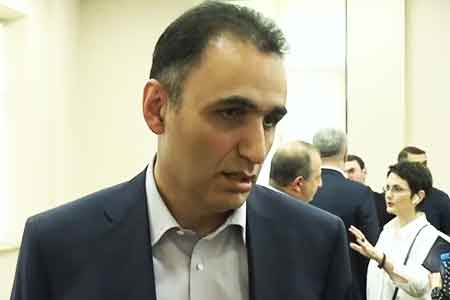
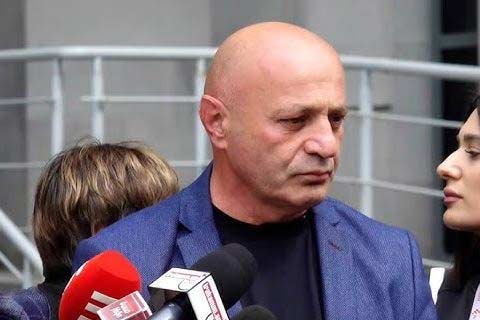
ArmInfo. Armenia must choose – does it want to see itself as a semi- state entity integrated into the Turkic world, or does it seek to build a nation-state, relying on the support of Russia and its other natural allies. Political prisoner and coordinator of the "Hayakve" movement Avetik Chalabyan delivered this message from the Armavir penitentiary institution, commenting on the first sessions of the newly elected National Assembly.
Armenia must make a choice: whether it wishes to see itself as a semi-state entity integrated into the Turkic world, or whether it strives to build a national state, relying on the support of both Russia and our other natural allies. This message was delivered from the "Armavir" Penitentiary Institution by Avetik Chalabyan, a political prisoner and coordinator of the Hayakve movement, as he commented on the first sessions of the newly elected National Assembly.
Specifically, he addressed a key thesis raised during the discussions there. "This thesis—put forward only on the second day of discussions—was articulated by Arman Yeghoyan, a deputy from the 'Civil Contract' party, who stated that the main contradiction in the current parliament is as follows: do we want to see Armenia as a sovereign and independent state, or as a state dependent on and governed by Russia? Naturally, from the perspective of the 'Civil Contract' party, such a framing is advantageous because it allows them to portray themselves as proponents of the former approach. However, this framing is fundamentally false and deliberately distorts reality. The reality is that the core question is whether we want to see ourselves as a semi-state entity integrated into the Turkic world, or whether we strive to build a national state, relying on the support of both Russia and our other natural allies," Chalabyan pointed out.
According to him, at the core of this contradiction lies a thesis persistently promoted by the ruling "Civil Contract" party: that anti-Turkish sentiment among Armenians was artificially instilled by the Russian Empire in order to turn the Armenian people into an instrument of its own expansionist policy. However, according to the movement's coordinator, this is also a false claim. Chalabyan notes that a study of the entire history of Armenian-Turkish relations demonstrates that the contradictions between the countries arose and deepened even before the Russian Empire advanced into the region, and were driven by several obvious circumstances.
First and foremost, as the coordinator of the Hayakve movement noted, the Turks (Ottomans) conquered the entire Middle East by military force and considered themselves the absolute masters of the peoples inhabiting it. "They simply viewed Christian peoples, and Armenians in particular, as slaves and treated them accordingly. Second, while the Ottoman Empire possessed a powerful army, its administrative system was extremely backward and deeply corrupt. As a result, Armenians lived under conditions of double taxation, were completely disenfranchised, and were regularly forced to rise up in various parts of the empire against the lawlessness taking place. Later, having lost all their European possessions, the Turks turned their gaze eastward—toward Turan. Along the path of this expansion, they saw the Armenians as the primary obstacle that had to be eliminated in order to unite Turkey and Turan," Chalabyan explained.
.He noted that over the past 150 years—whether the Hamidian pogroms of 1894-1896, the Armenian Genocide of 1915, the genocidal invasions of Eastern Armenia in 1918 and 1920, the forced displacement of Armenians from Artsakh in 2023, or the quiet de-Armenization of Nakhichevan during the Soviet years—all these actions pursued a single goal: to eliminate the Armenian barrier between Turkey and Turan. He noted with regret that, despite the stubborn resistance of the Armenian people, this goal has largely been achieved.
"Today, new strategists from the Civil Contract party have entered the political arena. They, through their leader, are essentially claiming that the only path to our salvation is to become a bridge between Turkey and Turan, since the barrier supposedly no longer works and will collapse sooner or later. However, this assertion requires asking a simple question. Today, Turkey's population is approximately 85 million people, and approximately the same number lives in the five Turkic states of Turan, while Armenia's population is approximately 3 million. If we become a bridge within the Turkic space with a population of 170 million, won't we eventually dissolve within it and become Turks ourselves?" the movement's coordinator asked.
He also noted that, in attempting to preserve their Armenian and Christian identity, Armenians could find themselves back in the same situation they faced two hundred years ago, when 170 million, and potentially even more, Muslim Turks will once again treat Armenians as a disenfranchised service caste and, if the opportunity arises, deport or exterminate them, as they have done repeatedly in the past, including just three years ago. "This is precisely the core issue of our confrontation, and each of us must answer it. I have already answered this question for myself. Yes, I realize that my answer presupposes greater dependence on Iran, as well as India, China, and all those who are prepared to resist Turkish expansion into Central Asia and who view us, Armenians, as their natural allies. If you are reading these lines, ask yourself this question as well. Try to answer what future you envision for your children: to become Turkified and thrown at the mercy of Turkey, or to fight and defend your freedom to the end? God helps those who fight. So, don't hesitate – choose the fight," Chalabyan concluded.
Recall, on June 24, the Yerevan Court of First Instance ordered Avetik Chalabyan to be held in pretrial detention for two months. The Investigative Committee previously presented the reason for his detention, noting that in May 2026, the latter traveled to and met with officials of another state, during which, through persuasion, as well as an interest in ensuring the victory of their preferred political force, he persuaded them to use their official powers, authority, and the influence they owed to them, to obstruct the free exercise of the electoral rights of citizens of the Republic of Armenia who had the right to vote in the parliamentary elections held in the Republic of Armenia on June 7, 2026. Chalabyan did not admit this and called it a lie.
















 Expert: The arrest of opposition figures in Armenia for social media posts is a systematic attempt to intimidate the public and suppress dissent.
 Azerbaijani Studies Expert: While Azerbaijan Prepares Its Generation for War, Aliyev’s Aide Calls on Armenia to Prepare Armenian Society for “Peace”
 Turkologist: Azerbaijan will never, under any circumstances, stop pressuring the Armenian people
 Political scientist: We need to move away from the question of "when" and replace it with more important questions
 International Law Specialist: Azerbaijan intends to initiate legal proceedings against Armenia by sentencing Armenian prisoners
 Dmitry Medvedev predicted a Ukrainian-like fate for Armenia amid the country`s shift in foreign policy
 Russian Security Council: In Armenia, they want to force Russian asset owners to dispose of their assets
 Zakharova: Russia ready to discuss with Armenia the prospects for expanding military cooperation as part of a review of bilateral ties
 Tevanyan: Armenia, like Ukraine and Moldova, is being drawn into the EU’s global war
 Yerevan City Hall is considering introducing a valet parking system in the city
 Expert: The circus surrounding the “Albanization” of Armenian culture in the presence of foreign ambassadors in occupied Artsakh is genocide
 Political scientist: If Russian-Armenian relations are destroyed, Turkey will take Russia`s place
 Political scientist: The Armenian public is simply obliged to significantly change the entire content of public discourse and struggle
 Cross tattoos are being removed from the skin of Christian prisoners in Azerbaijan by fire, according to a human rights activist.
 Zakharova: Armenia`s likely introduction of visas with Russia will be a step against Yerevan itself
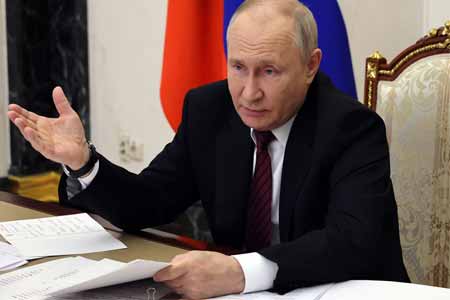 Putin: Armenia`s recognition of Karabakh as part of Azerbaijan in Prague has given Russia`s position on this issue an ambivalent character
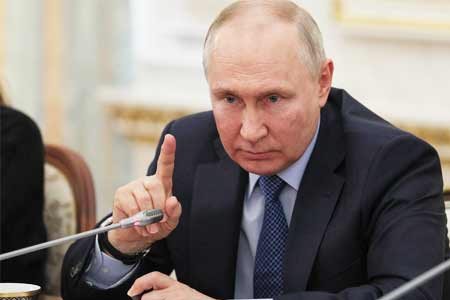 Putin: Armenia`s adoption of the law on EU accession means an announcement of its withdrawal from the Eurasian Economic Union