

ArmInfo.Rhetoric about "colonialism" requires consistency, otherwise it becomes a tool for political expediency and double standards. This opinion was expressed on his Telegram page by Vahe Davtyan, a specialist in cross-border transport and energy projects, political scientist, and PhD, in response to Azerbaijani President Ilham Aliyev's attacks on the "colonial legacy" of the USSR.
The Armenian expert noted that Aliyev, at a media forum in occupied Shushi, reiterated the "colonial legacy" of the 19th and 20th centuries, accusing the USSR of exploiting the republic's resources, particularly its oil wealth.
"However, the question arises: could modern Azerbaijan even exist without Russian and Soviet modernization? It was during this period that the foundations of the country's industrial economy were laid, the oil industry was created, and the infrastructure, education system, and engineering school were established. Today, it's convenient to talk about 'exporting billions of tons of oil,' forgetting that it was the Soviet period that transformed Azerbaijan into an industrial republic with a developed energy complex," the expert stated.
Davtyan noted that, despite all this, Aliyev himself rightly draws attention to the environmental consequences of large-scale resource exploitation. However, he added, this raises another question: why is the discussion of resource "colonialism" limited to the Soviet period?
In this vein, the expert recalled that the so-called "Contract of the Century" was signed in 1994, opening Azerbaijan's oil sector to international corporations. He added that the consortium included 11 major companies, and the country's energy policy became closely linked to the interests of external players.
"It was this stage that marked the formation of a new model of dependence. British BP (British Petroleum) assumed a key role in Azerbaijan's oil sector. At the same time, despite the massive revenues from oil exports, the Caspian's environmental problems only worsened. Moreover, Aliyev himself has repeatedly stated that the Caspian Sea level is approaching its lowest point in 200 years," Davtyan noted.
He drew attention to the fact that, according to data provided by the Azerbaijani side, the Caspian Sea level has dropped by approximately 1 meter over the past five years, 1.5 meters over 10 years, and approximately 2.5 meters over 30 years. The current rate of decline is estimated at 20-30 cm per year.
"This raises an awkward question: if the Soviet model of resource exploitation is declared 'colonialist' due to its environmental consequences, how should we evaluate the post-Soviet model, in which transnational corporations have gained control over a strategic sector? Neocolonialism differs from colonialism in that it comes not through administrative management, but through control of technology, investment, and resource flows.
The rhetoric about 'colonialist' requires consistency. Otherwise, it becomes a tool for political expediency and double standards," Davtyan concluded.















 Expert: The arrest of opposition figures in Armenia for social media posts is a systematic attempt to intimidate the public and suppress dissent.
 Azerbaijani Studies Expert: While Azerbaijan Prepares Its Generation for War, Aliyev’s Aide Calls on Armenia to Prepare Armenian Society for “Peace”
 Turkologist: Azerbaijan will never, under any circumstances, stop pressuring the Armenian people
 Political scientist: We need to move away from the question of "when" and replace it with more important questions
 International Law Specialist: Azerbaijan intends to initiate legal proceedings against Armenia by sentencing Armenian prisoners
 Dmitry Medvedev predicted a Ukrainian-like fate for Armenia amid the country`s shift in foreign policy
 Russian Security Council: In Armenia, they want to force Russian asset owners to dispose of their assets
 Zakharova: Russia ready to discuss with Armenia the prospects for expanding military cooperation as part of a review of bilateral ties
 Tevanyan: Armenia, like Ukraine and Moldova, is being drawn into the EU’s global war
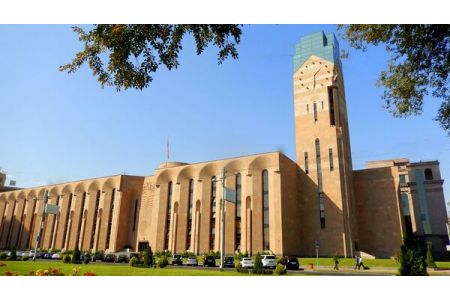 Yerevan City Hall is considering introducing a valet parking system in the city
 Expert: The circus surrounding the “Albanization” of Armenian culture in the presence of foreign ambassadors in occupied Artsakh is genocide
 Political scientist: If Russian-Armenian relations are destroyed, Turkey will take Russia`s place
 Political scientist: The Armenian public is simply obliged to significantly change the entire content of public discourse and struggle
 Cross tattoos are being removed from the skin of Christian prisoners in Azerbaijan by fire, according to a human rights activist.
 Zakharova: Armenia`s likely introduction of visas with Russia will be a step against Yerevan itself
 Putin: Armenia`s recognition of Karabakh as part of Azerbaijan in Prague has given Russia`s position on this issue an ambivalent character
 Putin: Armenia`s adoption of the law on EU accession means an announcement of its withdrawal from the Eurasian Economic Union