

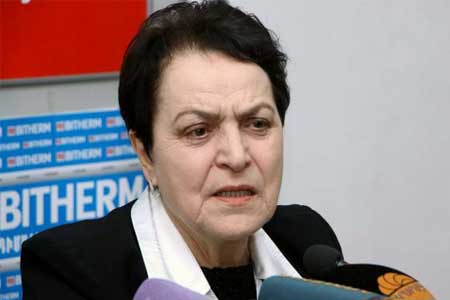
ArmInfo. Introducing a residency requirement in Armenia would be a rollback on democratic norms and the principles of the rule of law. This opinion was expressed by Armenia's first Human Rights Ombudsman, Larisa Alaverdyan, in an interview with an ArmInfo correspondent, responding to the amendments to the Electoral Code initiated by the Armenian authorities to introduce a residency requirement for voters.
Alaverdyan noted that they have long fought to ensure that all Armenian citizens, wherever they are, can vote in elections. According to her, depriving citizens of the right to vote because they live in another country is a sign of the state's backwardness. "Such an initiative is essentially directed against all citizens, who have often been forced to leave the country for one reason or another. It essentially seeks to deprive full-fledged citizens of Armenia of the opportunity to participate in elections," the human rights activist noted.
Alaverdyan suggested that the discussion of such an initiative could be linked to the authorities' tally of the results of the parliamentary elections held on June 7, as they could show that citizens who came to Armenia to participate in the elections did not vote for the party of Armenian Prime Minister Nikol Pashinyan. In other words, according to Armenia's first Human Rights Defender, the voting results did not satisfy the ruling party. "And although they attempted to adjust the voting results, it's clear they were far from what was desired. The announced results didn't correspond to reality, which, in my opinion, the ruling party representatives know best. I believe this is precisely what prompted the intention to deprive Armenian citizens living in other countries of their right to vote. But this is unacceptable, since every citizen of Armenia has this right," the human rights activist emphasized.
Alaverdyan, however, did not link the discussion of such an initiative to the ongoing proceedings in the Constitutional Court challenging the election results, where a decision to schedule a second round could theoretically be made. Since, as the human rights activist explained,
The Constitutional Court, like the entire judicial system in Armenia, is currently effectively under the control of the executive branch, and therefore she does not expect such a decision (to schedule a second round - ed.) to be made. However, she noted that this initiative still needs to be challenged. "If the relevant law is adopted, it should be appealed in court. After all, if the dispute ends in favor of the government, between 800,000 and 1,000,000 Armenian citizens living abroad could be deprived of the right to vote. Citizenship is the highest status. And in this sense, deprivation of the right to vote is one of the most serious violations for any country striving for a democratic system and the formation of a state governed by the rule of law," Alaverdyan noted. According to Armenia's first Ombudsman, this is an unprecedented situation, and challenging such a law is necessary, even given the executive branch's control over the judicial system. "Failure to appeal to the court could be interpreted as consent to the current situation. Therefore, the challenge procedure itself is mandatory. This issue should even be brought to the European Court and the UN Court (International Court of Justice - ed.), as what is happening represents a rollback of democratic norms and the principles of the rule of law. Therefore, it should be raised not only in the courts but also in all political arenas," Alaverdyan concluded.
As a reminder, at the behest of Prime Minister Nikol Pashinyan, members of parliament from the Civil Contract party initiated amendments to the Electoral Code, according to which citizens of the Republic who have actually resided in Armenia for 183 or more days during the previous 365 days will be eligible to participate in National Assembly elections and referendums. This initiative was criticized by opposition figures and representatives of civil society.
















 Expert: The arrest of opposition figures in Armenia for social media posts is a systematic attempt to intimidate the public and suppress dissent.
 Azerbaijani Studies Expert: While Azerbaijan Prepares Its Generation for War, Aliyev’s Aide Calls on Armenia to Prepare Armenian Society for “Peace”
 Turkologist: Azerbaijan will never, under any circumstances, stop pressuring the Armenian people
 Political scientist: We need to move away from the question of "when" and replace it with more important questions
 Lukashenko called for Armenia to assume the CIS presidency in 2029
 Dmitry Medvedev predicted a Ukrainian-like fate for Armenia amid the country`s shift in foreign policy
 Russian Security Council: In Armenia, they want to force Russian asset owners to dispose of their assets
 Zakharova: Russia ready to discuss with Armenia the prospects for expanding military cooperation as part of a review of bilateral ties
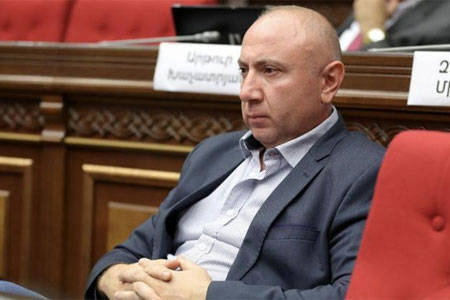 Tevanyan: Armenia, like Ukraine and Moldova, is being drawn into the EU’s global war
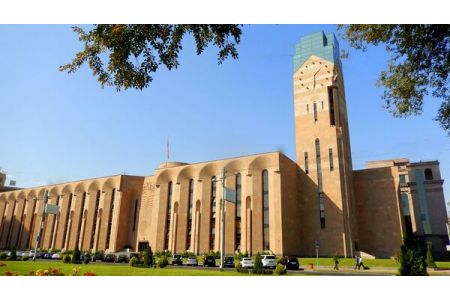 Yerevan City Hall is considering introducing a valet parking system in the city
 Expert: The circus surrounding the “Albanization” of Armenian culture in the presence of foreign ambassadors in occupied Artsakh is genocide
 Political scientist: If Russian-Armenian relations are destroyed, Turkey will take Russia`s place
 Political scientist: The Armenian public is simply obliged to significantly change the entire content of public discourse and struggle
 Cross tattoos are being removed from the skin of Christian prisoners in Azerbaijan by fire, according to a human rights activist.
 Zakharova: Armenia`s likely introduction of visas with Russia will be a step against Yerevan itself
 Putin: Armenia`s recognition of Karabakh as part of Azerbaijan in Prague has given Russia`s position on this issue an ambivalent character
 Putin: Armenia`s adoption of the law on EU accession means an announcement of its withdrawal from the Eurasian Economic Union
