
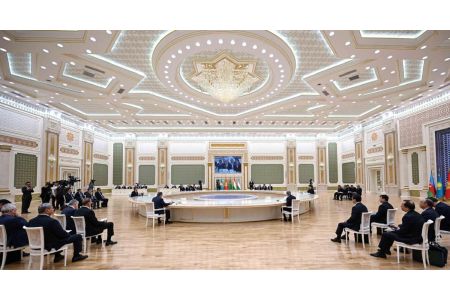
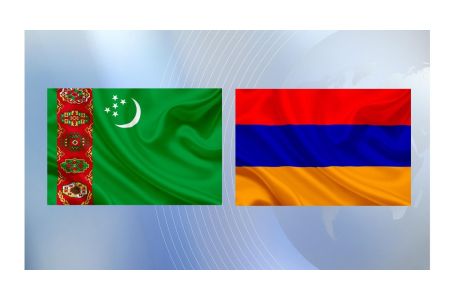
ArmInfo.Artsakh's Cultural Heritage Ombudsman, Hovik Avanesov, expresses his categorical protest over the President of Turkmenistan's visit to occupied Artsakh-an ancient Armenian land whose indigenous population was forcibly expelled as a result of Azerbaijan's military aggression in 2020-2023.
"This visit was not simply to a disputed region or to a typical international forum. The President of Turkmenistan visited a territory from which an entire people was completely displaced, where the consistent destruction of their historical memory continues, and where cultural heritage is systematically desecrated, appropriated, and falsified," Avanesov noted in his Facebook post. According to him, it is particularly outrageous that the Turkmen leader's visit to Artsakh is taking place while Azerbaijan continues its policy of cultural erasure of the Armenian presence. Monuments are being destroyed, Armenian inscriptions are being removed, the historical appearance of settlements is being altered, and traces of centuries-old Armenian civilization are being erased. All of this is happening before the eyes of the international community and with a demonstrative refusal to allow independent international missions to objectively assess the state of the region's cultural heritage.
"This visit cannot be considered a neutral diplomatic act. It is objectively being used by the Azerbaijani side as a tool for international legitimization of the consequences of the ethnic cleansing of Armenians in Artsakh and a policy of cultural revisionism. In fact, the presence of the Turkmen leader in the territory from which approximately 150,000 Armenians were expelled is becoming part of a propaganda campaign designed to convince the world that the Artsakh issue is closed and that the forcibly created situation must be accepted as the new political reality," he continued.
Avanesov emphasized that it is impossible to build a stable peace on the ruins of destroyed shrines, on silence about the ethnic cleansing that took place, and on attempts to erase the memory of the people who, for decades, created the cultural and spiritual heritage of this region.
He said it was particularly alarming that the head of a state that has repeatedly declared its commitment to respecting the history, culture, and traditions of the world's peoples chose to ignore the fate of dozens of monasteries, hundreds of churches, cemeteries, thousands of khachkars (cross-stones) and other monuments that were threatened with destruction after Azerbaijan established control over Artsakh.
"History knows of numerous cases where the destruction of cultural heritage became the final stage of a policy of expulsion. First, a people is deprived of the right to live on their land, then traces of their existence are destroyed, and then the world is asked to forget what happened. Today, this is precisely the scenario being played out in Artsakh. We consider it unacceptable for foreign leaders to participate in events in the occupied territory without publicly assessing the fate of the exiled population and condemning the ongoing destruction of their cultural heritage. Any other approach is inevitably perceived as political indifference to gross violations of human rights and international norms for the protection of cultural property," he stated. The Artsakh Cultural Heritage Ombudsman declares that no international visit, no ceremony, and no political declaration can change the historical truth: Artsakh is one of the most ancient centers of Armenian civilization, and its cultural heritage was created by the Armenian people and is an integral part of the world's cultural heritage.
"We call on the President of Turkmenistan to publicly assess the facts of the destruction of Armenian cultural heritage, support international monitoring of Artsakh's monuments, and renounce any steps that could be used to justify or legitimize the consequences of ethnic cleansing and cultural destruction. History will judge not only those who destroyed churches, monasteries, and cemeteries, but also those who chose to visit these lands after the expulsion of the indigenous people, pretending nothing had happened," the Artsakh Cultural Heritage Ombudsman concluded.











 Azerbaijani Studies Expert: While Azerbaijan Prepares Its Generation for War, Aliyev’s Aide Calls on Armenia to Prepare Armenian Society for “Peace”
 Turkologist: Azerbaijan will never, under any circumstances, stop pressuring the Armenian people
 Political scientist: We need to move away from the question of "when" and replace it with more important questions
 International Law Specialist: Azerbaijan intends to initiate legal proceedings against Armenia by sentencing Armenian prisoners
 Dmitry Medvedev predicted a Ukrainian-like fate for Armenia amid the country`s shift in foreign policy
 Russian Security Council: In Armenia, they want to force Russian asset owners to dispose of their assets
 Zakharova: Russia ready to discuss with Armenia the prospects for expanding military cooperation as part of a review of bilateral ties
 Tevanyan: Armenia, like Ukraine and Moldova, is being drawn into the EU’s global war
 Yerevan City Hall is considering introducing a valet parking system in the city
 Expert: The circus surrounding the “Albanization” of Armenian culture in the presence of foreign ambassadors in occupied Artsakh is genocide
 Political scientist: If Russian-Armenian relations are destroyed, Turkey will take Russia`s place
 Political scientist: The Armenian public is simply obliged to significantly change the entire content of public discourse and struggle
 Cross tattoos are being removed from the skin of Christian prisoners in Azerbaijan by fire, according to a human rights activist.
 Zakharova: Armenia`s likely introduction of visas with Russia will be a step against Yerevan itself
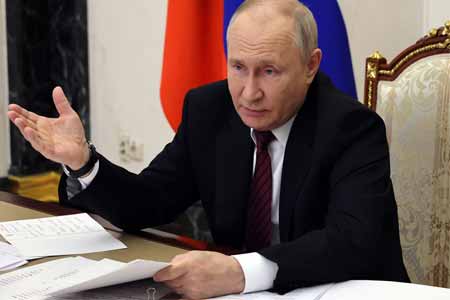 Putin: Armenia`s recognition of Karabakh as part of Azerbaijan in Prague has given Russia`s position on this issue an ambivalent character
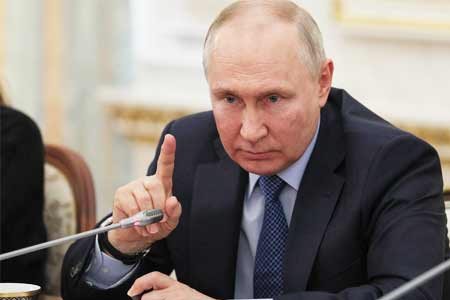 Putin: Armenia`s adoption of the law on EU accession means an announcement of its withdrawal from the Eurasian Economic Union
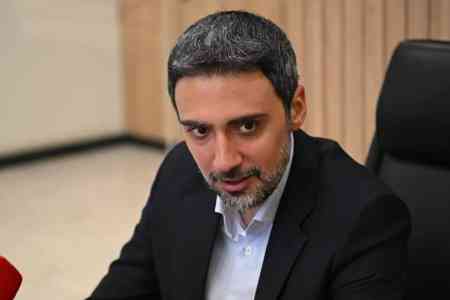 Aram Vardevanyan: Public demands solutions, not apology scandals in Parliament
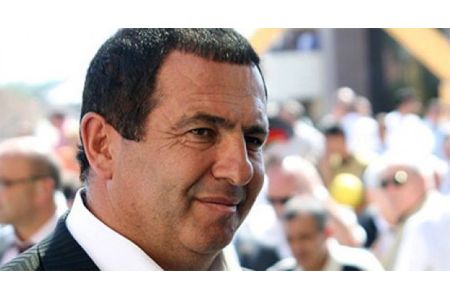 Arrested Armenian oligarch on economy and new jobs