
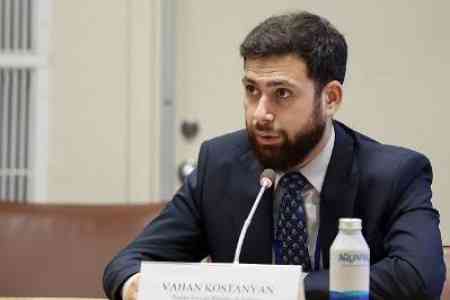
ArmInfo. Armenian Deputy Foreign Minister Vahan Kostanyan met with Simon Mordue, Chief Diplomatic Adviser to the President of the European Commission, and Maya Bakrani, Deputy Director-General of the European Commission's Directorate-General for Mobility and Transport.
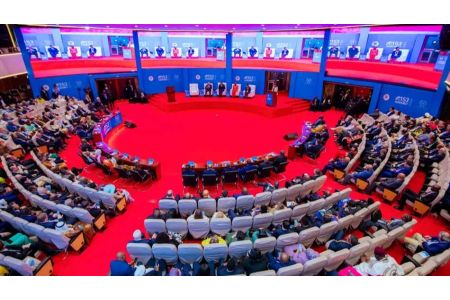
The meeting took place during the launch of the Connectivity Agenda Platform (CAP). During the meeting with Simon Mordue, the parties emphasized the importance of continuing and deepening bilateral work to expand export opportunities for Armenian products amid existing trade and economic restrictions. The parties also noted the significance of the financial assistance provided by the European Union to the Armenian government in the form of budget support. They also emphasized the need to maintain high-level contacts to advance the current bilateral agenda.
At the meeting with Maya Bakrani, among other issues, the agreements reached following the Armenia-EU summit held in Yerevan on May 5 of this year, as well as the progress of their implementation, were discussed.
The parties emphasized the importance of further deepening the partnership between Armenia and the European Union in the areas of connectivity, developing sustainable transport infrastructure, and promoting projects of mutual interest.
They also discussed issues related to the process of removing Armenian air carriers from the EU aviation security list and cooperation in this area.
It should be noted that, according to the RA Statistics Committee, foreign trade turnover between Armenia and the EU increased by 45.2% in January-April 2026, amounting to $1.058 billion. Exports also increased by 97.3% to $355.7 million, amid a 28% increase in imports to $702.9 million.
As a reminder, Russian authorized agencies—Rospotrebnadzor and Rosselkhoznadzor—imposed restrictions on the export of agricultural products and flowers from Armenia to markets in the Eurasian Economic Union (EAEU). The agencies' official statements cited violations as the reason for these restrictions.
At the same time, Armenia traditionally exported approximately 90% of its fresh agricultural produce to the Russian market. Due to the current situation and the difficulties facing Armenian producers, the government has developed several programs to support exports to European markets, including reimbursement of transportation costs and customs duties. Furthermore, farmers have been exempted from loan obligations for a six-month period to enable them to find new markets.







 Azerbaijani Studies Expert: While Azerbaijan Prepares Its Generation for War, Aliyev’s Aide Calls on Armenia to Prepare Armenian Society for “Peace”
 Turkologist: Azerbaijan will never, under any circumstances, stop pressuring the Armenian people
 Political scientist: We need to move away from the question of "when" and replace it with more important questions
 International Law Specialist: Azerbaijan intends to initiate legal proceedings against Armenia by sentencing Armenian prisoners
 Dmitry Medvedev predicted a Ukrainian-like fate for Armenia amid the country`s shift in foreign policy
 Russian Security Council: In Armenia, they want to force Russian asset owners to dispose of their assets
 Zakharova: Russia ready to discuss with Armenia the prospects for expanding military cooperation as part of a review of bilateral ties
 Tevanyan: Armenia, like Ukraine and Moldova, is being drawn into the EU’s global war
 Yerevan City Hall is considering introducing a valet parking system in the city
 Expert: The circus surrounding the “Albanization” of Armenian culture in the presence of foreign ambassadors in occupied Artsakh is genocide
 Political scientist: If Russian-Armenian relations are destroyed, Turkey will take Russia`s place
 Political scientist: The Armenian public is simply obliged to significantly change the entire content of public discourse and struggle
 Cross tattoos are being removed from the skin of Christian prisoners in Azerbaijan by fire, according to a human rights activist.
 Zakharova: Armenia`s likely introduction of visas with Russia will be a step against Yerevan itself
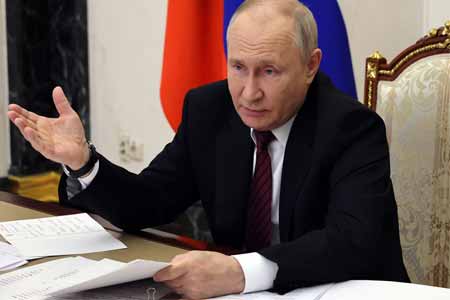 Putin: Armenia`s recognition of Karabakh as part of Azerbaijan in Prague has given Russia`s position on this issue an ambivalent character
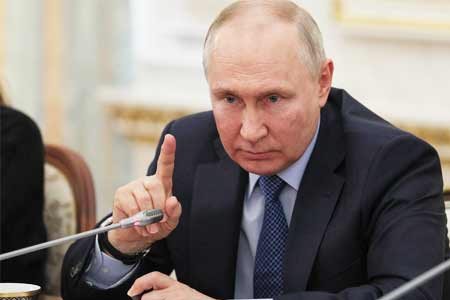 Putin: Armenia`s adoption of the law on EU accession means an announcement of its withdrawal from the Eurasian Economic Union
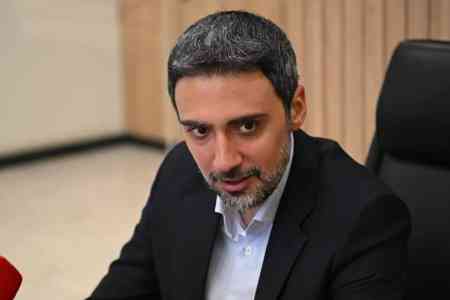 Aram Vardevanyan: Public demands solutions, not apology scandals in Parliament
 Arrested Armenian oligarch on economy and new jobs