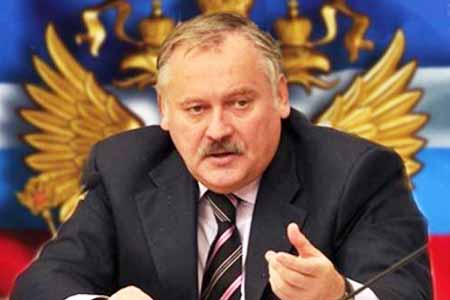
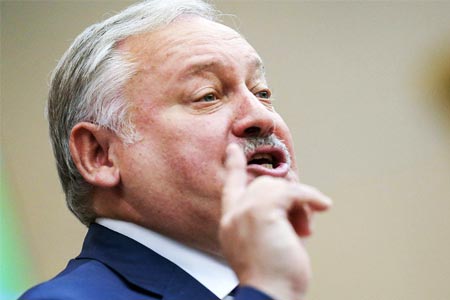
ArmInfo. Moscow must take a "principled position" regarding the political situation in Armenia after the parliamentary elections, while continuing to engage with the current government at the de facto level. This was stated by Konstantin Zatulin, First Deputy Chairman of the State Duma Committee on CIS Affairs, in an interview with Moskovsky Komsomolets.
According to him, the Russian side cannot recognize the recent elections as fully democratic and in line with international standards.
The MP recalled that the electoral process lacked equal conditions for political competition, and pressure was applied against the opposition. Zatulin noted that, in his opinion, such trends persisted both during the pre-election period and after the vote.
"We cannot in any way consider the recent elections democratic or in line with generally accepted standards. We cannot do so because the conditions for a fair electoral contest were not met," the politician said.
He also noted violations during the voting and controversial decisions at certain polling stations, which, he said, could have influenced the final vote distribution.
At the same time, the MP emphasized the need to maintain practical cooperation with Armenia, despite political differences.
"We declare that we do not accept the results of these elections as fair and objective. But since we are allied with Armenia and have traditionally developed ties, we will continue to work with it, based on the fact that today it is led by people who remained in power as a result of unfair, undemocratic elections," the Russian politician said.
He added that Moscow will continue to cooperate with the current Armenian authorities, while simultaneously maintaining a political position of not recognizing the de jure results. Zatulin also commented on the prospects for economic and integration relations between the countries, including the possible continuation of restrictions on the import of Armenian goods and Armenia's continued participation in Eurasian structures. He believed that changes in Yerevan's political course toward the EU could lead to a revision of the terms of cooperation.
Regarding energy prices, he noted that this issue should be resolved depending on Armenia's strategic choices and the format of bilateral relations.
Zatulin also touched on military-political cooperation, including the Russian military presence in the region, emphasizing that Russia will not initiate a review of this relationship but will respond to possible steps by the Armenian side.
In conclusion, he stated that the level of political contacts between Moscow and Yerevan could be reduced, and visits could be reconsidered in favor of greater restraint.









 Analyst: The primary issue with Armenia`s new Parliament Speaker`s speech lies is its one-sided interpretation of the causes of the political crisis
 Expert: Gagik Tsarukyan embodies post-Soviet model of big business-state relations; this model is used in many other post-Soviet countries
 Expert: Azerbaijan promoting aggressive plans against Armenia at state level
 NA Vice Speaker candidate believes his wife`s salary as director of HayPost is the lowest in the company`s history
 RF Permanent Representative: There is no CSTO-Armenia conflict
 Moscow: NATO seeking to "Pull" Armenia away from CSTO Allies
  Political analyst: Russia intends to determine which "Camp" Armenia will choose through a referendum
 Armenia and France discuss further development of strategic partnership and EU cooperation
  To overcome risks Armenia must reduce domestic escalation - expert
  Zatulin: Pashinyan was eager to get back to Russia because he actually lost the elections
 Human rights activist Ruben Melikyan dismissed from YSU
 Zakharova: Armenia`s pro-EU pivot poses economic security risks to EAEU member states
 It`s time for South Caucasus countries to think of South Caucasus as single, unified region - RA premier
  Pashinyan: Armenia and Azerbaijan should leave each other alone