
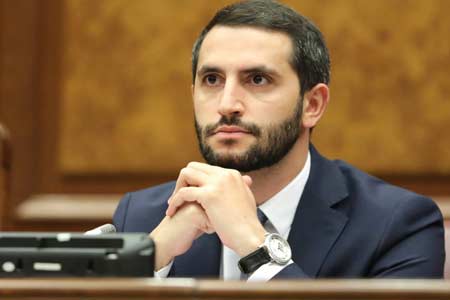
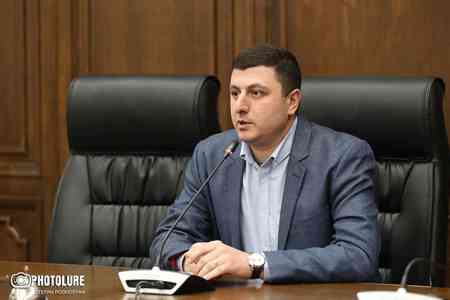
ArmInfo. In fact, Armenian Prime Minister Nikol Pashinyan was re-elected not to a third, but to a fourth term, as stated by Deputy Speaker Ruben Rubinyan in a conversation with journalists in Parliament. He was responding to a question regarding why Pashinyan is seeking another term, given his previous opposition in 2018 to the attempts of the third president, Serzh Sargsyan, to remain in power.
Rubinyan clarified that Pashinyan's tenure began in 2018 (following the Velvet Revolution), followed by periods beginning in 2019, 2021 (snap parliamentary elections-ed), and now 2026. Regarding the criticism directed at former President Sargsyan, Rubinyan argued that the situations are fundamentally different due to the change in the form of government.
Rubinyan claimed that Sargsyan had promised not to remain in power but subsequently changed the Constitution specifically to bypass term limits that would have prevented him from serving a third term as president. "Our situation is completely different. We are now a parliamentary state, and in this regard, we have no restrictions on how long we can remain in power. Furthermore, we must take into account that the parliamentary system grants a mandate not only to Pashinyan but also to the Civil Contract party. Whereas a presidential system presumes that the president has more authority than parliament," Rubinyan noted.
The Deputy Speaker defended the legitimacy of the current government, stating that their electoral results are valid, while questioning those of the opposition. He suggested that issues regarding the opposition should be addressed by law enforcement, citing this as one of the reasons for the government's intention to tighten penalties for bribery. "Because the votes we received are legitimate, and the parliamentary majority is legitimate. As for the opposition, their issue should be resolved by law enforcement agencies. This is, among other things, the reason for our intention to toughen penalties for bribery," Rubinyan stated.
Rubinyan also commented on the political situation in Gyumri, noting that the ruling party received over 50% of the vote there in the recent elections. "Although technically this does not mean that new elections must be held there immediately, I believe that from a political point of view, there are sufficient grounds to argue that the Gyumri Council of Elders should be dissolved. A crisis of legitimacy has emerged in Gyumri, which must also be resolved," he said.
Rubinyan also expressed his position on the opposition's mandates. When asked what would happen to parliament if the opposition didn't take seats, given that the constitution requires at least 101 deputies, the deputy speaker noted that he didn't see any issues. "Theoretically, if the opposition didn't take seats, there wouldn't be a constitutional crisis. It's impossible to say the country has had an opposition at all for the past five years, given that they haven't shown up for sessions. Look, there are empty seats; there's no opposition. For the past five years, 50% of parliament has been empty. Therefore, we don't see any problems—if they want to take seats, let them take them; if they don't want to, let them not take them," Rubinyan concluded.



















 Analyst: The primary issue with Armenia`s new Parliament Speaker`s speech lies is its one-sided interpretation of the causes of the political crisis
 Expert: Gagik Tsarukyan embodies post-Soviet model of big business-state relations; this model is used in many other post-Soviet countries
 Expert: Azerbaijan promoting aggressive plans against Armenia at state level
 Iranologist: Baku`s propaganda of might masks the country`s inability to provide water to its own population
 NA Vice Speaker candidate believes his wife`s salary as director of HayPost is the lowest in the company`s history
 RF Permanent Representative: There is no CSTO-Armenia conflict
 Moscow: NATO seeking to "Pull" Armenia away from CSTO Allies
  Political analyst: Russia intends to determine which "Camp" Armenia will choose through a referendum
 Narek Karapetyan will give up his parliamentary salary in favor of charitable contributions.
 Armenia and France discuss further development of strategic partnership and EU cooperation
  To overcome risks Armenia must reduce domestic escalation - expert
  Zatulin: Pashinyan was eager to get back to Russia because he actually lost the elections
 Human rights activist Ruben Melikyan dismissed from YSU
 Pashinyan removed from INNOPROM guest list
 Zakharova: Armenia`s pro-EU pivot poses economic security risks to EAEU member states
 It`s time for South Caucasus countries to think of South Caucasus as single, unified region - RA premier
  Pashinyan: Armenia and Azerbaijan should leave each other alone
 Moscow sees situation with Armenia as attempt to attack Russia-involving integration associations - Russian presidential aid