
ArmInfo. The victory of incumbent Prime Minister Nikol Pashinyan's party in Armenia's parliamentary elections does not give him the right to make any major changes in political course, either domestically or in foreign policy.
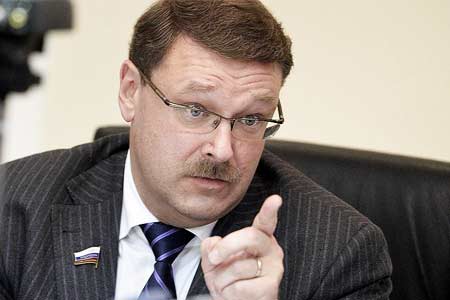
At the same time, Russia has every reason to remove all benefits from its trade and economic agreements with Armenia that were based solely on the friendly nature of the two countries' relations. This was stated by Deputy Chairman of the Federation Council Konstantin Kosachev, in response to questions from the Parlamentskaya Gazeta outlet.
"The votes he received, apparently, will give him the right to form a government. But, in my deep conviction, they do not give him any right—moral, political, or legal—to undertake any large-scale reforms to the country's domestic or foreign policy. Mr. Pashinyan, who received less than half of the votes in Armenia, clearly lacks the people's mandate to do so. With such a vote result, he is obliged to maintain the continuity of Armenia's policy and not reverse it 180 degrees, as he is attempting," Kosachev stated.
He recalled that Armenia is a member of the Eurasian Economic Union, and has yet withdrawn from the CSTO, although making statements to that effect. He added that Armenia is trying to build normal, friendly relations with Russia, although there have already been enough "turns" in this regard. "In my view, Pashinyan and his team's statement that they will never do anything against Russia is 'erased' by the very fact that the May EU summit was held in Yerevan and Zelensky, the head of the Kyiv regime, was invited. It would have been impossible to imagine a more anti-Russian gathering—what was done then in Yerevan during the Armenia-EU summit was an absolutely anti-Russian action, without a doubt. In my view, Mr. Pashinyan has no mandate to continue this kind of action, whether it involves holding anti-Russian gatherings on Armenian territory with the participation of Zelensky, or withdrawing the country from the EAEU or the CSTO," he added. When asked to clarify the current policy of the authorities led by Prime Minister Pashinyan, Kosachev noted that, in his view, it consists of sitting on every possible "chair" in order to profit from each of them—somewhere in the economy, somewhere in politics, somewhere else.
"Some say, including Mr. Pashinyan himself, that this is a pragmatic policy. But, in my opinion, such a policy is dishonest, to call a spade a spade. Consistency is essential in politics, and what, in Armenia's case, is now coyly disguised as a vague term like 'multi-vectorism,' in fact, in my view, is more accurately characterized by the word 'omnivorousness' and is associated with attempts to get a piece of every pie at any cost. And this almost always ends badly—sooner or later, I suspect, Armenia under Pashinyan will have nowhere else to bite off from," he said.
Kosachev also believes that Russia must now be very selective in its trade and economic relations with Armenia. "I would start by removing from the agreements all the benefits and advantages flowing from the friendly nature of Russian-Armenian relations—currently, the relations between Moscow and Yerevan can only be called such with great difficulty. Yes, they are not unfriendly, but you can't call them friendly either. But when it comes to any actions or measures we take against unfriendly states, I would certainly not rush and exercise caution. Because, firstly, our relations have not yet become unfriendly, and secondly, we must clearly understand that sanctions and similar measures often have the exact opposite effect on people's moods," he concluded.





 Expert: Economic pressure on Armenia may be virtually painless for other EAEU members, but not for Armenia itself
 Expert on protests in France: Civilizations fade when society loses a vision of the future
 Turkologist: Azerbaijan is not all-powerful—its vulnerabilities should become part of Armenia’s security strategy
 Opinion: The development of the Amulsar mine near the resort town of Jermuk is the beginning of an environmental disaster in Armenia
 Expert: The arrest of opposition figures in Armenia for social media posts is a systematic attempt to intimidate the public and suppress dissent.
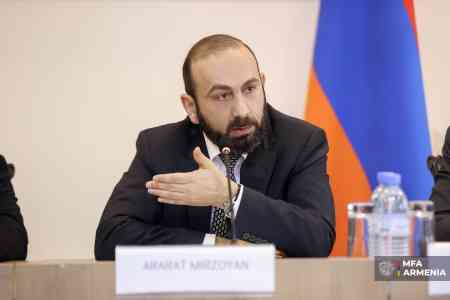 The Armenian Foreign Minister commented on the country`s return to work within the CSTO.
 The Artsakh Public Council expressed outrage at the UN Secretary-General`s behavior
 Lukashenko called for Armenia to assume the CIS presidency in 2029
 Dmitry Medvedev predicted a Ukrainian-like fate for Armenia amid the country`s shift in foreign policy
 Russian Security Council: In Armenia, they want to force Russian asset owners to dispose of their assets
 Zakharova: Russia ready to discuss with Armenia the prospects for expanding military cooperation as part of a review of bilateral ties
 Tevanyan: Armenia, like Ukraine and Moldova, is being drawn into the EU’s global war
 Yerevan City Hall is considering introducing a valet parking system in the city
 Expert: The circus surrounding the “Albanization” of Armenian culture in the presence of foreign ambassadors in occupied Artsakh is genocide
 Political scientist: If Russian-Armenian relations are destroyed, Turkey will take Russia`s place
 Political scientist: The Armenian public is simply obliged to significantly change the entire content of public discourse and struggle
 Cross tattoos are being removed from the skin of Christian prisoners in Azerbaijan by fire, according to a human rights activist.
 Zakharova: Armenia`s likely introduction of visas with Russia will be a step against Yerevan itself
 Putin: Armenia`s recognition of Karabakh as part of Azerbaijan in Prague has given Russia`s position on this issue an ambivalent character
 Putin: Armenia`s adoption of the law on EU accession means an announcement of its withdrawal from the Eurasian Economic Union