

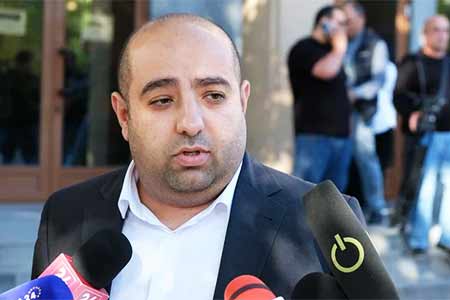
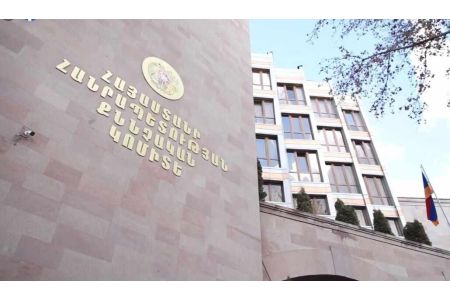
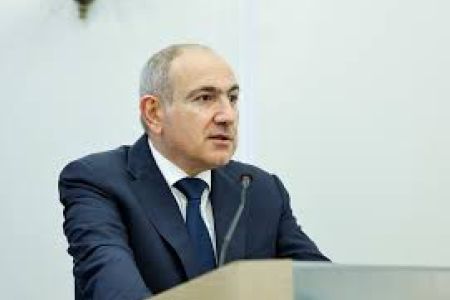
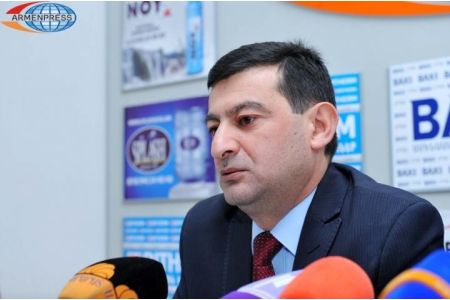
ArmInfo.The lack of consistency in the actions of law enforcement agencies indicates their interest in engaging in anti-campaigning policies, as stated by lawyer Hovhannes Khudoyan at a press conference on May 15 titled "Corruption during the Pre-Election Period."
The lawyer clarified that the practice of mentioning the names of political parties in law enforcement reports or using their emblems in video footage poses a serious problem. He stated that such an approach can only be justified in cases where the criminal case involves the actions of an entire political team and it is necessary to demonstrate which specific party is involved. "However, when it comes to a specific incident for example, the illegal actions of one of the campaign staff in a particular region such a presentation of information already takes on the characteristics of an anti-campaigning campaign," the lawyer explained.
Khudoyan emphasized that law enforcement agencies have the right to inform the public within the scope of their authority; moreover, they are obligated to do so for the purposes of crime prevention. "Warning citizens that certain actions are criminal is consistent with the logic of crime prevention. The problem arises when brief official announcements are accompanied by edited videos that effectively target the political forces participating in the elections. Because such materials mention the names of parties and show footage that is not directly related to the case. In this case, it is no longer a matter of informing the public, but of using one's powers as part of an anti-campaigning policy," the lawyer noted. Khudoyan also drew attention to another aspect of the Anti-Corruption Committee's activities. According to him, the published recordings included statements by an alleged member of the campaign headquarters, who, when referring to people from the same field, used the term "rabble." The lawyer emphasized that this expression has no legal significance, meaning the Anti-Corruption Committee had no need to publish it, as it is irrelevant to the case. Nevertheless, as Khudoyan noted, such fragments are made public, after which they become part of the political agenda for a certain period.
"A similar approach has previously been characteristic of other agencies, particularly the Investigative Committee and the National Security Service. At this stage, this tool is being actively used by the Anti- Corruption Committee," the lawyer noted.
In this context, Khudoyan also touched on the situation surrounding the "Armenia" bloc of Armenia's second president, Robert Kocharyan. He noted that, as in previous cases, the individuals involved in the case had not even been questioned at the time, while the crime report had already been presented to the public as an established fact. According to the lawyer, even if law enforcement agencies occasionally remind us of the presumption of innocence, such reservations are largely formal in nature, since it is the published video and audio materials that make the main impression on the public.
"I cannot disclose all the circumstances of the case for fear of compromising the investigation, but according to my preliminary information, this involves financial relationships between close friends. For example, this could be a situation where one friend lends money to another. After the announcement of this case was released, the court imposed house arrest and administrative supervision on the defendants. However, that same day, the information about alleged pressure being exerted on one of the defendants was refuted," the lawyer said.
However, as Khudoyan noted, the public has not seen the same active reporting of new developments in the case from the Anti-Corruption Committee since then. "More often than not, subsequent information is published much less prominently, whereas at the initial stage, reporting on the case is more intensive. The lack of consistency in the actions of law enforcement agencies indicates their interest in participating in anti-campaigning policies," Khudoyan concluded.
Recall, on May 14, the "Armenia" bloc of Armenia's second president, Robert Kocharyan, confirmed reports that the Armenian Anti-Corruption Committee had conducted searches at the political party's office in Spitak. The bloc noted that the searches were not unexpected and expressed the belief that this was an attempt to intimidate their political party ahead of the parliamentary elections on June 7, 2026. Furthermore, the bloc emphasized that what is happening is not a legitimate process, but another cheap attempt to interfere with the normal functioning of the political party's structures.















 Armenian Historian: People Like Magdalena Grono Should Be Kept Away from the Thresholds of Armenian Shrines
 Azerbaijani studies expert: Armenia’s Foreign Ministry could use the ICC against Aliyev’s Armenophobic statements
 An Armenian political analyst exposed Hajiyev’s lies and attempts to mislead diplomats accredited in Azerbaijan in occupied Artsakh
 Expert: The circus surrounding the “Albanization” of Armenian culture in the presence of foreign ambassadors in occupied Artsakh is genocide
 Zakharova: Russia ready to discuss with Armenia the prospects for expanding military cooperation as part of a review of bilateral ties
 Tevanyan: Armenia, like Ukraine and Moldova, is being drawn into the EU’s global war
 Yerevan City Hall is considering introducing a valet parking system in the city
 Political scientist: If Russian-Armenian relations are destroyed, Turkey will take Russia`s place
 Political scientist: The Armenian public is simply obliged to significantly change the entire content of public discourse and struggle
 Cross tattoos are being removed from the skin of Christian prisoners in Azerbaijan by fire, according to a human rights activist.
 Zakharova: Armenia`s likely introduction of visas with Russia will be a step against Yerevan itself
 Putin: Armenia`s recognition of Karabakh as part of Azerbaijan in Prague has given Russia`s position on this issue an ambivalent character
 Putin: Armenia`s adoption of the law on EU accession means an announcement of its withdrawal from the Eurasian Economic Union
 Medvedev: Yerevan will never become an EU member, but it will permanently damage relations with the Eurasian Economic Union, including with Moscow.
 Aram Vardevanyan: Public demands solutions, not apology scandals in Parliament
 Arrested Armenian oligarch on economy and new jobs
  "In Baku, we gave a worthy rebuff to the false claims regarding the past and present of our people" – Former Artsakh Parliament Speaker from Baku captivity
  NA Vice Speaker candidate believes his wife`s salary as director of HayPost is the lowest in the company`s history