

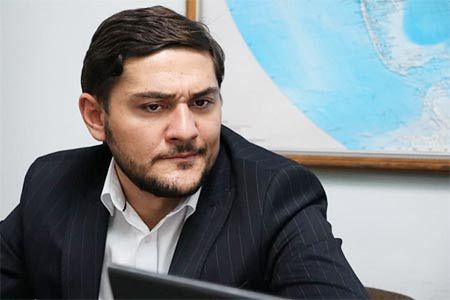
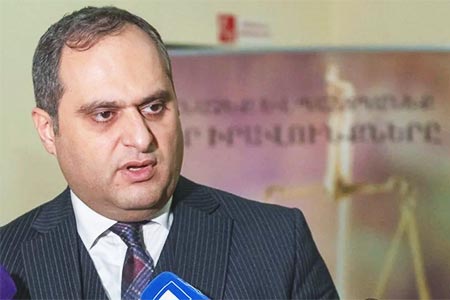
ArmInfo. The inclusion of "material interest" (with regard to participating in rallies) as a criminal offense in Armenia's Criminal Code serves solely the interests of the ruling Civil Contract party, according to lawyer Varazdat Harutyunyan. Speaking at a Yerevan press conference titled "Corruption in the Pre-election Period," Harutyunyan warned that the current administration is using this legal loophole against political opponents ahead of June's parliamentary elections.
The lawyer noted that the criminal law provision in question is virtually unprecedented in international legal practice. He recalled that the amendments in question were made to the Armenian Criminal Code in 2021, adding a new element "material interest" to the provision on coercing a person to participate or not participate in assemblies.
The lawyer argues that this unique phrasing has no equivalent in international standards and effectively allows the state to restrict and criminalize standard political mobilization. ""Initially, this norm was not flagged as a violation of international standards due to a mistranslation sent to the Venice Commission. In its inquiry, Armenia's Constitutional Court used an English translation that deviated from the original Armenian text. It introduced the word 'coercion,' which distorted the true meaning of the clause. Believing the law was strictly about stopping the forced coercion of citizens to attend rallies, the Venice Commission issued a positive opinion," the lawyer clarified.
After the amendments were introduced, the lawyer noted, Avetik Chalabyan, coordinator of the Hayakve initiative, was arrested for the first time under this article in May 2022 (he was accused of providing financial incentives to the head of the student council at the Agrarian University in order to attract approximately two thousand students to protests ed.). "The defense pointed out that the relevant amendments were only supposed to take effect in July 2022, meaning that at the time of the arrest, the 'material interest' component was still essentially absent from the current version of the article," the lawyer said.
At the same time, Harutyunyan noted that the practice of providing material incentives for participation in public events is widespread worldwide. Specifically, the lawyer noted, in the United States, there are specialized organizations and campaigns dedicated to attracting people to mass events and providing extras.
In this sense, the state should not interfere with a person's motivation to participate in a rally unless there is an element of coercion. However, following the Chalabyan case, other criminal cases were launched against various individuals specifically on the grounds of "material interest" in organizing participation or non-participation in rallies. The basis for such cases, as a rule, was wiretaps published by the Investigative Committee, which were mostly doctored," the lawyer noted.
Harutyunyan mentioned that in August 2024, the parliamentary opposition appealed to the Constitutional Court to review the constitutionality of this provision. However, in October of that year, the court suspended consideration of the case to request an advisory opinion from the Venice Commission. "The Constitutional Court stated that freedom of assembly includes three protective components: a person's real opportunity to participate in rallies, the absence of obstacles to such participation, and the individual's internal freedom and motivation to participate. It was this last component that was introduced to justify the constitutionality of the disputed provision," Harutyunyan asserted.
The lawyer characterized this approach as a manifestation of "legal paternalism," where the state begins to interfere in the personal motivations of citizens. According to him, this contradicts the very logic of freedom of assembly, since the state's task is only to ensure the possibility of participation in rallies, and not to control the reasons to participate. He emphasized that there are no similar precedents in international practice. Harutyunyan explained why the Venice Commission allowed for certain restrictions on material incentives during election campaigns. "This is due to the need to ensure equality of opportunity between political forces, for example, during election campaigning, since wealthier participants in the electoral process are able to organize large-scale events and thereby gain an advantage over competitors without comparable resources," Harutyunyan stated.
According to the lawyer, the court's decision partially defined the framework and made it clear which expenses would not be considered a violation of the law, although it did not, in essence, resolve the issue, as it only benefits the ruling party, which continues to use it against its political opponents. "As a result, any recordings of conversations that mention money, even if they are not directly related to political processes, can be used as grounds for accusations. This creates a 'freezing effect' that limits citizens' participation in political life and ultimately serves as a tool of political pressure," Harutyunyan concluded.
Recall, on May 14, 2022, activist Avetik Chalabyan was arrested on suspicion of financially incentivizing the head of the Agrarian University's student council to attract 2,000 students to protests. Notably, Chalabyan was charged with acts that were not considered crimes at the time they were committed. Later, the Venice Commission recognized that the Armenian authorities had used the clause in the Armenian Criminal Code on "material interest in participating in assemblies" to imprison their opponents, although initially, due to a mistranslation, it had deemed it consistent with international standards and consistent with restrictions on freedom of assembly.




























 Armenian Historian: People Like Magdalena Grono Should Be Kept Away from the Thresholds of Armenian Shrines
 Azerbaijani studies expert: Armenia’s Foreign Ministry could use the ICC against Aliyev’s Armenophobic statements
 An Armenian political analyst exposed Hajiyev’s lies and attempts to mislead diplomats accredited in Azerbaijan in occupied Artsakh
 Expert: The circus surrounding the “Albanization” of Armenian culture in the presence of foreign ambassadors in occupied Artsakh is genocide
 Zakharova: Russia ready to discuss with Armenia the prospects for expanding military cooperation as part of a review of bilateral ties
 Tevanyan: Armenia, like Ukraine and Moldova, is being drawn into the EU’s global war
 Yerevan City Hall is considering introducing a valet parking system in the city
 Political scientist: If Russian-Armenian relations are destroyed, Turkey will take Russia`s place
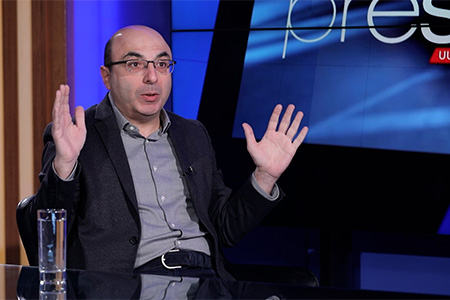 Political scientist: The Armenian public is simply obliged to significantly change the entire content of public discourse and struggle
 Cross tattoos are being removed from the skin of Christian prisoners in Azerbaijan by fire, according to a human rights activist.
 Zakharova: Armenia`s likely introduction of visas with Russia will be a step against Yerevan itself
 Putin: Armenia`s recognition of Karabakh as part of Azerbaijan in Prague has given Russia`s position on this issue an ambivalent character
 Putin: Armenia`s adoption of the law on EU accession means an announcement of its withdrawal from the Eurasian Economic Union
 Medvedev: Yerevan will never become an EU member, but it will permanently damage relations with the Eurasian Economic Union, including with Moscow.
 Aram Vardevanyan: Public demands solutions, not apology scandals in Parliament
 Arrested Armenian oligarch on economy and new jobs
  "In Baku, we gave a worthy rebuff to the false claims regarding the past and present of our people" – Former Artsakh Parliament Speaker from Baku captivity
