
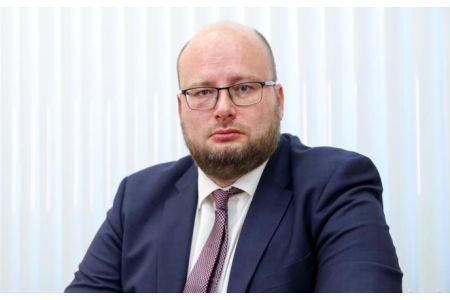
ArmInfo. The European Union is seeking to separate Armenia from Russia by strengthening its own control over the country. Mikhail Kalugin, Director of the Fourth Department of the CIS Countries at the Russian Foreign Ministry, stated this in an interview with TASS.
According to the diplomat, the European Union needs Armenia to address its own geopolitical objectives, which are currently focused on confrontation with Russia. "We see how the EU is trying to exploit the upcoming parliamentary elections in Armenia for this purpose. Two missions have already been deployed in the republic, similar to those deployed during the election campaigns in Moldova," he noted. "The stated goals may certainly sound noble, but in reality, the missions' purpose is clear: to strengthen the EU's control over the republic's socio-political life and economy, thereby facilitating its break from Moscow," Kalugin added.
As the department head pointed out, European "specialists" are literally trying to "make" Russia an enemy, creating the false impression that Moscow is "against the establishment of an independent Armenia." Furthermore, Kalugin continued, the Europeans baselessly accuse Russia of "hybrid attacks" and interference in the republic's internal affairs, "while for some reason they don't consider their own deep involvement in them to be such."
"And in general, the EU has repeatedly been caught red-handed attempting to orchestrate electoral processes in other countries. We notice how some Armenian media outlets and officials are joining in spreading these messages," the diplomat concluded.
At the same time, he acknowledged that Yerevan's so-called European path could lead to systemic changes in relations with Moscow. Commenting on Russian Deputy Prime Minister Alexey Overchuk's statement that Armenia has come too close to the point where Russia will have to restructure its relations with the country, Kalugin noted that Overchuk's statement is an example of the signals that the Russian side has conveyed and continues to convey to the Armenian leadership and public at various levels.
"We believe that the citizens of our countries should know that Yerevan's advancement along the so-called European path could at some point lead to systemic changes in Russian-Armenian relations," Kalugin noted.
The head of the department emphasized that "the EU offers no clear alternative in terms of instruments for ensuring security, economic stability, well-being, and prosperity, which underpin the country's sovereignty." "And this is understandable-Brussels' interest lies not in caring for Armenia or the countries of the South Caucasus, but in resolving, first and foremost, its own geopolitical challenges, which are currently focused on confrontation with Russia," the diplomat stated.
He emphasized that Russia and Armenia are bound by a number of treaties that "guard the republic's security." "The CSTO remains an important element of this architecture. For us, Yerevan's 'freezing' of its membership in the organization does not change the essence of these obligations. It is difficult to imagine what could replace such guarantees. As we have seen during the EU-sponsored summits held in Yerevan, no one offers a tangible alternative," the diplomat noted.
According to him, Russia, in turn, "has not only offered what it can, but has for many years actually and effectively ensured Armenia's stability and security." Among the Russian-Armenian security agreements, Kalugin also named the 1992 treaty on protecting the border with Turkey and Iran by Russian border guards, the 1995 treaty on the deployment of a military base, and the 1997 treaty on friendship, cooperation, and mutual assistance.
"We are the republic's main trade and economic partner. By the end of 2025, 36% of its foreign trade turnover was with our country (while the EU accounted for about 10%). 98% of agricultural products and 78% of strong alcoholic beverage exports go to the Russian market. 98% of foreign trade transactions are conducted in national currencies. Dozens of domestic business projects have been launched in Armenia, with a cumulative investment volume of $4.2 billion. Russia is the guarantor of energy and food security. At the same time, vital goods and energy resources for Armenia are supplied at prices significantly below market prices," the head of the Russian Foreign Ministry department concluded. He also commented on the Ukrainian President's threat from Yerevan, noting that the Armenian authorities seemed to ignore Volodymyr Zelenskyy's "disgusting attacks" against Moscow during his visit to Armenia.
"Of course, Moscow noted Volodymyr Zelenskyy's clearly Brussels-inspired visit to Yerevan, along with his disgusting anti-Russian attacks, which the Armenian hosts studiously ignored," the diplomat noted.
According to Kalugin, holding the European Political Community and Armenia-EU summits in Armenia fits into the logic of creating an alluring European "mirage" for the Armenian population, especially on the eve of parliamentary elections.
"From this perspective, one point is indicative. The statement following the Armenia-EU summit mentions a sum-I emphasize-of ?2.5 billion for 'possible investments' in Armenia. This is exactly the same amount the EU promised several years ago, but has been unable to secure in all this time," the head of the department noted. "That is, the Europeans are trying to 'sell' something that doesn't exist, and not for the first time. The statement also missed the importance of joint efforts to decommission the Metsamor Nuclear Power Plant-one of the pillars of the republic's energy supply-behind the glamorous veneer," the diplomat added.
As Kalugin pointed out, all this only confirms that the Europeans' obsessive attention to their so-called "equal partners" is based on a purely utilitarian approach, which has been repeatedly stated. "In Brussels, no one even considered the interests of Armenia, which until recently sought to maintain an equitable position on the Ukrainian crisis. The Europeans brought their Russophobic agenda to the republic and- wittingly or unwittingly-pulled Yerevan into it. Essentially, they used the country as a convenient platform for their political schemes," the department head stated.














 Armenian Historian: People Like Magdalena Grono Should Be Kept Away from the Thresholds of Armenian Shrines
 Azerbaijani studies expert: Armenia’s Foreign Ministry could use the ICC against Aliyev’s Armenophobic statements
 An Armenian political analyst exposed Hajiyev’s lies and attempts to mislead diplomats accredited in Azerbaijan in occupied Artsakh
 Expert: The circus surrounding the “Albanization” of Armenian culture in the presence of foreign ambassadors in occupied Artsakh is genocide
 Zakharova: Russia ready to discuss with Armenia the prospects for expanding military cooperation as part of a review of bilateral ties
 Tevanyan: Armenia, like Ukraine and Moldova, is being drawn into the EU’s global war
 Yerevan City Hall is considering introducing a valet parking system in the city
 Political scientist: If Russian-Armenian relations are destroyed, Turkey will take Russia`s place
 Political scientist: The Armenian public is simply obliged to significantly change the entire content of public discourse and struggle
 Cross tattoos are being removed from the skin of Christian prisoners in Azerbaijan by fire, according to a human rights activist.
 Zakharova: Armenia`s likely introduction of visas with Russia will be a step against Yerevan itself
 Putin: Armenia`s recognition of Karabakh as part of Azerbaijan in Prague has given Russia`s position on this issue an ambivalent character
 Putin: Armenia`s adoption of the law on EU accession means an announcement of its withdrawal from the Eurasian Economic Union
 Medvedev: Yerevan will never become an EU member, but it will permanently damage relations with the Eurasian Economic Union, including with Moscow.
 Aram Vardevanyan: Public demands solutions, not apology scandals in Parliament
 Arrested Armenian oligarch on economy and new jobs
  "In Baku, we gave a worthy rebuff to the false claims regarding the past and present of our people" – Former Artsakh Parliament Speaker from Baku captivity