

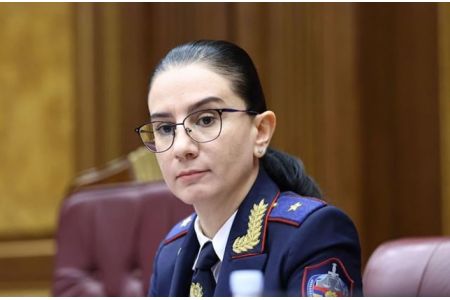
ArmInfo. During a meeting of the RA National Assembly Committee on State and Legal Affairs on March 29, Prosecutor General Anna Vardapetyan, while presenting her report on the work carried out by her office in 2025, reported on some of the results of the investigation into the events in Yerevan on March 1-2, 2008.
The Prosecutor General noted that the criminal case against Deputy Chief of Police Sasha Afyan, which was previously closed due to the expiration of the statute of limitations, was reopened on August 11, 2025. However, since the act of torture imputed to him constitutes cruel treatment and cannot be subject to the statute of limitations, on December 25, 2025, a decision was made to initiate a new public criminal prosecution against Sasha Afyan. On the same day he was charged with an offence outlined in Part 2 of Article 38-309 of the former Criminal Code. Namely, Afyan, having exceeded his official authority on March 1, 2008, in collusion with other high-ranking police officials, organized the dispersal of a peaceful demonstration in Freedom Square in Yerevan. This involved the use of violence and special means, forcible removal of demonstrators from the square, followed by a ban on their gatherings in the central districts of the city. Thus, his actions violated the rights and legitimate interests of individuals, as well as the rights of society and the state. On December 26, 2025, it was decided to separate the criminal proceedings against the accused, Sasha Afian. The case was sent to court with an approved indictment.
Furthermore, as Anna Vardapetyan noted, on November 24, 2025, the prosecutor submitted new indictments to the court against Robert Kocharyan, Armen Gevorgyan, Seyran Ohanyan, Yuri Khachaturov, and Armen Gevorgyan. On January 16, 2026, a judge of the Anti-Corruption Court approved the new indictments against them. On August 11, 2025, the Prosecutor General's Office filed a lawsuit with the Anti-Corruption Court against Robert Kocharyan, Armen Gevorgyan, Seyran Ohanyan, and Yuri Khachaturov, demanding the retroactive confiscation of 670 million drams in favor of the Republic of Armenia as compensation for the damages caused. At the same time, the Prosecutor General's Office filed a motion for a security measure, requesting the seizure of the property of Robert Kocharyan, Armen Gevorgyan, Seyran Ohanyan, and Yuri Khachaturov in the amount of the claim of 670 million drams. By a decision of the Anti-Corruption Court on August 13, 2025, the claim was accepted for consideration, and the motion for a security measure was granted.
On March 6, 2026, the prosecutor presented the criminal case materials to the court with the approved indictment against the defendants in the March 1 case: Robert Melkonyan, who served as commander of the patrol regiment of the Yerevan City Police Department of the Republic of Armenia in 2008; his deputy, Valery Osipyan; and Karen Movsisyan, who served as a company commander in the same regiment.
According to the case materials, the gatherings near the Myasnikyan monument were the result of spontaneous and unorganized events, while the earlier dispersal of protesters from Freedom Square, including its violent nature, as well as several other similar or uncontrolled events that occurred that same day, could have played a role in the subsequent escalation of violence and did not constitute pre-planned unrest or an attempted coup. There was no compelling evidence to support the then authorities' assertions that the protesters who perpetrated violence in the area were armed with firearms rather than improvised devices, nor was there any evidence that the deaths were the result of deliberate actions on the part of the protesters.
A review of the aforementioned events revealed that the lack of clear, detailed, and mandatory instructions on the use of tear grenades, the lack of proper training and supervision, and the use of tear grenades significantly contributed to the misuse of these crowd-dispersal weapons in violation of safety regulations, leading to the deaths of three people. The deaths of five additional people from firearms were caused by state actions.
The positions taken in the decisions of the cases Farmanyan et al. v. Armenia, Mushegh Saghatelyan v. Armenia, Myasnik Malkhasyan v. Armenia, Dareskizb LLC v. Armenia, and Virabyan v. Armenia support the opinion that the conclusions regarding the criminal-law assessment of the events that took place in Yerevan on March 1-2 are valid. These conclusions, in particular, concern the legal prohibition on the application of statutes of limitations in this case.










 Expert: The arrest of opposition figures in Armenia for social media posts is a systematic attempt to intimidate the public and suppress dissent.
 Azerbaijani Studies Expert: While Azerbaijan Prepares Its Generation for War, Aliyev’s Aide Calls on Armenia to Prepare Armenian Society for “Peace”
 Turkologist: Azerbaijan will never, under any circumstances, stop pressuring the Armenian people
 Political scientist: We need to move away from the question of "when" and replace it with more important questions
 Lukashenko called for Armenia to assume the CIS presidency in 2029
 Dmitry Medvedev predicted a Ukrainian-like fate for Armenia amid the country`s shift in foreign policy
 Russian Security Council: In Armenia, they want to force Russian asset owners to dispose of their assets
 Zakharova: Russia ready to discuss with Armenia the prospects for expanding military cooperation as part of a review of bilateral ties
 Tevanyan: Armenia, like Ukraine and Moldova, is being drawn into the EU’s global war
 Yerevan City Hall is considering introducing a valet parking system in the city
 Expert: The circus surrounding the “Albanization” of Armenian culture in the presence of foreign ambassadors in occupied Artsakh is genocide
 Political scientist: If Russian-Armenian relations are destroyed, Turkey will take Russia`s place
 Political scientist: The Armenian public is simply obliged to significantly change the entire content of public discourse and struggle
 Cross tattoos are being removed from the skin of Christian prisoners in Azerbaijan by fire, according to a human rights activist.
 Zakharova: Armenia`s likely introduction of visas with Russia will be a step against Yerevan itself
 Putin: Armenia`s recognition of Karabakh as part of Azerbaijan in Prague has given Russia`s position on this issue an ambivalent character
 Putin: Armenia`s adoption of the law on EU accession means an announcement of its withdrawal from the Eurasian Economic Union