

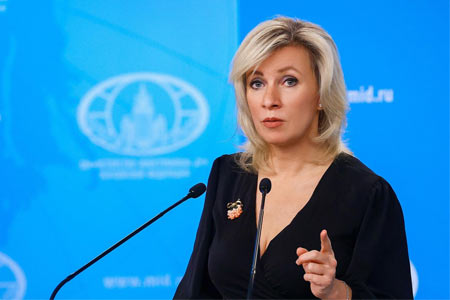
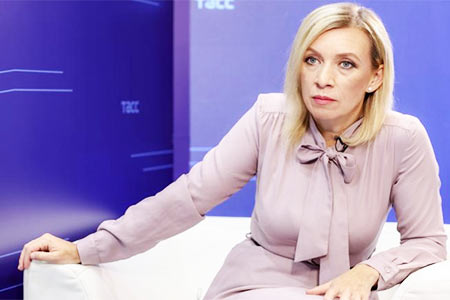
ArmInfo. Moscow is convinced that the goal of the new EU civilian mission in Armenia is to interfere in the country's internal affairs, as stated by Russian Foreign Ministry spokesperson Maria Zakharova during a weekly briefing on April 24.
She recalled that on April 21, the Council of EU Foreign Ministers decided to dispatch a partner mission to Armenia. "We're talking about a second civilian mission in this country. It's clear that the new mechanism, which the EU is presenting as helping Yerevan combat hybrid threats, will give Brussels additional leverage over Armenian ministries and national institutions—this is also clear, obvious, and, by the way, no one in Brussels is hiding it. Under the pretext of tracking illicit financial flows, countering cyberattacks, and manipulating information and information interference by third countries, the EU will attempt to interfere in Armenia's internal affairs," Zakharova expressed her conviction, urging to "call a spade a spade".
She expressed confidence that the EU will also seek to influence the outcome of the parliamentary elections in Armenia on June 7. As evidence for her assertions, she cited the mission's rationale: "tracking illicit financial flows." Zakharova expressed her belief that if the EU wanted to track illicit financial flows, it would be more logical to send such a mission to Ukraine rather than Armenia. "So why are they sending a mission to Armenia and not Ukraine? Because their goal isn't to monitor, but to influence—to politically influence and manipulate," the Russian diplomat added.
According to her, the mission, which ostensibly intends to combat certain interferences, is itself an instrument of such interference. Zakharova recalled that a similar partner mission is operating in Moldova, and everyone is well aware of the results of its activities.
"It has been repeatedly emphasized that the expanded presence of non-regional actors, including from the European Union and other structures, in the South Caucasus runs counter to the principle of regional responsibility, whereby the region's problems are resolved by its countries and their neighbors. It also carries risks for the very fragile stability in this part of Eurasia. And it's long been known what Western European political thinking is geared toward—drawing its partners into some kind of coordinate system with empty promises. This system, as a rule, is Russophobic. Afterwards, they use them to solve their own problems," the Russian Foreign Ministry spokesperson continued.
At the same time, Zakharova emphasized that Moscow sees the EU, which has adopted a course of "militarization to counter the mythical Russian threat, seeking to turn Armenia into its outpost." "This all stands in stark contrast to Yerevan's official policy of not serving as a bargaining chip for the interests of third countries. Armenia's agreement to host a new mission, as EU officials describe it, is apparently linked to the fact that the leadership hopes to use it to accelerate its progress along the European path. We simply shouldn't confuse the path to the European Union through EU membership—and quite a few countries are already stalling on this path—with the European path. It seems to me that Armenia, like Moldova, doesn't need the path to the EU, but rather a European path, and that's definitely not the right path," the Russian diplomat continued.
Zakharova pointed out that assistance to mitigate the damage to the national economy and the population's well-being will definitely not be forthcoming if Yerevan shifts its focus from EU membership to simply the EU and European demands. "We hope that our Armenian allies and friends will not allow this new, so- called mission to be used to interfere in their internal affairs and draw Yerevan into the West's geopolitical games, which would involve the destruction of friendly ties with our country and its involvement in Brussels' anti-Russian policies," Zakharova concluded.
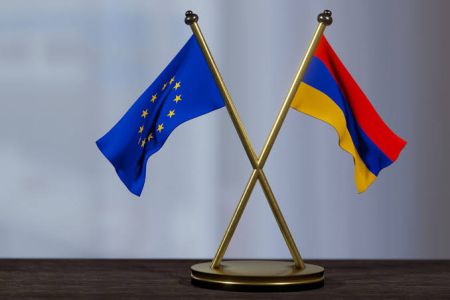
Recall, on April 21, the EU Council of Foreign Ministers approved the deployment of a new civilian mission to Armenia. It will last for two years. According to the statement, "the mission will strengthen Armenia's resilience to hybrid threats by providing strategic and practical advice and support to ministries and security agencies." These consultations will focus on policy development, identifying and responding to external information manipulation, cyberattacks, and illicit financial flows. The mission will also assess the need to develop Armenia's security capacity to enable the country to more effectively identify and respond to hybrid threats in line with EU methodologies and standards.
Earlier, Radio Liberty reported that it had a letter at its disposal from Armenian Foreign Minister Ararat Mirzoyan to Brussels, in which he "requested the deployment of a rapid response team to Yerevan to counter Kremlin disinformation and Russian interference in the parliamentary elections in Armenia, and then, possibly, a more permanent civilian mission." In this regard, it was recalled that the EU sent a similar team of approximately 20 people to Chisinau during last year's parliamentary elections "to help the Moldovan authorities identify and counter disinformation emanating from Russia on social media." It should be added that the EU's top diplomat, Kaja Kallas, had previously announced the allocation of EUR 15 million to Armenia to "counter Russian propaganda."






























 Azerbaijani studies expert : Ruben Vardanyan’s wife threatened with arrest if she visits Baku
 Political scientist: The model of allied relations between Russia and Armenia has collapsed
 Expert: The defeated authorities` position on normalizing relations with the enemy should not affect the rights of Artsakh refugees
 Political scientist: If Russian-Armenian relations are destroyed, Turkey will take Russia`s place
 Political scientist: The Armenian public is simply obliged to significantly change the entire content of public discourse and struggle
 Cross tattoos are being removed from the skin of Christian prisoners in Azerbaijan by fire, according to a human rights activist.
 Zakharova: Armenia`s likely introduction of visas with Russia will be a step against Yerevan itself
 Putin: Armenia`s recognition of Karabakh as part of Azerbaijan in Prague has given Russia`s position on this issue an ambivalent character
 Putin: Armenia`s adoption of the law on EU accession means an announcement of its withdrawal from the Eurasian Economic Union
 Medvedev: Yerevan will never become an EU member, but it will permanently damage relations with the Eurasian Economic Union, including with Moscow.
 Aram Vardevanyan: Public demands solutions, not apology scandals in Parliament
 Arrested Armenian oligarch on economy and new jobs
  "In Baku, we gave a worthy rebuff to the false claims regarding the past and present of our people" – Former Artsakh Parliament Speaker from Baku captivity
  NA Vice Speaker candidate believes his wife`s salary as director of HayPost is the lowest in the company`s history
 RF Permanent Representative: There is no CSTO-Armenia conflict
 Moscow: NATO seeking to "Pull" Armenia away from CSTO Allies
  Political analyst: Russia intends to determine which "Camp" Armenia will choose through a referendum
 Narek Karapetyan will give up his parliamentary salary in favor of charitable contributions.