

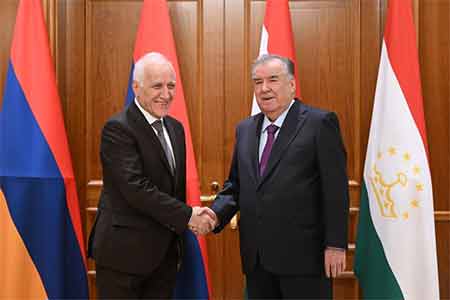
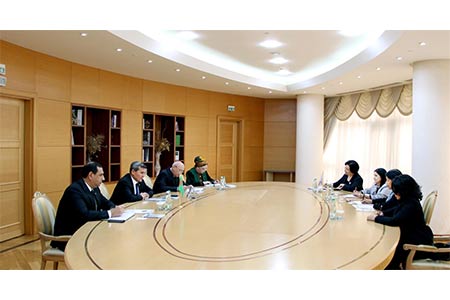
ArmInfo. During their meeting in Astana, Presidents Vahagn Khachaturyan of Armenia and Emomali Rahmon of Tajikistan confirmed their countries' readiness to further develop and deepen bilateral relations, taking them to a qualitatively new level.
According to the press service of the President of Armenia, the interlocutors noted with satisfaction that relations between the two countries are developing steadily and positively, encompassing various areas of cooperation. At the same time, the parties mutually recognized the significant untapped potential in bilateral relations, the full realization of which requires targeted and consistent steps, as well as the expansion of joint initiatives. Khachatryan and Rahmon discussed regional developments in detail, emphasizing that following the events of August 2025 (the signing of the Washington Declaration - ed.), a qualitatively new situation has emerged in the South Caucasus. The parties noted that the current realities open up new opportunities for the region and neighboring countries to rethink cooperation and build it on a more predictable, mutually beneficial, and long-term basis. In this context, the importance of peace, stability, and the development of communications as a prerequisite for economic activity and the deepening of mutual ties was also emphasized.
The presidents of Armenia and Tajikistan also considered ways to expand cooperation in the economy, high technology, artificial intelligence, agriculture, education and science, and other promising areas. In particular, they noted the importance of promoting innovation, developing scientific and educational ties, exchanging professional experience and best practices, and implementing joint programs that contribute to the economic growth and competitiveness of both countries.
The parties also attached great importance to further strengthening cooperation on international and regional platforms, emphasizing the need for the effective use of multilateral formats. In this context, Khachatryan and Rahmon emphasized the importance of promoting consonant agendas, as well as converging positions on issues of mutual interest for the benefit of both countries and to ensure broader regional stability.












 Expert: The arrest of opposition figures in Armenia for social media posts is a systematic attempt to intimidate the public and suppress dissent.
 Azerbaijani Studies Expert: While Azerbaijan Prepares Its Generation for War, Aliyev’s Aide Calls on Armenia to Prepare Armenian Society for “Peace”
 Turkologist: Azerbaijan will never, under any circumstances, stop pressuring the Armenian people
 Political scientist: We need to move away from the question of "when" and replace it with more important questions
 International Law Specialist: Azerbaijan intends to initiate legal proceedings against Armenia by sentencing Armenian prisoners
 Lukashenko called for Armenia to assume the CIS presidency in 2029
 Dmitry Medvedev predicted a Ukrainian-like fate for Armenia amid the country`s shift in foreign policy
 Russian Security Council: In Armenia, they want to force Russian asset owners to dispose of their assets
 Zakharova: Russia ready to discuss with Armenia the prospects for expanding military cooperation as part of a review of bilateral ties
 Tevanyan: Armenia, like Ukraine and Moldova, is being drawn into the EU’s global war
 Yerevan City Hall is considering introducing a valet parking system in the city
 Expert: The circus surrounding the “Albanization” of Armenian culture in the presence of foreign ambassadors in occupied Artsakh is genocide
 Political scientist: If Russian-Armenian relations are destroyed, Turkey will take Russia`s place
 Political scientist: The Armenian public is simply obliged to significantly change the entire content of public discourse and struggle
 Cross tattoos are being removed from the skin of Christian prisoners in Azerbaijan by fire, according to a human rights activist.
 Zakharova: Armenia`s likely introduction of visas with Russia will be a step against Yerevan itself
 Putin: Armenia`s recognition of Karabakh as part of Azerbaijan in Prague has given Russia`s position on this issue an ambivalent character
 Putin: Armenia`s adoption of the law on EU accession means an announcement of its withdrawal from the Eurasian Economic Union
 Aram Vardevanyan: Public demands solutions, not apology scandals in Parliament